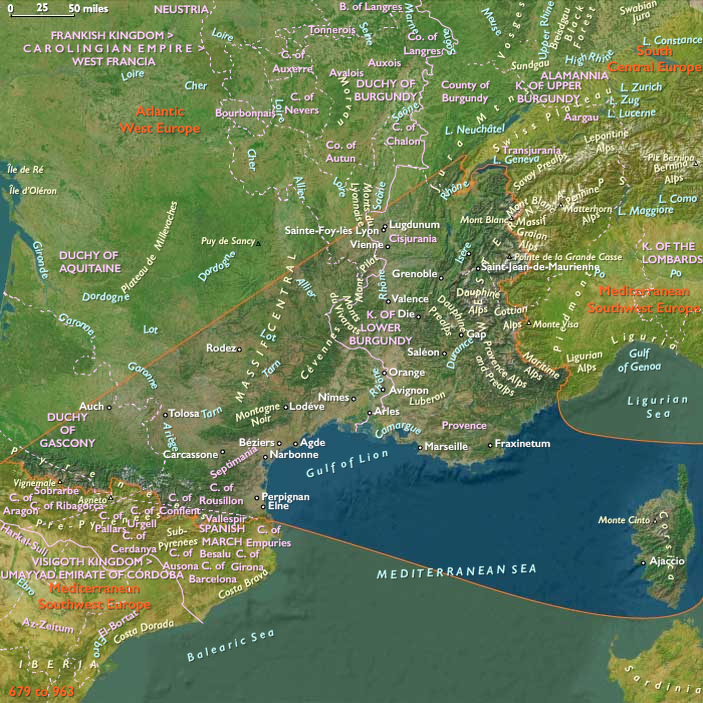
The Jews return to Narbonne in 692, …
Years: 692 - 692
The Jews return to Narbonne in 692, after an absence of two decades.
Locations
Groups
Topics
Subjects
Regions
Subregions
Related Events
Filter results
Showing 10 events out of 55932 total
Wu Zetian has Crown Princess Liu and Consort Dou killed after Wu Zetian's trusted lady in waiting Wei Tuan'er, who hates Li Dan (the reason why she did so is lost to history), falsely accuses Li Dan's wife Crown Princess Liu and Consort Dou of using witchcraft in 693.
Li Dan, fearful that he is to be next, does not dare to speak of them.
When Wei further plans to falsely accuse Li Dan, however, someone else informs on her, and she is executed.
Wu Zetian nevertheless has Li Dan's sons demoted in their princely titles, and when the officials Pei Feigong and Fan Yunxian are accused of secretly meeting Li Dan, she executes Pei and Fan and further bars officials from meeting Li Dan.
There follow accusations that Li Dan is plotting treason, and under Wu Zetian's direction, Lai launches an investigation.
Lai arrests Li Dan's servants and tortures them—and the torture is such that many of them are ready to falsely implicate themselves and Li Dan.
One of Li Dan's servants, An Jinzang, however, proclaim Li Dan's innocence and cuts his own belly open to swear to that fact.
When Wu Zetian hears of what An did, she has doctors attend to An and barely saves his life, then orders Lai to end the investigation, thus saving Li Dan.
Emperor Taizong of Tang in 640 had launched a campaign against the Western Regions and the Kingdom of Khotan had submitted to the Tang emperor.
The Four Garrisons of Anxi had been established, one of them at Khotan.
The Tibetans had subsequently defeated the Chinese and had taken control of the Four Garrisons, and the Khotanese had helped the Tibetans to conquer Aksu.
Tang China under Empress Wu in 692 regains control.
Khotan is made a protectorate.
The Emperor's bloody persecution of the Manichaeans and suppression of popular traditions of non-Orthodox origin has meanwhile caused dissension within the Church.
In 692, Justinian convenes the so-called Quinisext Council at Constantinople to to issue disciplinary decrees related to the second and third councils of Constantinople (held in 553 and 680-681).
Also called the Council in Trullo (after the palace hall in Constantinople where it meets), the Council expands and clarifies the rulings of the Fifth and Sixth ecumenical councils (hence the name Quinisext), but by highlighting differences between the Eastern and Western observances (such as the marriage of priests and the Roman practice of fasting on Saturdays), the council compromises imperial relations with the Roman Church.
The two ecumenical councils had dealt only with doctrinal matters.
The Quinisext Council, which officially accepts as normative the decretal letters of twelve Fathers of the Church, prepares 102 canons, many of which are directed against Western Church customs and legislation.
In collections called “Nomocanons,” the council also includes, with canons of councils, imperial laws having to do with church affairs.
The Western Church and the Pope are not represented at the council.
Justinian, however, wants the Pope as well as the Eastern bishops to sign the canons.
The emperor orders Pope Sergius I arrested, but the militias of Rome and Ravenna rebel and take the Pope's side.
The Quinisext Council lays the foundation for Orthodox Canon Law, but the canons will never be fully accepted by the Western Church.
Justinian, emboldened by the increase of his forces in Asia Minor, now renews the war against the Arabs, provoking them into attacking the eastern frontier over a disagreement concerning Cypriot policy.
The Umayyad army is led by Muhammad ibn Marwan, brother of the Caliph, and included the minister of defense, the famously known Al-Hajjaj ibn Yusuf.
The imperial forcers are led by Leontios and include a "special army" of thirty thousand resettled Slavs under their leader Neboulos.
Justinian’s new troops help him to win a battle against the Caliphate in Armenia in 691, but they are soon bribed to revolt by the Arabs.
The Umayyads, incensed at the breaking of the treaty, use copies of its texts in the place of a flag.
Although the battle seems to be tilting to the imperial advantage, the defection of upwards of twenty thousand Slavs ensures a Roman defeat.
Justinian takes out his frustration, according to Theophanes, by slaughtering as many of the Slavs in and around the Opsikion Theme as he can lay his hands on, including women and children, yet modern scholars do not consider this a reliable account.
Arabia, having lost its political primacy with the ruling Umayyads' transfer of the caliphate to the more centrally located Damascus, suffers growing disunity by 692.
The only remaining center of opposition to Umayyad rule is the now aging anticaliph, Ibn az-Zubayr, who Caliph Abd al-Malik publicly chides for his temerity.
The Caliph had charged his famous general al-Ḥajjaj first to negotiate with ibn al-Zubayr and to assure him of freedom from punishment if he capitulated but, if the opposition continued, to starve him out by siege, but on no account to let the affair result in bloodshed in Mecca.
Since the negotiations failed and al-Ḥajjāj lost patience, he had sent a courier to ask Abd al-Malik for reinforcements and also for permission to take the city by force.
Al-Ḥajjaj had received both.
Angered at being prevented by Ibn al-Zubayr from performing Hajj, al-Ḥajjaj bombards Mecca, going so far as to target the Ka’bah and its pilgrims during the Hajj.
After the siege had lasted seven months and ten thousand men (among them two of ibn az-Zubayr's sons) had gone over to al-Ḥajjaj, Ibn al-Zubayr and loyal followers, including his youngest son, are killed in the fighting around the Ka’bah in October 692.
Al-Ḥajjaj's siege of the Hijaz has resulted in the deaths of thousands of innocent inhabitants.
While subsequently governing the Hijaz, al-Ḥajjaj will be known for his severe rule.
The Muslim community is finally unified.
The metropolitan of Toledo, Sisebert, leads a rebellion against Egica in 692 in favor of raising a man named Suniefred to the throne.
The rebels control Toledo for a time, because they are able to mint coins in the potential usurper's name.
The plan to assassinate Ergica, the dowager queen Liuvigoto, and several main counselors fails, and Sisebert is defrocked and excommunicated.
The powers of the secret police officials meanwhile continue, but appear to be curbed starting about 692, when Lai Junchen is foiled in his attempt to have the chancellors Ren Zhigu, Di Renjie, Pei Xingben, and other officials Cui Xuanli, Lu Xian, Wei Yuanzhong, and Li Sizhen executed, as Di, under arrest, had hid a secret petition inside a change of clothes and had it submitted by his son Di Guangyuan.
The seven are still exiled, but after this incident, particularly at the urging of Li Zhaode, Zhu Jingze, and Zhou Ju, the waves of politically motivated massacres decrease, although do not end entirely.
Also in 692, Wu Zetian commissions the general Wang Xiaojie to attack Tufan, and Wang recaptures the four garrisons of Xiyu that had fallen to Tufan in 670—Qiuzi, Yutian, Shule, and Suiye.
Sisebert’s rebellion having been suppressed, Egica calls a general council of the church in Spain to deal with the future security of the kingship and the discipline of the renegades.
Sixty bishops, five abbots, and six counts attend the council.
The bishops of Narbonensis cannot attend on account of an epidemic.
The Sixteenth Council of Toledo, the second of Egica's three councils, first meets on April 25, 693.
The king opens the council with a speech declaring that any officials who betrayed the trust of the Gothic people would be driven from office and enslaved to the treasury, forfeiting their property to the royal coffers.
The king, the council concurs, could bestow this confiscated property on anyone he wished, the church obviously not excluded.
The descendants of rebels are likewise prohibited from holding any palatine office.
Finally, the rebels are anathematized on the basis of the seventy-fifth canon of the Fourth Council.
On May 2, the final day of the council, the bishops solemnly excommunicate Sisebert for life and defrock him.
He will be allowed communion on his deathbed only, unless the king pardons him earlier.
Furthermore, his descendants are barred from holding any offices and any other rebel or descendant of a rebel who might rise up against Ergica is to be sold into slavery.
Without precedent, the bishops transfer the archbishop of Seville, Felix, to Toledo and the archbishop of Braga, Faustinus, to Seville.
They also order the bishops of Narbonensis to approve the decrees of the Sixteenth Council in a local synod of their own.
The council also reforms the laws of the realm on several points.
Incorporated into the Forum Iudicum formulated by Chindasuinth, published by Recceswinth, and modified by Erwig is the law that any oath rendered unto anybody other than the monarch is invalid and illegal.
A few laws are revoked and some are reestablished, such as that prohibiting the mutilation of slaves.
The council reaffirms Chindasuinth's penalty of castration for homosexuality, but only defrocking and exile for clerical offenders, though Egica increases that penalty to castration as well, after the council.
The council is also important in the long legal history of the Visigoths in suppressing Judaism.
Egica has apparently added to Erwig's law code tax-freedom to Jewish conversos and transferred their former burden to the unconverted.
At the Sixteenth Council, converts are allowed to trade with Christians, but not until he has proved himself by recitation of creeds and eating of non-kosher food.
Penalties are even enacted against Christians who transact with unconverted or unproven Jews.
In regards to the church, aside from dealing with the rebel Sisebert and the vacancy of his see, two important decrees are promulgated.
Firstly, the bishops are ordered to maintain all church edifices in good repair and keep a priest in each parish.
Secondly, the bishops are ordered to take all offerings offered by "rustics" to pagan gods and exterminate these continuing practice (no doubt only occurring in the remotest provincial backwaters).

A second Arab army, commanded by Sass'n ibn an-Nu'min, is dispatched from Egypt in 693.
It faces stiff resistance in the eastern Aurés Mountains from the Jaw'ra Berbers under the command of a Jewish woman whom the Arabs refer to as Kihinah (”the Priestess”).
Soldiers of the pagan Berber tribes swell her Judeo-Berber army after the death of Kusaila.