The Jews of Poznan are forced to …
Years: 1704 - 1704
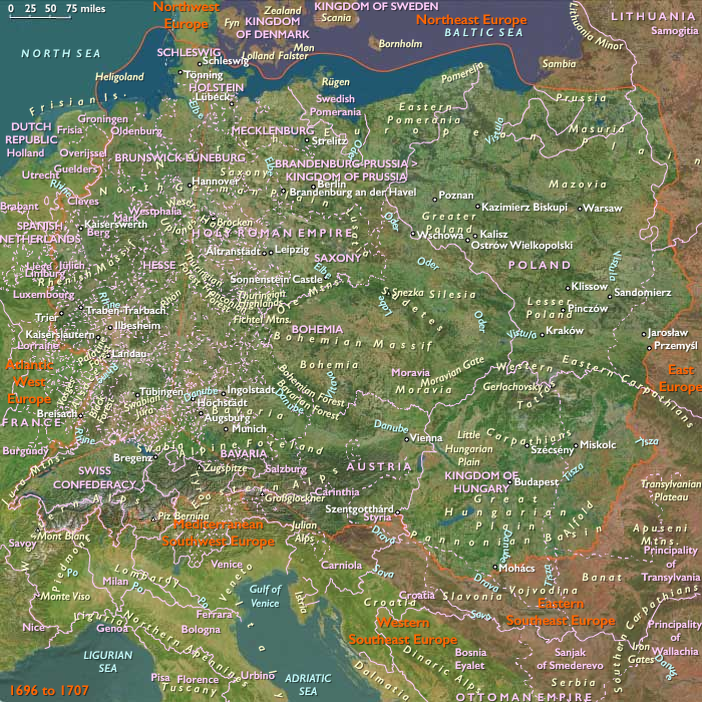
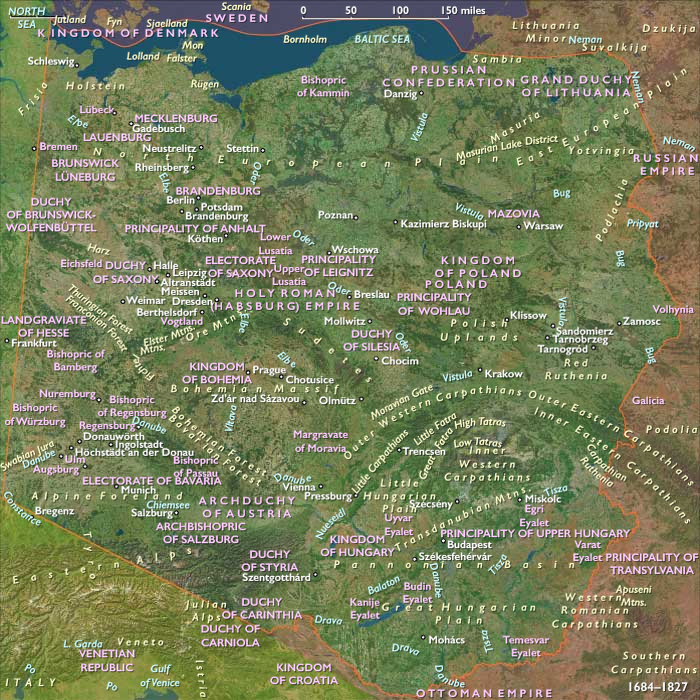
The Jews of Poznan are forced to help defend the city in 1704 by catching firebombs with their hands during the Great Northern War, in which Russia, Denmark-Norway, and Saxony-Poland challenge the supremacy of Sweden in the Baltic area.
Locations
Groups
- Jews
- Saxony, Electorate of
- Sweden, (second) Kingdom of
- Denmark-Norway, Kingdom of
- Russia, Tsardom of
- Polish-Lithuanian Commonwealth (Commonwealth of the Two Nations)
Topics
Subjects
Regions
Subregions
Related Events
Filter results
Showing 10 events out of 28786 total
The successful Swedish invasion of Poland enables Charles XII to dethrone Augustus II and coerce the Polish sejm to replace him with Stanisław Leszczyński in 1704.
Leszczyński, born in Lwów in 1677, was the son of Rafał Leszczyński, voivode of Poznań Voivodeship, and Anna Katarzyna Jabłonowska.
He had married Katarzyna Opalińska, by whom he has a daughter, Maria, who had become Queen-Consort of France as wife of Louis XV.
As Cupbearer of Poland in 1697, he had signed the confirmation of the articles of election of August II the Strong.
He had in 1703 joined the Lithuanian Confederation, which the Sapiehas with the aid of Sweden have formed against August.
Selected by Charles XII to supersede Augustus II, who is hostile towards the Swedes, Leszczyński is a young man of blameless antecedents, respectable talents, and comes from an ancient family, but certainly without sufficient force of character or political influence to sustain himself on so unstable a throne.
Nevertheless, with the assistance of a bribing fund and an army corps, the Swedes succeed in procuring his election by a scratch assembly of half a dozen castellans and a few score of gentlemen on July 12, 1704.
Stanisław is a few months later forced by a sudden inroad of Augustus to seek refuge in the Swedish camp, but finally on September 24, 1705, he is crowned king with great splendor.
Charles himself supplies his nominee with a new crown and scepter in lieu of the ancient Polish regalia, which had been carried off to Saxony by August.
The King of Sweden sends Peter Estenberg to King Stanislaw to act as an ambassador and correspondence secretary.
The Polish king's first act is to cement an alliance with Charles XII whereby the Polish-Lithuanian Commonwealth will engage to assist Sweden against the Russian tsar.

Cadillac becomes commandant of Fort Ponchartrain du Detroit in 1704.
Moore leads an expedition against the Apalachee missions in 1704 that virtually wipes them out.
Ex-Governor Moore had presented to the Carolina assembly and his replacement, Nathaniel Johnson, a plan for an expedition against the Spanish towns in Apalachee Province.
He had promised that, unlike the St. Augustine expedition, the colony would not have to pay for anything; he expects its costs to be recovered by the taking of loot and slaves.
The Carolina assembly on September 7, 1703, had approved the plan, asking Moore to go "to the Assistance of the Cowetaws and other our friendly Indians, and to attacque the Appalaches." (Crane, Verner W (1956) [1929]. The Southern Frontier, 1670–1732. Ann Arbor, MI: University of Michigan Press.)
After recruiting fifty colonists, he had traveled to the upper waters of the Ocmulgee River, where he had recruited one thousand Creeks to join the expedition against their traditional enemies.
Moore's force arrives on January 25, 1704, at Ayubale, near present Tallahassee, one of the larger mission towns in Apalachee.
While most of the Creeks raid the surrounding villages, Moore takes most of the whites and fifteeen Creeks into Ayubale itself around 7:00 am.
The only resistance is organized by Father Angel Miranda, who retreats into the town's church compound, which is surrounded by a mud wall.
With twenty-six men he successfully holds the English at bay for nine hours, and only surrenders himself, his men, and fifty-eight women and children after they run out of arrows.
According to one Spanish account, Miranda threw himself and his followers on Moore's mercy.
He was, according to this account (but apparently not others; see following text) then summarily slain in cold blood by Moore's native allies, and some of his followers were then tortured and killed.
Word of the attack reaches San Luis de Apalachee, eight leagues (about twenty-four miles [thirty-nine kilometers]) south of Ayubale, where Captain Juan Ruíz de Mexía raises a force of four hundred Apalachee and thirty Spanish cavalry.
This force engages Moore's at Ayubale, and is decisively defeated.
More than two hundred Apalachees are killed or captured, three Spaniards are killed and eight are captured, Mexía among them.
There is evidence that as many as fifty Apalachee joined with the English against the Spanish-led forces in this encounter.
Moore considers making an attack on the fort at San Luis, but his force has suffered a significant number of casualties, so he opts instead for an attempt at extortion.
Some of the Spanish prisoners manage to escape, so he releases Miranda, Mexía and others to go to San Luis with the hope that the San Luis garrison commander will then pay a ransom for them.
However, the garrison commander refuses to pay.
The Great Storm of 1703, unprecedented in ferocity and duration, is generally reckoned by witnesses to represent the anger of God—in recognition of the "crying sins of this nation", the government declares January 19, 1704, a day of fasting, saying it "loudly calls for the deepest and most solemn humiliation of our people".
It will remain a frequent topic of moralizing in sermons well into the nineteenth century.
The Great Storm also coincides with the increase in English journalism, and is the first weather event to be a news story on a national scale.
Special issue broadsheets are produced detailing damage to property and stories of people who had been killed.
Moore continues his march through Apalachee following the battle at Ayubale.
One village, San Lorenzo de Ivitachuco, survives when its leader surrenders his church's gold ornaments and a train of supplies.
Moore moves slowly, since many of the Apalachee apparently want to leave with the English.
According to his report, most of the population of seven villages joined his march voluntarily.
In Moore's report of the expedition, he claimed to have killed more than eleven hundred men, women, and children.
He also stated that he "removed into exile" three hundred and "captured as slaves" more than forty-three hundred people, mostly women and children.
The only major missions to survive in Apalachee are San Luis and San Lorenzo de Ivitachuco.
The Spanish at first attempt to fortify these places, but they are eventually judged to be indefensible and abandoned.
The survivors are consolidated at Abosaya, east of San Francisco de Potano.
Spanish authorities in St. Augustine and Pensacola mobilized their meager forces, but did not return to Ayubale until after Moore's force had clearly left the area.
They bury the Christian dead, many of whom they report as exhibiting evidence of torture.
Despite the losses, they do not immediately abandon or consolidate the missions until further raiding took place, after which the demoralized surviving Apalachee insist they will either retreat to Pensacola or go over to the English.
D'arco is charged with treason for surrendering Breisach, and beheaded on February 18, 1704, at Bregenz.
His second in command Luigi Ferdinando Marsigli is stripped of all honors and his sword is broken over him.
Joint French and native forces attack the town of Deerfield, Massachusetts, on February 29, 1704, during Queen Anne's War, in what becomes known as the 1704 Raid on Deerfield.
Under the command of Jean-Baptiste Hertel de Rouville are forty-seven Canadiens and two hundred Abenaki, Kanienkehaka, and Wyandot as well as a few Pocumtuck.
They strike at dawn, razing Deerfield and killing fifty-six colonists, including twenty-two men, nine women, and twenty-five children.
The French and native raiders take as captives one hundred and nine survivors, including women and children, and force them on a months-long trek to Quebec.
Many die along the way; some are killed because they cannot keep up.
Deerfield and other communities collect funds to ransom the captives, and negotiations are conducted between colonial governments.
Years: 1704 - 1704
Locations
Groups
- Jews
- Saxony, Electorate of
- Sweden, (second) Kingdom of
- Denmark-Norway, Kingdom of
- Russia, Tsardom of
- Polish-Lithuanian Commonwealth (Commonwealth of the Two Nations)