The Jewish population of Livorno has expanded …
Years: 1700 - 1700
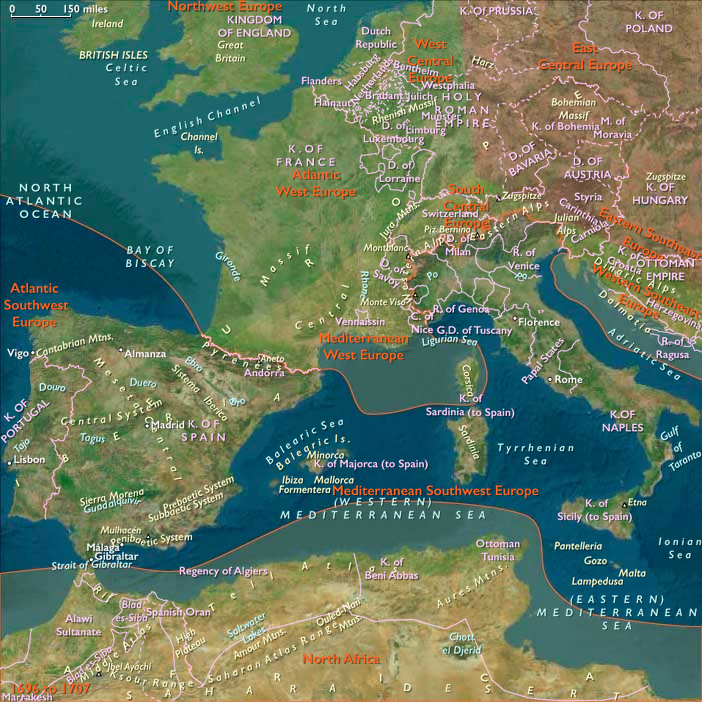
The Jewish population of Livorno has expanded rapidly over the past decade, numbering five thousand at the end of the seventeenth century.
Locations
Groups
Topics
Subjects
Regions
Subregions
Related Events
Filter results
Showing 4 events out of 4 total
The Canadian force, after the rigors of the previous year's campaign in Nova Scotia, is weakened by illness, including Ramezay, which is why he delegates command of the attack on Grand Prè to Captain Nicolas Antoine II Coulon de Villiers.
Born in Contrecœur, Quebec, as a son of Nicolas-Antoine Coulon de Villiers and Angelique Jarret de Verchères, his three brothers are Louis Coulon de Villiers, François Coulon de Villiers and Joseph Coulon de Jumonville.
Coulon de Villiers had fought against the Sauks in his youth and had become commander of Fort St. Joseph (Niles, Michigan) after the death of his father in battle.
Returning to Quebec in 1742, he had on October 9, 1743, married Madeleine-Marie-Anne Tarieu de La Pérade, the widow of Richard Testu de La Richardière.
The French embark on January 21, 1747, on a twenty-one day winter march to the Minas.
The troops, on snowshoes and utilizing sleds, cross to Bay Verte, follow the Northumberland shore to Tatamagouche, cross the Cobequid Mountains to Cobequid Bay near present-day Truro, and by February 2 have reached the Shubenacadie River, which they find blocked by ice and too dangerous for the main force to cross.
De Villiers orders Boishébert to cross the river with ten men and to block the roads so that word of the impending attack is not spread by the locals.
The Canadian force has been joined throughout the trek by both Acadian militia and Mi'kmaq warriors.
Further assistance comes when they are sheltered and fed by local Acadian families who also provide information on the New England positions.
There are Acadians, however, who are not allies.
View Event
Born in Contrecœur, Quebec, as a son of Nicolas-Antoine Coulon de Villiers and Angelique Jarret de Verchères, his three brothers are Louis Coulon de Villiers, François Coulon de Villiers and Joseph Coulon de Jumonville.
Coulon de Villiers had fought against the Sauks in his youth and had become commander of Fort St. Joseph (Niles, Michigan) after the death of his father in battle.
Returning to Quebec in 1742, he had on October 9, 1743, married Madeleine-Marie-Anne Tarieu de La Pérade, the widow of Richard Testu de La Richardière.
The French embark on January 21, 1747, on a twenty-one day winter march to the Minas.
The troops, on snowshoes and utilizing sleds, cross to Bay Verte, follow the Northumberland shore to Tatamagouche, cross the Cobequid Mountains to Cobequid Bay near present-day Truro, and by February 2 have reached the Shubenacadie River, which they find blocked by ice and too dangerous for the main force to cross.
De Villiers orders Boishébert to cross the river with ten men and to block the roads so that word of the impending attack is not spread by the locals.
The Canadian force has been joined throughout the trek by both Acadian militia and Mi'kmaq warriors.
Further assistance comes when they are sheltered and fed by local Acadian families who also provide information on the New England positions.
There are Acadians, however, who are not allies.
Washington's force, marching through the forests of the frontier, is joined by more men at Winchester.
He learns of the French advance at this point from Captain Trent.
Trent also brings a message from Tanacharison, who promises warriors to assist the British.
Washington, to keep Tanacharison's support, decides not to turn back, choosing instead to advance.
He reaches a place known as the Great Meadows (now in Fayette County, Pennsylvania), about thirty-seven miles (sixty kilometers) south of the forks, began construction of a small fort and awaited further news or instructions.
Contrecœur operates under orders that forbid attacks by his force unless they are provoked.
He sends Joseph Coulon de Villiers de Jumonville with thirty-five soldiers on May 23 to see if Washington had entered French territory, and with a summons to order Washington's troops out; this summons is similar in nature to the one Washington had delivered to the French four months earlier.
Washington is informed on May 27 by Christopher Gist that a Canadian party numbering about fifty is in the area.
In response, Washington sends seventy-five men with Gist to find them.
That evening, Washington receives a message from Tanacharison, informing him that he had found the Canadien camp, and that the two of them should meet.
Despite the fact that he had just sent another group in pursuit of the Canadians, Washington goes with a detachment of forty men to meet with Tanacharison.
The Mingo leader has with him twelve warriors, two of whom are boys.
After discussing the matter, the two leaders agree to make an attack on the Canadians.
The attackers take up positions behind rocks around the Canadian camp, counting not more than forty Canadiens.
Exactly what happened next has been a subject of controversy and debate.
Washington ambushed the French, killing ten to twelve, wounding two and capturing twenty-one.
The few primary accounts of the affair agree on a number of facts, and disagree on others.
They agree that the battle lasted about fifteen minutes, that Jumonville was killed, and that most of his party were either killed or taken prisoner.
The exact manner of Jumonville's is death is uncertain, but by several accounts Tanacharison executed Jumonville in cold blood, crushing his head with a tomahawk and washing his hands in Jumonville's brains.
One account, reported by a native to Contrecœur, claims that Jumonville had been killed by Half King while the summons was being read.
The dead are left on the field or buried in shallow graves, where they will later be found by the French.
According to Canadian records, most of the dead were colonials.
The Battle of Jumonville Glen is widely considered the formal start of the French and Indian War and ultimately of the Seven Years' War.
Following the battle, ...
View Event
He learns of the French advance at this point from Captain Trent.
Trent also brings a message from Tanacharison, who promises warriors to assist the British.
Washington, to keep Tanacharison's support, decides not to turn back, choosing instead to advance.
He reaches a place known as the Great Meadows (now in Fayette County, Pennsylvania), about thirty-seven miles (sixty kilometers) south of the forks, began construction of a small fort and awaited further news or instructions.
Contrecœur operates under orders that forbid attacks by his force unless they are provoked.
He sends Joseph Coulon de Villiers de Jumonville with thirty-five soldiers on May 23 to see if Washington had entered French territory, and with a summons to order Washington's troops out; this summons is similar in nature to the one Washington had delivered to the French four months earlier.
Washington is informed on May 27 by Christopher Gist that a Canadian party numbering about fifty is in the area.
In response, Washington sends seventy-five men with Gist to find them.
That evening, Washington receives a message from Tanacharison, informing him that he had found the Canadien camp, and that the two of them should meet.
Despite the fact that he had just sent another group in pursuit of the Canadians, Washington goes with a detachment of forty men to meet with Tanacharison.
The Mingo leader has with him twelve warriors, two of whom are boys.
After discussing the matter, the two leaders agree to make an attack on the Canadians.
The attackers take up positions behind rocks around the Canadian camp, counting not more than forty Canadiens.
Exactly what happened next has been a subject of controversy and debate.
Washington ambushed the French, killing ten to twelve, wounding two and capturing twenty-one.
The few primary accounts of the affair agree on a number of facts, and disagree on others.
They agree that the battle lasted about fifteen minutes, that Jumonville was killed, and that most of his party were either killed or taken prisoner.
The exact manner of Jumonville's is death is uncertain, but by several accounts Tanacharison executed Jumonville in cold blood, crushing his head with a tomahawk and washing his hands in Jumonville's brains.
One account, reported by a native to Contrecœur, claims that Jumonville had been killed by Half King while the summons was being read.
The dead are left on the field or buried in shallow graves, where they will later be found by the French.
According to Canadian records, most of the dead were colonials.
The Battle of Jumonville Glen is widely considered the formal start of the French and Indian War and ultimately of the Seven Years' War.
Following the battle, ...
Washington had expected to be attacked after retiring from Jumonville.
Tanacharison attempts to convince the Delaware, Shawnee and the Seneca to join the Virginians at Great Meadows.
With about one hundred and fifty Virginians at Great Meadows, they had begun to construct a fort, which had been completed on June 3.
The fort, which Washington names Fort Necessity, is a circular stockade made of seven-foot-high (two point one meters) upright logs covered with bark and skins built around a little hut that contains ammunition and provisions.
The rest of the Virginia Regiment arrived at Great Meadows on June 9.
One hundred British regulars under the command of James Mackay arrive a few days later, but instead of making camp with the Virginians they camp separately outside the fort.
Washington has heard that there are five hundred poorly-supplied French troops at Fort Duquesne, and thus he had led the three hundred Virginians out of Great Meadows on June 16 to widen the road for those who would follow to an advanced position at Red Stone Creek.
Washington meets on June 18 with Tanacharison, who tells him that he has been unable to convince the other chiefs to assist Washington and says that he will also be unable to help the Virginians.
Although Washington has lost native support, making his troops more vulnerable to attack, he continues to widen the road towards Red Stone Creek.
After a council of war on June 28, Washington orders the withdrawal to Great Meadows.
This same day, six hundred French and one hundred natives leave Fort Duquesne led by Louis Coulon de Villiers, the older brother of the slain Jumonville.
The Virginians have to abandon most of their supplies in order to keep ahead of the French/Canadian force.
View Event
Tanacharison attempts to convince the Delaware, Shawnee and the Seneca to join the Virginians at Great Meadows.
With about one hundred and fifty Virginians at Great Meadows, they had begun to construct a fort, which had been completed on June 3.
The fort, which Washington names Fort Necessity, is a circular stockade made of seven-foot-high (two point one meters) upright logs covered with bark and skins built around a little hut that contains ammunition and provisions.
The rest of the Virginia Regiment arrived at Great Meadows on June 9.
One hundred British regulars under the command of James Mackay arrive a few days later, but instead of making camp with the Virginians they camp separately outside the fort.
Washington has heard that there are five hundred poorly-supplied French troops at Fort Duquesne, and thus he had led the three hundred Virginians out of Great Meadows on June 16 to widen the road for those who would follow to an advanced position at Red Stone Creek.
Washington meets on June 18 with Tanacharison, who tells him that he has been unable to convince the other chiefs to assist Washington and says that he will also be unable to help the Virginians.
Although Washington has lost native support, making his troops more vulnerable to attack, he continues to widen the road towards Red Stone Creek.
After a council of war on June 28, Washington orders the withdrawal to Great Meadows.
This same day, six hundred French and one hundred natives leave Fort Duquesne led by Louis Coulon de Villiers, the older brother of the slain Jumonville.
The Virginians have to abandon most of their supplies in order to keep ahead of the French/Canadian force.
As the British work, Coulon approaches Fort Necessity using the road the Virginians have built.
He had arrived at Jumonville's Glen early on the morning of July 3.
Horrified to find several scalped French bodies, he had immediately ordered them to be buried.
Coulon comes within sight of Fort Necessity by 11:00 am.
At this time, the Virginians are digging a trench in the mud.
The pickets fire their muskets and fall back to the fort, whereupon three columns of Canadian soldiers and natives advance downhill towards the fort.
However, Coulon has miscalculated the location of the fort and has advanced with the fort at his right.
As Coulon halts and redeploys his troops, Washington begins to prepare for an attack.
Coulon moves his troops into the woods, within easy musket range of the fort.
Washington knows he has to dislodge the Canadians and natives from this position, and orders an assault with his entire force across the open field.
Seeing the assault coming, Coulon orders his soldiers, led by natives, to charge directly at Washington's line.
Washington orders the men to hold their ground and fire a volley.
Mackay's regulars obey Washington's command, and supported by two swivel cannons, they inflict several casualties on the oncoming natives.
The Virginians, however, flee back to the fort, leaving Washington and the British regulars greatly outnumbered.
Washington orders a retreat back to the fort.
Coulon reforms his troops in the woods.
The Canadians spread out around the clearing and keep up heavy fire on Fort Necessity.
Washington orders his troops to return fire, but they aim too high, inflicting few casualties, and the swivel cannons fare no better.
To add to the garrison's troubles, heavy rain begins to fall in the afternoon, and Washington's troops are unable to continue the firefight because their gunpowder is wet.
Coulon, who does not know when British reinforcements might arrive, sends an officer under a white flag to negotiate.
Washington does not allow the Canadian officer into or near the fort, but sends two of his own men, including his translator Jacob Van Braam, to negotiate.
As negotiations begin, the Virginians, against Washington's orders, break into the fort's liquor supply and get drunk.
Coulon tells Van Braam that all he wants is the surrender of the garrison, and the Virginians can go back to Virginia.
He warns, however, that if they do not surrender now, the natives might storm the fort and scalp the entire garrison.
Van Braam brings this message to Washington, who agrees to these basic terms.
One of Louis Coulon de Villiers' aides then writes down Coulon's surrender terms and gives them to Van Braam, who in turn gives them to Washington.
Washington, who cannot read French, has Van Braam translate it for him, and in the document it says that Jumonville had been "assassinated".
However, Van Braam may have skipped over this word; otherwise Washington would have likely sent it back to Coulon and asked that the word be removed.
Both Washington and Mackay sign the surrender document.
View Event

He had arrived at Jumonville's Glen early on the morning of July 3.
Horrified to find several scalped French bodies, he had immediately ordered them to be buried.
Coulon comes within sight of Fort Necessity by 11:00 am.
At this time, the Virginians are digging a trench in the mud.
The pickets fire their muskets and fall back to the fort, whereupon three columns of Canadian soldiers and natives advance downhill towards the fort.
However, Coulon has miscalculated the location of the fort and has advanced with the fort at his right.
As Coulon halts and redeploys his troops, Washington begins to prepare for an attack.
Coulon moves his troops into the woods, within easy musket range of the fort.
Washington knows he has to dislodge the Canadians and natives from this position, and orders an assault with his entire force across the open field.
Seeing the assault coming, Coulon orders his soldiers, led by natives, to charge directly at Washington's line.
Washington orders the men to hold their ground and fire a volley.
Mackay's regulars obey Washington's command, and supported by two swivel cannons, they inflict several casualties on the oncoming natives.
The Virginians, however, flee back to the fort, leaving Washington and the British regulars greatly outnumbered.
Washington orders a retreat back to the fort.
Coulon reforms his troops in the woods.
The Canadians spread out around the clearing and keep up heavy fire on Fort Necessity.
Washington orders his troops to return fire, but they aim too high, inflicting few casualties, and the swivel cannons fare no better.
To add to the garrison's troubles, heavy rain begins to fall in the afternoon, and Washington's troops are unable to continue the firefight because their gunpowder is wet.
Coulon, who does not know when British reinforcements might arrive, sends an officer under a white flag to negotiate.
Washington does not allow the Canadian officer into or near the fort, but sends two of his own men, including his translator Jacob Van Braam, to negotiate.
As negotiations begin, the Virginians, against Washington's orders, break into the fort's liquor supply and get drunk.
Coulon tells Van Braam that all he wants is the surrender of the garrison, and the Virginians can go back to Virginia.
He warns, however, that if they do not surrender now, the natives might storm the fort and scalp the entire garrison.
Van Braam brings this message to Washington, who agrees to these basic terms.
One of Louis Coulon de Villiers' aides then writes down Coulon's surrender terms and gives them to Van Braam, who in turn gives them to Washington.
Washington, who cannot read French, has Van Braam translate it for him, and in the document it says that Jumonville had been "assassinated".
However, Van Braam may have skipped over this word; otherwise Washington would have likely sent it back to Coulon and asked that the word be removed.
Both Washington and Mackay sign the surrender document.