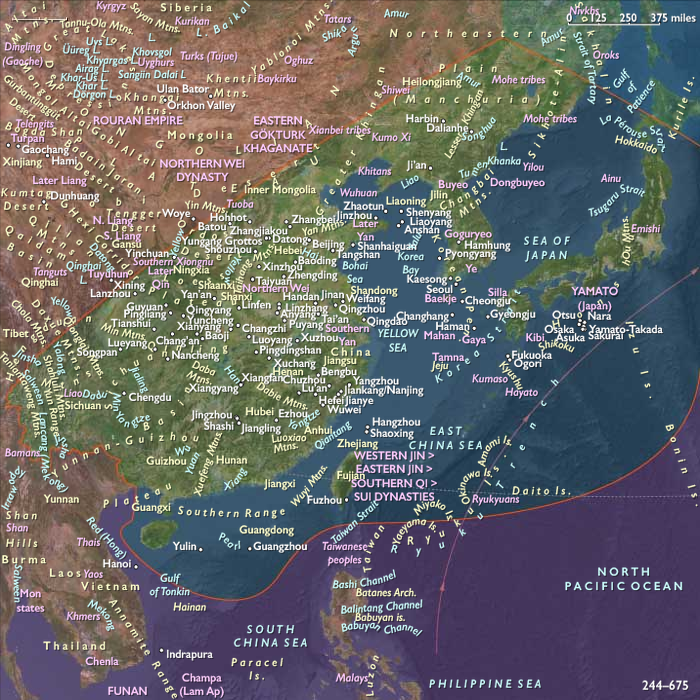
The Japanese imperial court appoints the first …
Years: 430 - 430
The Japanese imperial court appoints the first historiographers around 430.
Locations
Groups
Topics
Subjects
Regions
Subregions
Related Events
Filter results
Showing 10 events out of 58940 total
Feng Ba, formally Wencheng, an emperor (but using the title "Heavenly Prince": Tian Wang) of the Chinese state Northern Yan, had become emperor after Gao Yun (Emperor Huiyi), whom he supported in a 407 coup that overthrew Murong Xi of Later Yan, was assassinated in 409.
During his reign, Northern Yan has largely maintained its territorial integrity but made no headway against the much stronger rival Northern Wei.
He is said to have had more than 100 sons.
In 426, Feng Ba's crown prince Feng Yong dies, and he creates another son, Feng Yi, crown prince.
Seriously ill in 430, Feng Ba issues an edict transferring authority to Feng Yi.
However, Feng Ba's favorite concubine Consort Song wants to have her son Feng Shouju inherit the throne, and therefore tells Feng Yi that Feng Ba will soon recover and that he should not be so anxious to take over authority; Feng Yi agrees and withdraws to his palace.
Consort Song then falsely issues orders in Feng Ba's name cutting off communications with the outside, and Feng Yi and Feng Ba's other sons, as well as imperial officials, are not allowed to see Feng Ba.
Only one of her trusted officials, Hu Fu, is able to enter the palace to be in charge of security.
However, Hu is secretly resentful of Consort Song's ambitions, and he informs Feng Ba’s brother Feng Hong, who is prime minister, of her intentions.
Feng Hong immediately attacks the palace and seizes control.
Feng Ba, hearing of this, dies in shock.
Feng Hong now takes the throne himself as Emperor Zhaocheng and, after defeating Feng Yi's troops, slaughters all of Feng Ba's sons.

Liu Song launches a major attack in spring 430, and Emperor Taiwu, judging his own defenses south of the Yellow River to be unable to withstand a Liu Song attack, withdraws them north, judging correctly that Liu Song forces would stop at the Yellow River, planning to counterattack in the winter after the river freezes.
Meanwhile, Emperor Taiwu, hearing that Liu Song and Xia had subsequently entered into a treaty to attack him and divide Northern Wei lands, judges correctly that despite the treaty Liu Song has no intention of crossing the Yellow River north, and he decides to destroy Xia once and for all.
In fall 430, he makes a surprise attack on the new Xia capital Pingliang (in modern Pingliang), while Helian Ding is engaging Western Qin's prince Qifu Mumo, putting Pingliang under siege, but although he now sends Helian Chang to Pingliang to try to persuade its defender, Helian Shegan, younger brother to both Helian Chang and Helian Ding, to surrender, Pingliang will not fall quickly.
However, the Northern Wei general Tuxi Bi engages Helian Ding as Helian Ding is trying to relieve Pingliang, defeats him and surrounds him at the Chungu Plains (also in modern Pingliang).
Northern Wei forces surrounds him, and his army becomes hungry and thirsty.
After several days, he forcibly fights his way out of the siege, but his forces mostly collapse, and he himself is badly injured.
He gathers the remaining forces and flees to …
…Shanggui.
Indian Theravadin Buddhist commentator and scholar Buddhaghosa (Pali: Voice of the Buddha) translates extensive Sinhala commentaries on the Pāli Buddhist texts in Pāli.
Scholars do not agree about Buddhaghosa's birthplace, but it is known that he traveled to Anuradhapura, Sri Lanka, where he discovered many Sinhalese Buddhist commentaries; these he translated into Pali and communicated to his countrymen.
Certain commentaries are also attributed to him, including one on the Vinaya and one on the Dhammapada that includes 305 stories for context.
His Visuddhimagga (Pali: Path of Purification), a comprehensive manual of Theravada Buddhism, is divided into sections on Sila (ethics), Samadhi (meditation), and Prajna (wisdom).
This is a traditional division in Buddhist teachings, which suggest that ethics are essential to meditation, and that meditation is essential to developing wisdom.
From the Buddhist point of view this is the "path of purification" because it purifies the mind of the defilements of greed, hatred, and delusion.
Written approximately in 430 CE in Sri Lanka, it is considered the most important Theravada text outside of the Tipitaka canon of scriptures (it is still read and studied today).
The Visuddhimagga is based on the Rathavinitasutta, which describes the progression from the purity of discipline to the nibbana, comprising seven steps.
Peter the Iberian, or Peter of Iberia, had been born around 411 as Murvan (alternatively, Nabarnugios), prince of Iberia, to King Bosmarios, who had invited a noted philosopher, Mithridates, from Lazica to take part in Murvan’s education.
The prince had been sent in 423 as a political hostage to Constantinople, where he had received a brilliant education under the personal patronage of the Roman empress Aelia Eudocia, wife of Emperor Theodosius II.
The young prince, together with his mentor Mithridates, eventually left the palace and escaped to make a pilgrimage to Palestine where he had become a monk at Jerusalem under the name of Peter.
He founds his own monastery in 430 at Bethlehem (later known as the Georgian Monastery of Bethlehem).
Flavius Felix serves during the reign of emperors Valentinian III and Theodosius II.
Between 425, the year in which he had been made patricius, and 429 he had served as magister utriusque militae in defense of Italy, but despite a brief mention of one of his military actions in the Notitia Dignitatum, his subordinates Bonifacius and Flavius Aetius were considered more significant in this regard.
In 426, he had ordered the death of Patroclus, bishop of Arelate, and of Titus, deacon in Rome.
The following year he had opposed Bonifacius' rebellion in Northern Africa sending some troops to this province, but this force had been defeated by the troops loyal to Bonifacius.
He had been elected consul for the West in 428.
His carved ivory consular diptych is notable for depicting his clothing in great detail.
The diptych, believed to be the earliest yet known, will survive intact until the French Revolution, when the right leaf was stolen; it is now believed lost.
In May 430, Felix, his wife Padusia and a deacon are accused of plotting against Aetius, arrested in Ravenna and killed by order of Aetius himself.
Aetius, after successful battles in Gaul against the Visigoths and the Franks, is in 430 appointed magister utriusque militiae (“master of both services”).
Both sides in the crisis over the title Theotokos (“God-Bearer”) as applied to Mary, have appealed to Pope Celestine, who has already been offended by Nestorius' tactlessness.
Celestine holds a church council in Rome in August 430 that decides correct Christology requires the use of the term Theotokos and requests Nestorius to disown his errors.
When Bishop Cyril of Alexandria, who has been authorized to execute the sentence upon Nestorius, produces a string of provocative anathemas for him to subscribe to or face excommunication, Nestorius and his allies take alarm, and he persuades Eastern emperor Theodosius to convene a general church council.
It is Nestorius's hope that the council will result in the condemnation of Cyril.
The Huns led by Octar attack the Burgundians, who have occupied territory on the Rhine near the city of Worms (Germany).
Octar dies during the fighting and his army is destroyed.
Vortigern makes use of Hengist and Horsa, brothers and legendary leaders of the first Anglo-Saxon settlers in Britain who emigrate, according to the English historian and theologian Bede, to fight for the British king against the Picts.
The brothers are said to have been Jutes and sons of one Wihtgils.
The Anglo-Saxon Chronicle says that they landed at Ebbsfleet, Kent.