
The Japanese castaways, after staying temporarily in …
Years: 1789 - 1789
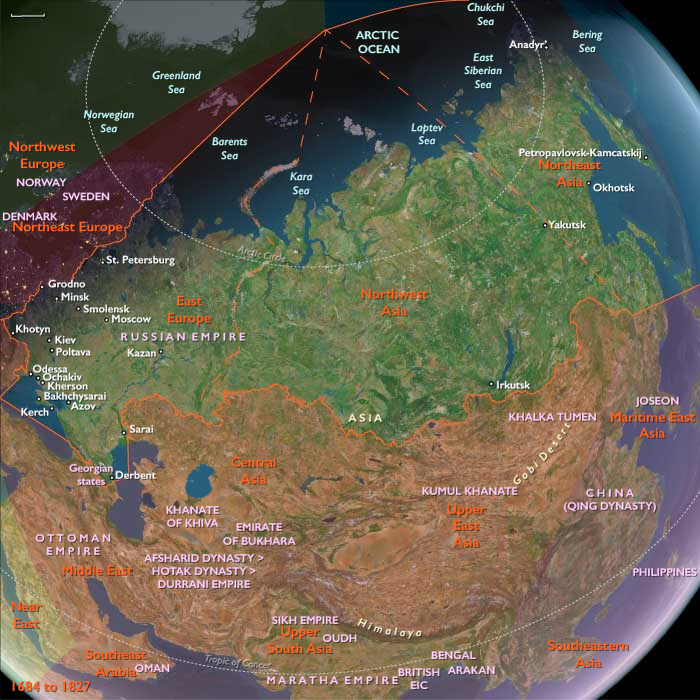
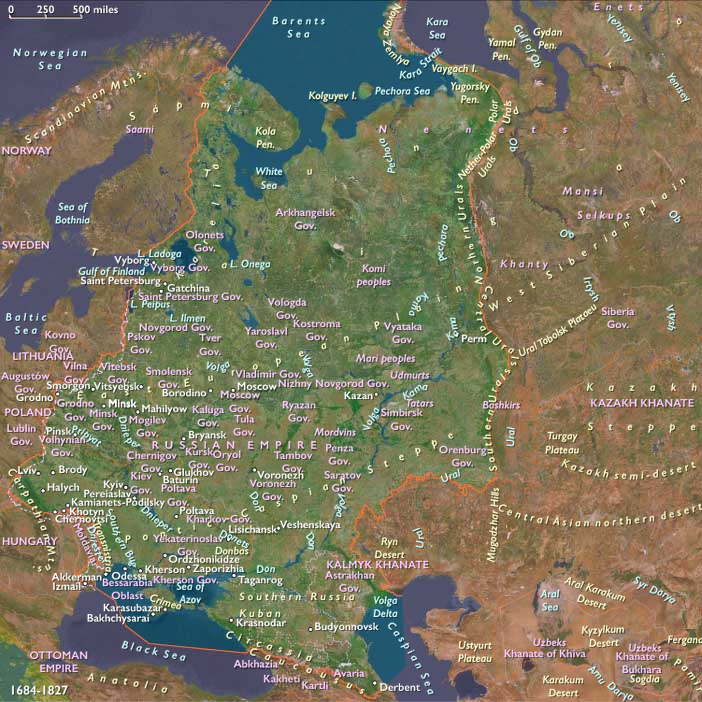
The Japanese castaways, after staying temporarily in Yakutsk, are introduced by the captain to Erik Laxmann, who assists Kōdayū's and his crew in Irkutsk.
Locations
People
Groups
Topics
Commodoties
Subjects
Regions
Subregions
Related Events
Filter results
Showing 10 events out of 24374 total
A Russian captain in Kamchatka leads Kōdayū's people to Okhotsk.
British sailors mutiny on the HMS Bounty in 1789, setting Captain Bligh and others adrift in the Pacific.
Philip King prevents a mutiny early in 1789, when some of the convicts plan to take him and other officers prisoner, and escape on the next boat to arrive.
While commandant on Norfolk Island, King has formed a relationship with the female convict Ann Inett—their first son, born on January 8, 1789, is named Norfolk. (He will go on to become the first Australian-born officer in the Royal Navy and the captain of the schooner Ballahoo.)
He is buried in the garden of the government building.
Colonel David Collins will say his death was "to the great regret of everyone who had witnessed how little of the savage was found in his manner, and how quickly he was substituting in its place a docile, affable, and truly amiable deportment".
European disease often precedes European settlers, even before their arrival in local districts.
A smallpox epidemic is recorded in Sydney in 1789, which wipes out about half the Indigenous Australians around Sydney: having no immunity, an estimated two thousand die.
It then spreads well beyond the then limits of European settlement, including much of southeastern Australia.
Based on information recorded in the journals of some members of the First Fleet, it has been surmised that the Aborigines of the Sydney region had never encountered the disease before and lacked immunity to it.
Unable to understand or counter the sickness they often flee, leaving the sick with some food and water to fend for themselves.
As the clans flee the epidemic it consequently spreads further along the coast and into the hinterland.
This has a disastrous effect on Aboriginal society; with many of the productive hunters and gathers dead, those who survive the initial outbreak begin to starve.
Lieutenant William Bradley records the first indications of the severity of the disaster that had struck the Aboriginal population of Sydney when he describes his shock at the small number of them to be seen on the harbor and its shores compared with previous times.
The British had not seen smallpox in anyone among themselves before the outbreak.
Although there had been fears about the health of some of the convicts on the First Fleet, these had been subsequently dismissed by Surgeon-General John White who believed they were suffering from "slight inflammatory complaints".
The origin of the smallpox epidemic is controversial, and it has been speculated that the surgeons on board the First Fleet brought vials of smallpox matter and either accidentally or intentionally released it as a "biological weapon".
Christopher Warren, writing in Journal of Australian Studies in 2014, will conclude that British marines were most likely to have spread smallpox, possibly without informing Governor Phillip but will concede in his conclusion that "today's evidence only provides for a balancing of probabilities and this is all that can be attempted." (Warren, Christopher (March 2014). "Smallpox at Sydney Cover - who, when and why?" (PDF). Journal of Australian Studies Vol.38 No.1. International Australian Studies Association. Retrieved November 3, 2017.)
British naval officer William Bligh, in the company of eighteen loyal crew members set adrift in an open boat following the mutiny on his ship, HMS Bounty, skillfully navigates more than thirty-six hundred miles (fifty-eight hundred kilometers) to Timor, charting part of the northeast coast of New Holland (Australia) en route.
On August 26, 1786 Wöllner had been appointed privy councilor for finance (Geheimer Oberfinanzrath), and on October 2, 1786, had been ennobled.
Though not in name, he had in fact become prime minister; in all internal affairs it is he who decides; and the fiscal and economic reforms of the new reign are the application of his theories.
Bischoffswerder, too, still a simple major, had been called into the king′s counsels; by 1789 he is already an adjutant-general.
The opposition to Wöllner was, indeed, at the outset strong enough to prevent his being entrusted with the department of religion; but this too in time was overcome, and on July 3, 1788 he had been appointed active privy councilor of state and of justice and head of the spiritual department for Lutheran and Catholic affairs.
From this position Wöllner pursues long lasting reforms concerning religion in the Prussian state.
The king has proved eager to aid Wöllner's crusade.
On July 9, 1788 the famous religious edict had been issued, which forbids Evangelical ministers from teaching anything not contained in the letter of their official books, proclaims the necessity of protecting the Christian religion against the "enlighteners" (Aufklärer), and places educational establishments under the supervision of the orthodox clergy.
On December 18, 1788 a new censorship law had been issued, to secure the orthodoxy of all published books.
This forces major Berlin journals like Christoph Friedrich Nicolai's Allgemeine Deutsche Bibliothek and Johann Erich Biester's Berliner Monatsschrift to publish only outside the Prussian borders.
Moreover, people like Immanuel Kant are forbidden to speak in public on the topic of religion.
Joseph II had returned to Vienna in November 1788 with ruined health, and is a dying man during 1789.
The concentration of his troops in the east gives the discontented Belgians an opportunity to revolt.
In Hungary, the nobles are in all but open rebellion, and in his other states, there are peasant risings and a revival of particularistic sentiments.
He decrees in 1789 that all peasant labor obligations must be converted into cash payments, but these policies are violently rejected by both the nobility and the peasants, since their barter economy lacks money.
He had also abolished the death penalty in 1787, and this reform will remain until 1795.
