The Japan trade loses most of its …
Years: 1668 - 1668
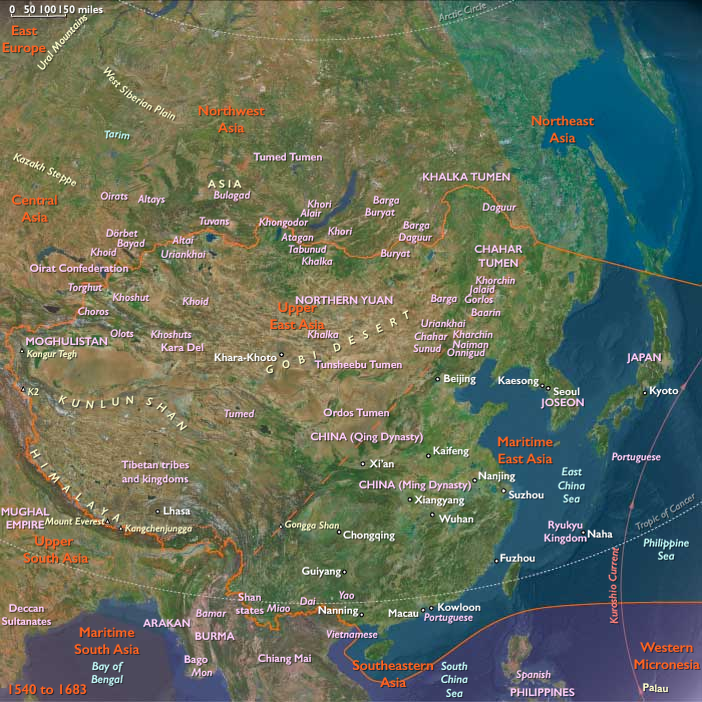
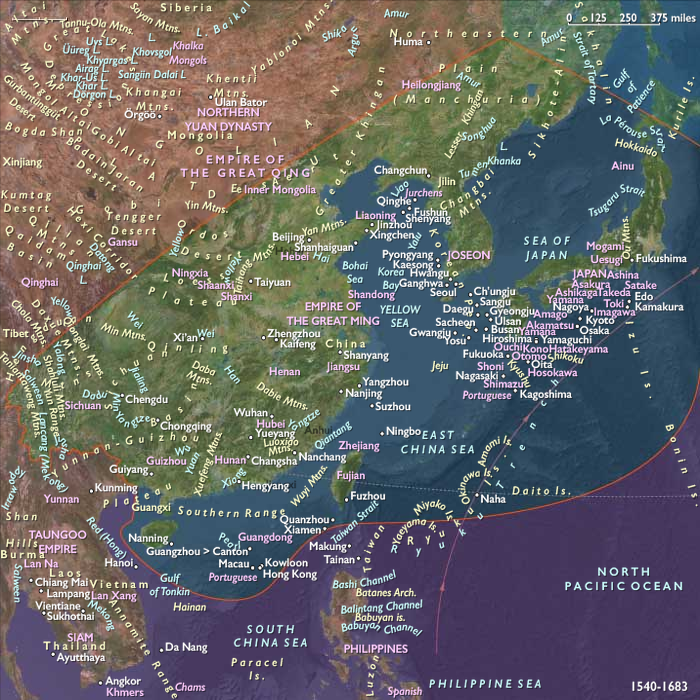
The Japan trade loses most of its importance for the VOC when in 1668 the Shogun embargoes the export of silver, with which the VOC have been using to finance most of its spice trade.
As Spanish bullion is now again easily obtainable for the Dutch, this does not greatly impede the VOC.
Locations
Groups
- Netherlands, United Provinces of the (Dutch Republic)
- Japan, Tokugawa, or Edo, Period
- Dutch East India Company (Vereenigde Oostindische Compagnie or VOC in Dutch, literally "United East Indies Company")
Commodoties
Subjects
Regions
Subregions
Related Events
Filter results
Showing 10 events out of 30907 total
The Anglo-Dutch conflicts have proved useful for the VOC for driving out its competitors, the EIC, from the Indonesian archipelago, by force of arms.
According to the Treaty of Westminster ending the First Anglo-Dutch War of 1652–1654, Pulo Run, the only English factory in the Spice Island, should have been returned to England.
The first attempt in 1660 had failed due to formal constraints by the Dutch; after the second in 1665, the English traders are expelled in the same year and the Dutch destroy the nutmeg trees, excluding the English from the clove trade.
The emotion aroused by the false messiah throughout the diaspora, well beyond the Ottoman domains, has made the political loyalty of the Jewish community suspect in the eyes of the sultan.
From the second half of the seventeenth centuryGreeks and Armenians, not Jews, hold the most important posts in the empire.
The Royal Charter of March 27, 1668, leads to the transfer of Bombay from Charles II to the British East India Company on September 21, 1668, for an annual rent of ten pounds (equivalent retail price index of twelve hundred and twenty-six pounds in 2007).
Two days later, George Oxenden becomes the first Governor of Bombay under the British East India Company, which immediately sets about the task of opening up the islands by constructing a quay and warehouses.
A customs house is also built, and fortifications are built around Bombay Castle.
A Judge-Advocate is appointed for the purpose of civil administration.
The VOC is by 1669 the richest private company the world had ever seen, with over one hundred and fifty merchant ships, forty warships, fifty thousand employees, a private army of ten thousand soldiers, and a dividend payment of forty percent on the original investment.
The Dutch government, because of the importance of the French market to its national economy, at first tries to ignore the hostile policies of Colbert.
Its inaction is also caused by differences of opinion about how best to proceed within the States Party.
Amsterdam, and especially the Amsterdam diplomat Coenraad van Beuningen, argue in favor of firm economic countermeasures against the French economic policies, together with the forming of a defensive alliance with Spain and the Holy Roman Empire.
De Witt, however, prefers the avoidance of such foreign entanglements and a conciliatory approach in the economic sphere.
The industrial cities of Leiden and Haarlem, their economic interests severely damaged by the French protectionism, side with Amsterdam in support of a more belligerent diplomacy.
After promising the Rotterdam regents compensation for the damage to their wine trade to win their assent, the States of Holland settle in 1671 on severe retaliatory measures against French imports, in effect banning French wine, vinegar, paper, and sail-canvas, setting the stage set for war.
Friedrich Jacob Merck, an apothecary in Schweinfurt, Germany, in 1668 purchases the "Engel-Apotheke" (Angel Pharmacy) in Darmstadt.
The Merck family is to start the company that will eventually become both Merck KGaA and Merck and Company.
William Penn the Younger had become a close friend of George Fox, the founder of the Quakers, whose movement started in the 1650s during the tumult of the Cromwellian revolution.
The times sprouted many new sects, besides Quakers, including Seekers, Ranters, Antinomians, Soul Sleepers, Adamites, Diggers, Levellers, Antibaptists, Behmenists, Muggletonians, and many others, as the Puritans were more tolerant than the monarchy had been.
Following Cromwell's death and the reestablishment of the Crown, the King had responded with harassment and persecution of all religions and sects other than Anglicanism.
Fox risks his life, wandering from town to town, and he attracts followers who likewise believed that the "God who made the world did not dwell in temples made with hands."
By abolishing the church’s authority over the congregation, Fox has not only extended the Protestant Reformation more radically, but he has helped extend the most important principle of modern political history – the rights of the individual – upon which modern democracies are later to be founded.
Penn has traveled frequently with Fox, through Europe and England.
He has also written a comprehensive, detailed explanation of Quakerism along with a testimony to the character of George Fox, in his introduction to the autobiographical Journal of George Fox.
In effect, Penn has become the first theologian, theorist, and legal defender of Quakerism, providing its written doctrine and helping to establish its public standing.
Penn’s first of many pamphlets, "Truth Exalted", was a "short but sure testimony" against all religions except Quakerism.
His strident attack on the Trinity and his branding the Catholic Church as "the Whore of Babylon" and Puritans as "hypocrites and revelers in God" brought him attention from the Anglican Church.
He also lambasted all "false prophets, tithemongers, and opposers of perfection".
Pepys, a neighbor of the Penns, thought it a "ridiculous nonsensical book" that he was "ashamed to read".
Penn is imprisoned in the Tower of London in 1668 after writing a follow up tract entitled The Sandy Foundation Shaken.
The Bishop of London orders that Penn be held indefinitely until he publicly recant his written statements.
The official charge is publication without a license but the real crime is blasphemy, as signed in a warrant by King Charles II.
Penn is placed in solitary confinement in an unheated cell and threatened with a life sentence.
He bravely responds, "My prison shall be my grave before I will budge a jot: for I owe my conscience to no mortal man."
Given writing materials in the hope that he would put on paper his retraction, Penn instead writes another inflammatory treatise, No Cross, No Crown, remarkable for its historical analysis and citation of sixty-eight authors whose quotations and commentary he had committed to memory and was able to summon without any reference material at hand.
Penn petitioned for an audience with the King, which is denied but which lead to negotiations on his behalf by one of the royal chaplains.
The twenty-four-year-old Penn is released after eight months of imprisonment.

The Sheldonian Theatre, located in Oxford, England, has been built from 1664 to 1668 after a design by Christopher Wren for the University of Oxford.
Wren’s second work, the building is named after Gilbert Sheldon, chancellor of the university at the time and the project's main financial backer.
It is used for music concerts, lectures and university ceremonies, but not for drama.
The building has a prominent eight-sided cupola in the center of the roof, accessed via a staircase leading to the dome over the main ceiling.
The cupola’s large windows on all sides provide views across central Oxford, as they continue to do today.
Newton has been generally credited with constructing in 1668 the first practical reflecting telescope.
It uses a spherically ground metal primary mirror and a small diagonal mirror in an optical configuration that will come to be known as the Newtonian telescope.
Despite the theoretical advantages of the reflector design, the difficulty of construction and the poor performance of the speculum metal mirrors being used at the time means it will it take over one hundred years for these devices to become popular.
Dr. Isaac Barrow, Bishop of Sodor and Mann, shocked at the state of knowledge of the Manx clergy, decides that the best way to eradicate their ignorance is to found an institution to educate prospective clergymen.
He establishes The Bishop Barrow Trust in 1668 by with the idea of building a university on the Isle of Man. (It will not be until a hundred and seventy five years later, in 1833, that King William's College, a fee-paying Public school rather than a university, will open its doors.)
Years: 1668 - 1668
Locations
Groups
- Netherlands, United Provinces of the (Dutch Republic)
- Japan, Tokugawa, or Edo, Period
- Dutch East India Company (Vereenigde Oostindische Compagnie or VOC in Dutch, literally "United East Indies Company")