The Jacobites, with France at peace with …
Years: 1719 - 1719
June
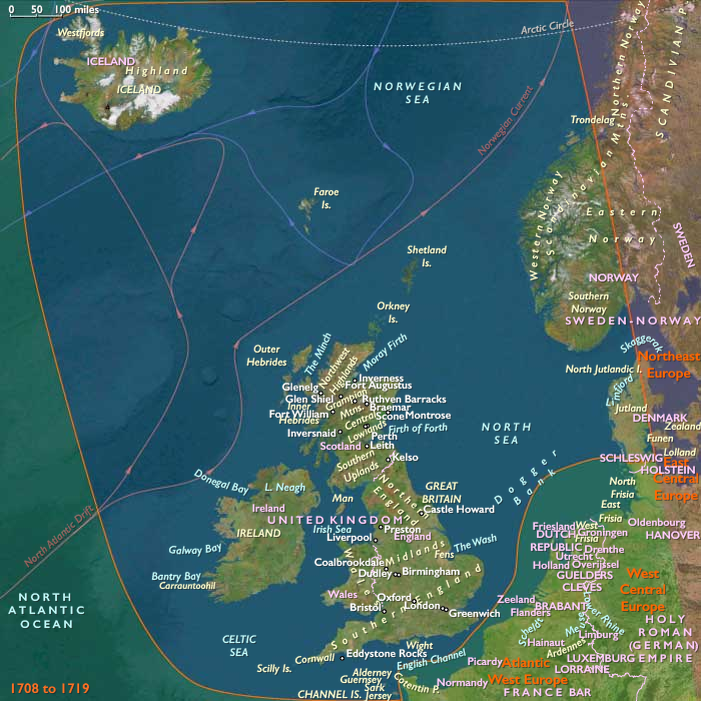
The Jacobites, with France at peace with Britain and enjoying a rapprochement due to the Anglo-French Alliance, find a new ally in Spain's Minister to the King, Cardinal Giulio Alberoni.
An invasion force sets sail in 1719 with two frigates to land in Scotland to raise the clans.
Twenty-seven ships carry five thousand soldiers to England, but the latter are dispersed by storms before they can land.
When the two Spanish frigates successfully land a party of Jacobites led by Lord Tullibardine and Earl Marischal with three hundred Spanish soldiers at Loch Duich, they hold Eilean Donan Castle.
They meet only lukewarm support from a few clans.
The Spanish soldiers are forced at the Battle of Glen Shiel to surrender to government forces.
Locations
People
Groups
Topics
Commodoties
Subjects
Regions
Subregions
Related Events
Filter results
Showing 10 events out of 28184 total
Dynastic succession in Oman leads to the nomination of Saif ibn Sultan II, who has not yet reached puberty by 1719.
His candidacy prompts a rivalry among the ulama and a civil war between the Hinawi and the Ghafiri, with the Ghafiri supporting Saif ibn Sultan II.
The area of modern Liechtenstein, once part of the Roman province of Rhaetia, and occupied by the southward expansion of the Alemanni tribe during the sixth century, had been incorporated into the Carolingian empire and divided into countships, which have become subdivided over the generations.
Because the duchy of Swabia lost its duke in 1268 and was never restored, all vassals of the duchy had become immediate vassals of the Imperial Throne (as had happened in much of Westphalia when the duchy of Saxony was divided and partially dissolved in aftermath of the defeat of Henry the Lion).
The medieval county of Vaduz had been formed in 1342 as a small subdivision of the Werdenberg county of the dynasty of Montfort of Vorarlberg.
The Liechtenstein dynasty, from which the Principality takes its name (rather than vice-versa) from Castle Liechtenstein in faraway Lower Austria, which it owned from at least 1140 until the thirteenth century (and will own again from 1807 onward).
Over the centuries, it has acquired vast swathes of land, mostly in Moravia, Lower Austria and Styria, but all these expansive and rich territories are held in fief under other more senior feudal lords, particularly under various lines of the Habsburg family, to which many Liechtensteins have been close advisors.
Thus, and without any territory held directly under the Imperial throne, the Liechtenstein dynasty has been unable to meet a primary requirement to qualify for a seat in the Imperial diet, the Reichstag, although they had been elevated to princely rank in 1608.
The third prince, Johann Adam Andreas, had bought the domain of Schellenberg in 1699 and the county of Vaduz in 1712.
This Prince Liechtenstein has wide landholdings in Austria, Bohemia and Moravia, but none of the lands are held directly from the Emperor.
Thus the prince is barred from admittance to the Council of Princes and the prestige and influence that would entail.
By acquiring these Lordships, which are directly subordinate to the Holy Empire because there is no longer a duke of Swabia, the prince obtains his end by having this small patch of mountain villages.
The territory took the name of the family that now ruled the county.
Emperor Charles VI on January 23, 1719, decrees that the counties of Vaduz and Schellenberg be promoted to a principality with the name Liechtenstein for his servant Anton Florian of Liechtenstein, whereby they become Heiliger Römischer Reichsfürst.
The plotted restoration of the Stuarts to the British throne in two Jacobite expeditions to Scotland in the spring of 1719 is another extravagant scheme of Alberoni's.
By provoking Britain, France, the Netherlands and the Empire to form the Quadruple Alliance, his hasty and ambitious plans have brought a flood of disaster to Spain, for which Alberoni is held responsible.
France launches an invasion of eastern Spain while the British successfully raid Vigo.
With Philip V fast becoming the common enemy of all Europe, Alberoni is on December 5, 1719, ordered to leave Spain, Elizabeth herself having taken an active part in procuring the decree of banishment.
The Allied Victory in the War of the Quadruple Alliance (1718–1720): Spain Forced to Abandon Sardinia and Sicily
During the War of the Quadruple Alliance (1718–1720), the allied forces of Britain, France, Austria, and the Dutch Republic successfully occupied Sicily and northern Spain, forcing Spain to renounce its claims to Sardinia and Sicily.
The Occupation of Sicily and Northern Spain
✔ Allied Invasion of Sicily (1718–1719)
- Austria led the campaign to expel Spanish forces from Sicily, engaging in several battles against the Spanish army, which had occupied the island since 1718.
- The British navy played a crucial role, defeating the Spanish fleet off Cape Passaro (1718), ensuring naval superiority in the Mediterranean.
✔ Allied Invasion of Northern Spain (1719)
- French forces invaded northern Spain, advancing into the Basque region and Catalonia.
- This forced Spain to divert resources away from its Italian campaigns, leading to the rapid decline of Spanish resistance.
Spain Renounces Its Claims to Sardinia and Sicily
- With its military position collapsing, Spain was forced to sue for peace.
- By 1720, Spain formally renounced all claims to Sardinia and Sicily, as part of the peace settlement with the Quadruple Alliance.
- Under the terms of the agreement:
- Sardinia was transferred to Austria.
- Sicily was given to the House of Savoy, securing its role in Italian politics.
Conclusion: A Failed Spanish Attempt at Expansion
The War of the Quadruple Alliance ended Spain’s ambitions in Italy, reinforcing Austrian and Savoyard dominance in the region. The defeat also confirmed Britain and France’s role as key enforcers of the European balance of power, ensuring that Spain remained diplomatically isolated for decades.
Jan van Huysum is the brother of Jacob van Huysum, the son of the flower painter Justus van Huysum, and the grandson of Jan van Huysum I, who is said to have been expeditious in decorating doorways, screens and vases.
A picture by Justus is preserved in the gallery of Brunswick, representing "Orpheus and the Beasts in a wooded landscape", and here we have some explanation of his son's fondness for landscapes of a conventional and Arcadian kind; for Jan van Huysum, though skilled as a painter of still life, believes himself to possess the genius of a landscape painter.
Half his pictures in public galleries are landscapes, views of imaginary lakes and harbors with impossible ruins and classic edifices, and woods of tall and motionless trees—the whole very glossy and smooth, and entirely lifeless.
The earliest dated work of this kind is that of 1717, in the Louvre, a grove with maidens culling flowers near a tomb, ruins of a portico, and a distant palace on the shores of a lake bounded by mountains.
Watteau’s mature paintings seem to be so many depictions of frivolous fêtes galantes, but they in fact display a sober melancholy, a sense of the ultimate futility of life, that makes him, among eighteenth century painters, one of the closest to modern sensibilities.
His many imitators, such as Nicolas Lancret and Jean-Baptiste Pater, borrowe his themes but cannot capture his spirit.
Watteau typifies the lyrically charming and graceful style of the Rococo.
Among his last works is Pierrot (long identified as "Gilles"), a portrait of a clown in white painted as a signboard for the Théâtre de la Foire.
White as innocence (or imbecility) and roseate in complexion, “Gilles”, with his slowly fading smile, is the image of the actor during intermission—the actor who offers himself every day to the laughter of his fellows, the uncomprehending victim of a ceremony the full meaning of which seems to evade him.
He is represented in a grandness that recalls Rembrandt's Christ Presented to the People (Ecce Homo).
The painting may be read as Watteau's wry comment on his mortal illness.
Charles William of Baden-Durlach had decided to build himself a new palace in the Hardtwald forest in the plains west of Durlach.
The reasons for his choice of venue are shrouded in legend.
Apart from his quarrels with citizens of Durlach, he may have wanted to escape from the confines of the city and from the company of his unloved wife.
The foundation stone for the new Karlsruhe Palace is laid on June 17, 1715.
The central building of the palace and, subsequently, the whole city, is the so-called Lead Tower.
From this central tower, thirty-two avenues radiate in all directions, marking a uniform distance in all directions.
This outline shapes the map of the "fan city" of Karlsruhe to this day.
To promote the influx of citizens, Charles William had granted them legal, religious, and financial privileges in a decree dated September 24, 1715.
The construction of the castle and town had been sped up and already on July 5, 1717, he had held his first audience in the new palace.
The Court had moved in by 1718, and Charles William in 1719 orders all court officials to move to Karlsruhe, to the regret and anger of the citizens of Durlach.
The rapid implementation and the lack of money means that the building—except for the lead roof of the tower—has to be made of wood.
The wooden houses are painted red, and this causes Karlsruhe to be called the "Red City".
The capital of the northern part of the Margraviate of Baden (held by the Ernestine line) was initially Pforzheim after the margraviate was split in 1535.
Margrave Charles II had moved the capital to Durlach in 1565 for reasons unknown; his territory was then called Baden-Durlach.
He expanded the medieval Karlsburg Castle into a palace.
This palace was burned down by French troops in 1689 during the Nine Years' War, and the plundering was repeated in 1691.
Friedrich VII Magnus had begun to rebuild the palace in 1698 on his return from exile in Basel.
The economy of Baden-Durlach had suffered from the war, however, and had been unable to sustain his grand plan.
Construction had been suspended in 1703 after the completion of the first two palace wings.
The town is one of the oldest French colonial communities to survive into the twenty-first century in the American Midwest.
Edward Moseley, a prominent North Carolinian, accuses Governor Eden in 1719 of profiting from Blackbeard's crimes.
Moseley is arrested and fined for his accusations.
Eden presents an account of his dealings with Blackbeard to the provincial council, which accepts his pleas of innocence.
Eden's reputation will nevertheless long be clouded by his connections to Blackbeard.
Alexander Spotswood was born in the Colony of Tangier, Morocco, Africa, about 1676 to Catharine (née Maxwell, c. 1638 - December 1709) and her second husband, Dr Robert Spottiswoode (September 17, 1637 - 1680), the Chirurgeon (surgeon) to the Tangier Garrison.
Through his father, Alexander is a grandson of Judge Robert Spottiswoode (1596–1646), a great-grandson of Archbishop John Spottiswoode (1565–1639), and a descendant of King Robert II of Scotland through the 2nd Earls of Crawford.
Alexander's older half-brother (by his mother's first marriage to George Elliott) was Roger Elliott (circa 1655 - May 15, 1714), who had become one of the first Governors of Gibraltar.
Following the death of Robert Spotswood, his mother had married thirdly, Reverend Dr. George Mercer, the Garrison's Schoolmaster.
Alexander had on May 20, 1693, become an Ensign in the Earl of Bath's Regiment of Foot.
Commissioned in 1698, and promoted to Lieutenant-Colonel in 1703, he had been appointed Quartermaster-General of the Duke of Marlborough's army the same year, and was wounded at the Battle of Blenheim the following year.
Spotswood had been appointed Lieutenant Governor of Virginia in 1710, under the nominal governorship of George Hamilton, 1st Earl of Orkney.
He is the first to occupy the new Governors Mansion, which many citizens think overly extravagant (its twentieth-century reconstruction is now one of the principal landmarks in Colonial Williamsburg).
He had intervened in 1711 in Cary's Rebellion in North Carolina, sending a contingent of Royal Marines from the Chesapeake to put down the rebellion.
A Tobacco Act requiring the inspection of all tobacco intended for export or for use as legal tender is passed in 1713.
The next year, he had founded the First Germanna Colony, and regulates trade with native Americans at another of his pet projects, Fort Christanna.
He buys three thousand two hundred and twenty-nine acres (thirteen square kilometers) at Germanna in 1715.
He leads the Knights of the Golden Horseshoe Expedition in 1716 up the Rappahannock River valley and across the Blue Ridge Mountains at Swift Run Gap into the Shenandoah Valley to expedite settlement.
The following year sees the foundation of the Second Germanna Colony and the repeal of regulation of trade with native Americans.
A Third Germanna Colony follows in 1719, and the following year Germanna will be made the seat of Spotsylvania County.