Italian Renaissance Influence Arrives in France (1496) …
Years: 1496 - 1496
Italian Renaissance Influence Arrives in France (1496)
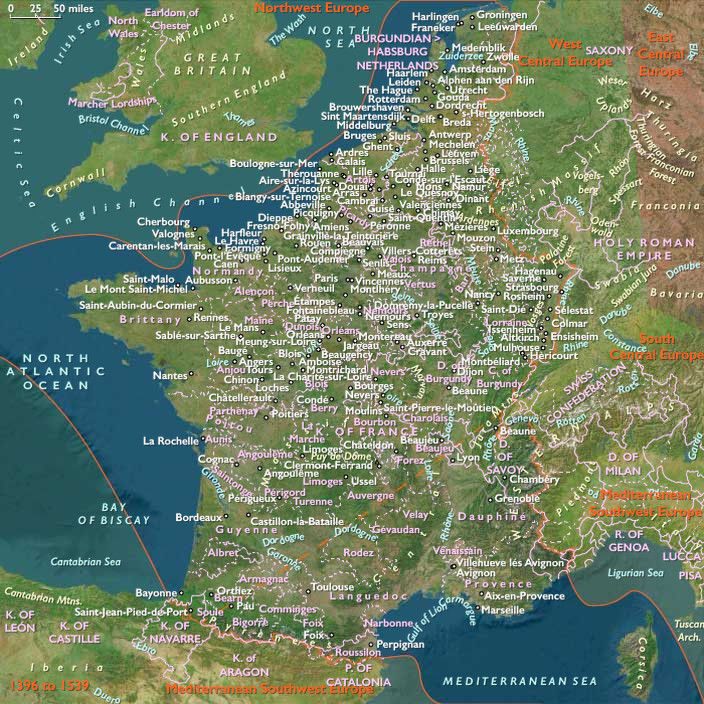
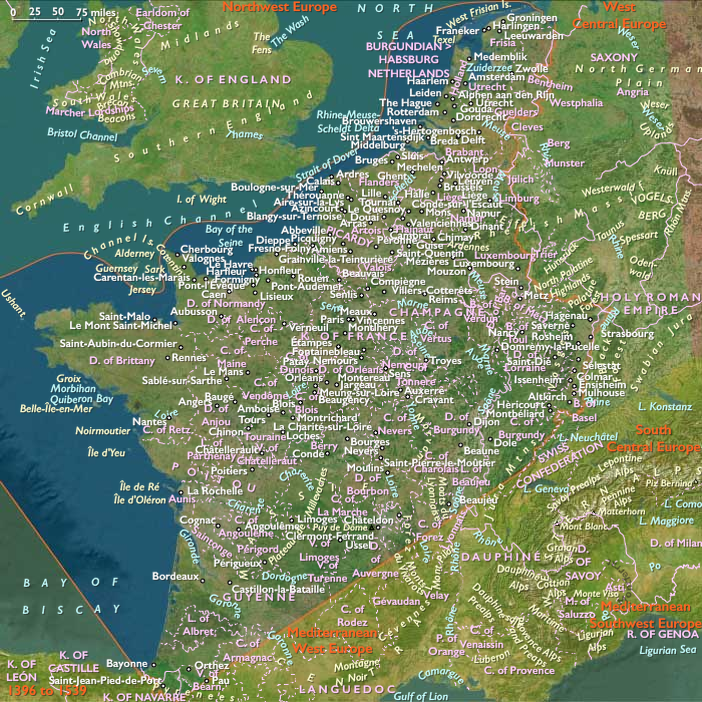
The Italian Renaissance begins to notably influence French art after Charles VIII returns in 1496 from his conquest of Naples, bringing several prominent Italian artists with him. This marks a significant turning point, leading to the integration of Renaissance artistic ideals and techniques into French culture.
Locations
People
Groups
Topics
Subjects
Regions
Subregions
Related Events
Filter results
Showing 10 events out of 40163 total
The Swiss have not accepted the resolutions of the Imperial Diet, and they explicitly refuse to pay the common penny.
They have no interest whatsoever in sending troops to serve in an army under Habsburg authority, nor in paying taxes, nor will they accept any foreign court's jurisdiction; and they have succeeded in securing public peace within their territories reasonably well by themselves.
They simply consider the whole proposal a curtailing of their freedom.
The Swiss are by far not the only members of the empire who refuse to accept the resolutions, but Maximilian will use their refusal later as a pretext to place the Swiss Confederacy under an imperial ban (Reichsacht).
Pope Alexander VI, concluding the inquiry he had initiated the previous year, in 1496 suspends Savonarola from preaching until the case is settled.
Savonarola at first complies, and a truce is arranged between the two so long as Savonarola avoids politics in his sermons—a condition that proves impossible for the dictatorial theocrat.
For some months Savonarola had obeyed the strictures imposed by the pope, but when he sees his influence slipping he defies the pope and resumes his sermons, which become more violent in tone.
He not only attacks secret enemies at home whom he rightly suspects of being in league with the papal Curia, he condemns the conventional, or "tepid" Christians who are slow to respond to his calls.
He dramatizes his moral campaign with special masses for the youth, processions, bonfires of the vanities and religious theater in San Marco.
Mauro Codussi, one of the first Venetian architects to use elements derived from the new classicizing architecture of Florence and central Italy, begins construction in 1496 on the Torre del Orologio and the Procurazie Vecchie on the Piazza San Marco.
Perugino begins work in 1496 on a polyptych altarpiece of the “Ascension” for Perugia’s San Pietro.
The polyptych had been originally commissioned for the Abbey of San Pietro at Perugia, the contract having been signed by Perugino on March 8, 1495.
It includes a large altarpiece and several panels, within a wooden frame by Domenico da Verona.
The altarpiece, depicting the Ascension of Christ, is to have a lunette with the God in Glory between Angels above it, while the predella has not been exactly defined.
The payment is five hundred golden ducats, and no more than two years and a half have been given to complete the work.
Juan del Encina and the Birth of Spanish Renaissance Drama (1496)
At age 28, Juan del Encina (1468–1529), a Spanish poet, playwright, and composer, wrote a series of dramatic eclogues (pastoral plays) that were published in 1496 in his Cancionero. His works established him as the founder of Spanish Renaissance drama and an innovator of secular theatrical traditions in Spain.
Encina’s Contribution to Spanish Drama and Poetry
- He introduced pastoral themes into Spanish theater, drawing from Latin and Italian humanist influences.
- His eclogues mixed rustic, comedic peasant dialogue with lyrical songs, creating a distinct style of vernacular drama.
- He composed music for his plays, making him one of the first playwrights to integrate song and drama into Spanish theatrical performance.
Cancionero (1496): A Landmark Work
- The Cancionero included both poetry and music, reflecting Spain’s evolving literary culture.
- It contained several eclogues, blending religious and secular themes.
- These works laid the foundation for the later development of Spanish Golden Age drama, influencing writers like Lope de Rueda and Lope de Vega.
Legacy and Influence
- Encina’s works bridged medieval and Renaissance literature, shaping the future of Spanish drama.
- His musical compositions helped develop Spanish secular song traditions, leading to the later zarzuela and opera forms.
- His use of comic peasant speech made his plays relatable to broader audiences, influencing the later Golden Age of Spanish Theater (17th century).
Thus, Juan del Encina’s Cancionero (1496) was a turning point in Spanish drama, marking the beginning of Renaissance theater in Spain and securing his place as one of its most important literary figures.
Dame Julian Berners, an English writer on heraldry, hawking and hunting, who was probably brought up at court, still retained her love of hawking, hunting and fishing, and her passion for field sports after she adopted the monastic life.
Said to have been prioress of the Priory of St. Mary of Sopwell, near St Albans in Hertfordshire, she is the supposed author of the work generally known as The Boke of Saint Albans, of which the first and rarest edition had been printed in 1486 by an unknown schoolmaster at St. Albans.
It has no title-page.
The only clue to the authorship of the Treatise, and the only documentary evidence of her, is an attribution at the end of the original 1486 book which reads: "Explicit Dam Julyans Barnes in her boke of huntyng."
Her name was changed by Wynkyn de Worde to "Dame Julyans Bernes."
There is no such person to be found in the pedigree of the Berners family, but there is a gap in the records of the priory of Sopwell between 1430 and 1480.
De Worde's edition (fol. 1496), also without a title-page, begins:
"This present boke shewyth the manere of hawkynge and huntynge: and also of diuysynge of Cote armours.
It shewyth also a good matere belongynge to horses: wyth other comendable treatyses.
And ferdermore of the blasynge of armys: as hereafter it maye appere."
This edition is adorned by three woodcuts, and included a Treatyse of fysshynge wyth an Angle, not contained in the St. Albans edition.
Joseph Haslewood, who published a facsimile of Wynkyn de Worde's edition (London, 1811, folio) with a biographical and bibliographical notice, examined with the greatest care the author's claims to figure as the earliest woman author in the English language.
He assigned to her little else in the Boke except part of the treatise on hawking and the section on hunting.
It is expressly stated at the end of the Blasynge of Armys that the section was "translatyd and compylyt," and it is likely that the other treatises are translations, probably from the French.
Only three perfect copies of the first edition are known to exist.
A facsimile, entitled The Boke of St Albans, with an introduction by William Blades, will appear in 1881.
During the sixteenth century, the work will be very popular, and many times reprinted, edited by Gervase Markham in 1595 as The Gentleman's Academie.
The treatise on fishing, which is added to the 1496 edition printed by Wynkyn de Worde, and probably has even less to do with Dame Juliana than the original texts, is the first known work on fly fishing.
It describes artificial flies that are still in use today.
An Italian navigator named Giovanni Caboto (anglicized as John Cabot), born probably in Genoa, had become a citizen of Venice in 1476 and had traveled widely in the Mediterranean before moving to England in 1495 with his family, including his son Sebastian.
Backed by Bristol merchants and letters patent from England’s King Henry VII, who promotes a commercial alliance with the Netherlands in competition with the Spanish and Portuguese claims sanctioned by the pope.
Like other Italian explorers, including Christopher Columbus, Cabot will lead an expedition on commission to another European nation, in his case, England.
Cabot plans to depart to the west from a northerly latitude where the longitudes are much closer together, and where, as a result, the voyage will be much shorter.
He still has an expectation of finding a route to China.
Historians had thought that, on arrival in England, Cabot went to Bristol, a major maritime center, to seek financial backers.
This is the only English city to have had a prior history of undertaking exploratory expeditions into the Atlantic.
Cabot's royal patent (issued by the Crown in 1496) states that all expeditions should be undertaken from Bristol, so his primary financial supporters likely are based in this city.
In the late twentieth century, British historian Alwyn Ruddock claimed to have found documentation that Cabot went first to London, where he received some financial backing from its Italian community.
She suggested one patron was Fr.
Giovanni Antonio de Carbonariis, an Augustinian friar who was also the deputy to Adriano Castellesi, the papal tax collector.
Dr Ruddock suggested that Carbonariis accompanied Cabot's 1498 expedition.
She also suggested that the friar, on good terms with the King, introduced the explorer to King Henry VII.
Beyond this, Ruddock claimed that Cabot received a loan from an Italian banking house in London.
As Ruddock ordered the destruction of all her research notes on her death in 2005, scholars have had to duplicate her research and rediscover documents.
The Cabot Project was formed at the University of Bristol in 2009 to research Cabot and the Bristol expeditions.
Dr. Francesco Guidi Bruscoli of the University of Florence found documentation that Cabot received money in March 1496 from the Bardi family banking firm of Florence.
The bankers located in London provided fifty nobles (£16 13s.
4d.)
to support Cabot's expedition to "go and find the new land".
This payment from the Florentine merchants would have represented a substantial contribution, although it was not enough to completely finance the expedition.
On March 5, 1496 Henry VII gives Cabot and his three sons letters patent with the following charge for exploration: ...free authority, faculty and power to sail to all parts, regions and coasts of the eastern, western and northern sea, under our banners, flags and ensigns, with five ships or vessels of whatsoever burden and quality they may be, and with so many and with such mariners and men as they may wish to take with them in the said ships, at their own proper costs and charges, to find, discover and investigate whatsoever islands, countries, regions or provinces of heathens and infidels, in whatsoever part of the world placed, which before this time were unknown to all Christians.
Those who received such patents have the right to assign them to third parties for execution.
His sons are believed to have still been minors.

Cabot goes to Bristol to arrange preparations for his voyage.
Bristol, the second-largest seaport in England, from 1480 onward has supplied several expeditions to look for Hy-Brazil.
According to Celtic legend, this island lies somewhere in the Atlantic Ocean.
There is widespread belief among merchants in the port that Bristol men had discovered the island at earlier date but then lost track of it. (Note: Ruddock had contended in a private 1988 letter to a colleague, Quinn, that she had found evidence in Italian archives that Bristol men had discovered North America pre-1470.
As the island was believed to be a source of brazilwood, from which a valuable red dye can be obtained, merchants had economic incentive to find it.
Cabot's first voyage is little recorded.
A winter 1497/98 letter from John Day (a Bristol merchant) to an addressee believed to be Christopher Columbus refers briefly to it, but writes mostly about the second, 1497 voyage.
He notes, "Since your Lordship wants information relating to the first voyage, here is what happened: he went with one ship, his crew confused him, he was short of supplies and ran into bad weather, and he decided to turn back."
Since Cabot received his royal patent in March 1496, it is believed that he made his first voyage that summer.
The Taíno on Hispaniola suffer more acutely than the Europeans, who have brought smallpox, measles, and typhus, which are deadly to the native peoples.
Mostly disease, but also murder and slavery will wipe out the Taíno within a generation.
La Isabela having barely survived, Columbus decides in 1496 to abandon it in favor of a new settlement.
Preparing to depart for Spain in 1496, he leaves his brother Bartholomew in charge with instructions to move the settlement to a site on the south coast of Hispaniola, now Santo Domingo.
La Isabela’s foreign crops have failed by 1496 and the colonists are living on small amounts of rationed wheat, bacon, and dried beans.
The people have become hungry and desperate.
The colonists have failed to adapt their food sources and at least fifty percent of them have scurvy.
They begin to die of scurvy or acute diseases that kill quickly, such as influenza.
Bones from the colony show that the colonists were young and used to heavy labor.
They were generally healthy.
Most were under thirty and few were over forty-five.
However, twenty percent of them died within four years.
None of the bones found show signs of trauma.
Although historical records mention neither women nor Africans, skeletal remains in graves found at least one European woman and indicated African origin for others, but whether the latter were sailors or slaves is as yet undetermined.