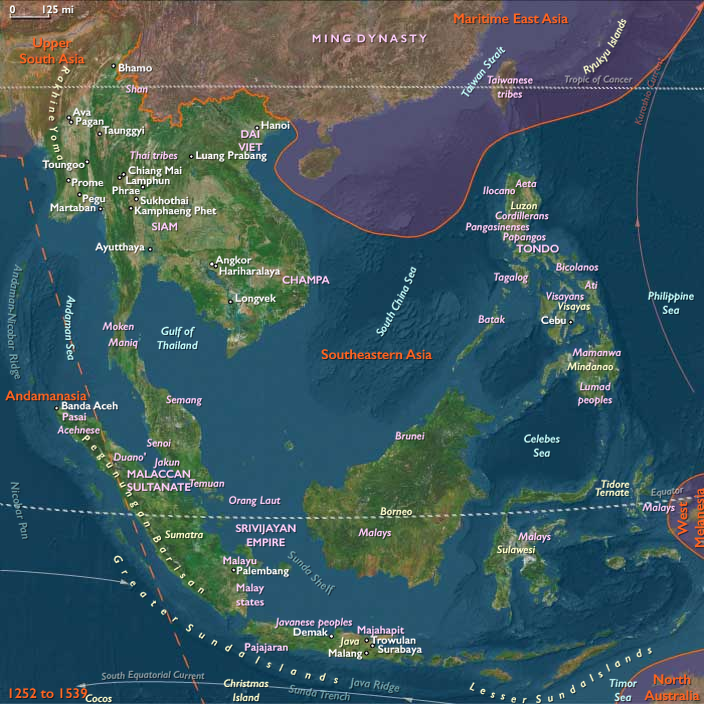
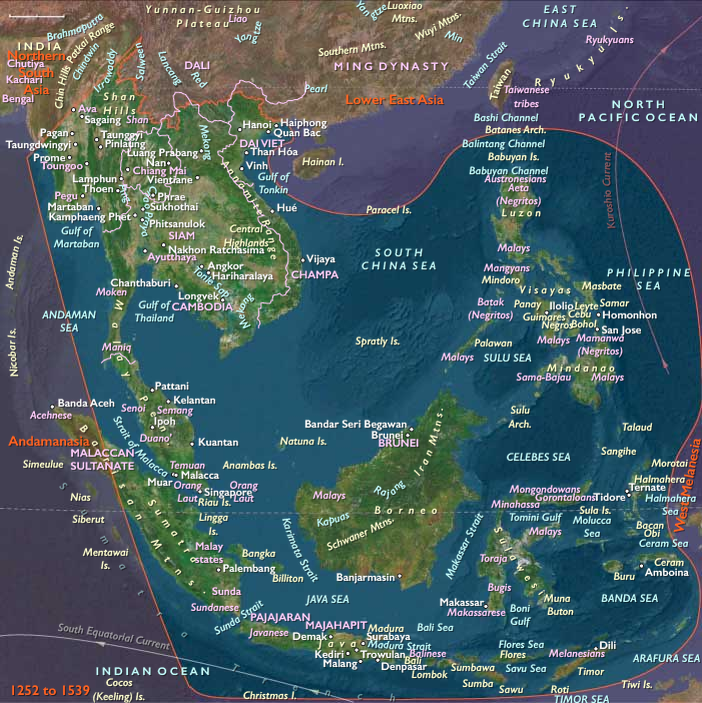
… the island of Bali, where Majahapit …
Years: 1498 - 1498
… the island of Bali, where Majahapit had founded a colony in 1343.
The refugees have probably fled to avoid Demak’s retribution for their support for Ranawijaya against Kertabhumi.
Locations
Groups
Subjects
Regions
Subregions
Related Events
Filter results
Showing 10 events out of 40110 total
Dates for the end of the Majapahit Empire range from 1478 to 1517.
In 1478, Ranawijaya’s army, under general Udara (who will later become vice-regent), had breached Trowulan defenses and killed Kertabhumi in his palace.
Demak had sent reinforcements under Sunan Ngudung, who later died in battle and was replaced by Sunan Kudus, but the reinforcements came too late to save Kertabumi although they manage sto repel Ranawijaya’s army.
This event is mentioned in the Trailokyapuri (Jiwu) and Petak inscriptions,in which Ranawijaya claims that he already defeated Kertabhumi and reunited Majapahit as one kingdom.
Ranawijaya rules from 1474 to 1498 with the formal name Girindrawardhana, with Udara as his vice-regent.
This event leads to war between the Sultanate of Demak and Daha, as Demak rulers are descendants of Kertabhumi.
A turning point comes in 1498, when Girindrawardhana is deposed by his vice regent, Udara.
After this coup, the war between Demak and Daha subsides, with some sources saying Raden Patah left Majapahit alone as his father had done before, while others said Udara agreed to become a vassal of Demak, even marrying Raden Patah's youngest daughter.
A large number of courtiers, artisans, priests, and members of the royalty move east to…
Dürer paints himself half-length and slightly turned, beside a window that opens onto a mountainous landscape.
He wears a white Jerkin with black edging and a shirt with gold lace, long hair, a black and white striped cap with tassels, a brown cape and gray kid gloves.
The choice of elegant, aristocratic clothing and the severe gaze he directs at the viewer with haughty serenity indicate Dürer’s wish to show off his social standing.
This work is outstanding for its rich details, the meticulous treatment of qualities, and its brilliant, gold-toned color scheme, all of which complement an impeccably precise drawing.
His satisfaction with his own artistic capacity is manifest in the German inscription on the window ledge, which reads: “1498, I painted it according to my figure.
I was twenty-six years old Albrecht Dürer.”
The Polish raid in Moldavia provokes Turks and Tatars to invade the southeastern corner of Poland in spring 1498: after crossing the Dniestr, the invaders ransack Red Ruthenia, capturing thousands of people and reaching as far as Przeworsk.
In the summer of this year, the Tatars again invade Poland, mainly Podolia and Volhynia.
Venice, having gained control of Cyprus in 1489, has built a major naval base in Famagusta, which it refuses to allow Bayezid to use against the Mamluks, instead using it as a base for pirate raids against Ottoman shipping and shores, thus pointing up the island's strategic importance to the sultan.
Askia Mohammad has raided Hausaland in 1497-98, during which he has sacked three of the region’s four largest cities—Gobir, Katsina, and …
…Zaria—and …
…extracts tribute form the biggest, Kano.
The kingdom of 'Alwah in the southern Sudan extends from Kabushiyah as far south as Sennar, with its capital at Soba near present Khartoum.
'Alwah is, with Abyssinia, one of Africa's two remaining Christian kingdoms and the last indigenous Christian barrier to Arab occupation of the Sudan.
Weakened by continuous and corrosive raids of the Bedouin throughout the fifteenth century, the kingdom collapses in 1498 under assault by the so-called Abdallabites, an Arab confederation led by 'Abd Allah Jamma'.
Pietro Lombardo has sculpted many Venetian tombs with the help of his sons.
These tombs include those of Dante Alighieri, Doge Pasquale Malipiero and Pietro Mocenigo.
He was the architect and chief sculptor for the Church of Santa Maria dei Miracoli from 1481 to 1489 and of San Giobbe He also depicts saints and the Virgin Mary on the walls of several Catholic churches.
after 1498, as an architect, he supervises work on the Doge's Palace.
Michelangelo had begun work on the “Pietá,” sculpted in Carrara marble, while in his twenties.
The first of a number of works of the same theme by the artist, the statue had been commissioned for the French Cardinal Jean de Bilhères, who was a representative in Rome.
The sculpture is made for the cardinal's funeral monument in the Chapel of Santa Petronilla, a Roman mausoleum near the south transept of St. Peter's, which the Cardinal had chosen as his funerary chapel.
Completed in 1499, it is the only piece Michelangelo ever signs.
This famous work of art depicts the body of Jesus on the lap of his mother Mary after the Crucifixion.
The theme is of Northern origin, popular by this time in France but not yet in Italy.
Michelangelo's interpretation of the Pietà is unprecedented in Italian sculpture.
It is an important work as it balances the Renaissance ideals of classical beauty with naturalism.
The structure is pyramidal, and the vertex coincides with Mary's head.
The statue widens progressively down the drapery of Mary's dress, to the base, the rock of Golgotha.
The figures are quite out of proportion, owing to the difficulty of depicting a fully grown man cradled full-length in a woman's lap.
Much of Mary's body is concealed by her monumental drapery, and the relationship of the figures appears quite natural.
Michelangelo's interpretation of the Pietà was far different from those previously created by other artists, as he sculpted a young and beautiful Mary rather than an older woman around fifty years of age.
The marks of the Crucifixion are limited to very small nail marks and an indication of the wound in Jesus' side.
Christ's face does not reveal signs of The Passion.
Michelangelo did not want his version of the Pietà to represent death, but rather to show the "religious vision of abandonment and a serene face of the Son",thus the representation of the communion between man and God by the sanctification through Christ.
The Madonna is represented as being very young for the mother of a thirty-three-year-old son, which is not uncommon in depictions of her at the time of the Passion of Christ.
Various explanations have been suggested for this.
One is that her youth symbolizes her incorruptible purity, as Michelangelo himself will say to his biographer and fellow sculptor Ascanio Condivi.