
The Islamic Empire had eventually taken control …
Years: 965 - 965
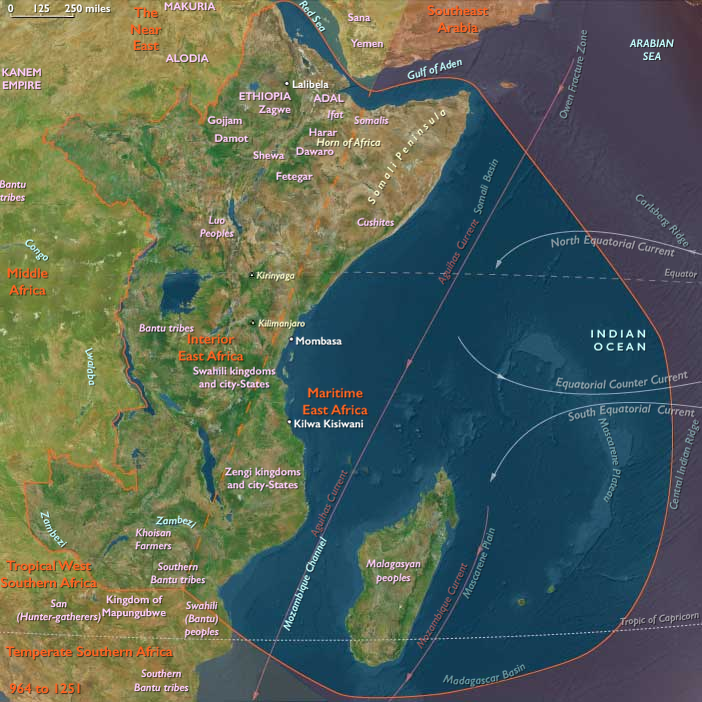
The Islamic Empire had eventually taken control of the Red Sea and most of the Nile, forcing Aksum into economic isolation.
Northwest of Aksum in modern day Sudan, the Christian states of Makuria and Alodia will last until the thirteenth century before becoming Islamic.
Aksum, isolated, nonetheless still remains Christian.
After a second golden age in the early sixth century, the empire began to decline, eventually ceasing its production of coins in the early seventh century.
Around this same time, the Aksumite population had been forced to go farther inland to the highlands for protection, abandoning Aksum as the capital.
Arab writers of the time continued to describe Ethiopia (no longer referred to as Aksum) as an extensive and powerful state, though they had lost control of most of the coast and their tributaries.
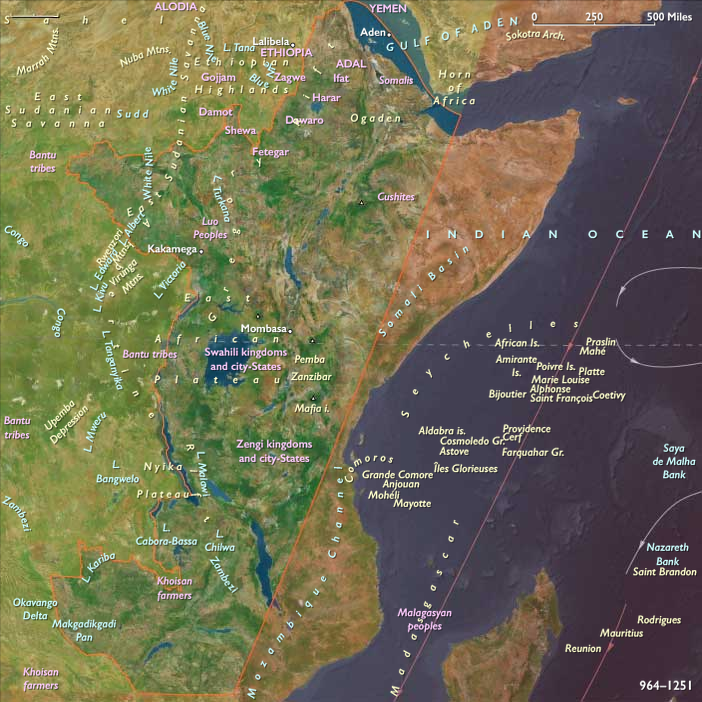
While land was lost in the north, it was gained in the south, and though Ethiopia was no longer an economic power it still attracted Arab merchants.
The capital was moved to a new location, currently unknown, though it may have been called Ku'bar or Jarmi.
Local history holds that around 960 a Jewish Queen named Yodit (Judith) or "Gudit" defeated the empire and burned its churches and literature, but while there is evidence of churches being burned and an invasion around this time, her existence has been questioned by some modern authors.
Another possibility is that the Aksumite power was ended by a southern pagan queen named Bani al-Hamwiyah, possibly of the tribe al-Damutah or Damoti (Sidama).
It is clear from contemporary sources that a female usurper did indeed rule the country at this time, and that her reign ended some time before 1003.
Locations
Groups
- Polytheism (“paganism”)
- Arab people
- Jews
- Aksum (or Axum), Kingdom of
- Makuria, Kingdom of
- Christianity, Chalcedonian
- Alodia, or Alwa (Subah, or Soba), Kingdom of
- Islam
Topics
Commodoties
Subjects
Regions
Subregions
Years: 965 - 965
Locations
Groups
- Polytheism (“paganism”)
- Arab people
- Jews
- Aksum (or Axum), Kingdom of
- Makuria, Kingdom of
- Christianity, Chalcedonian
- Alodia, or Alwa (Subah, or Soba), Kingdom of
- Islam
Topics
Commodoties
Subjects
Regions
Subregions