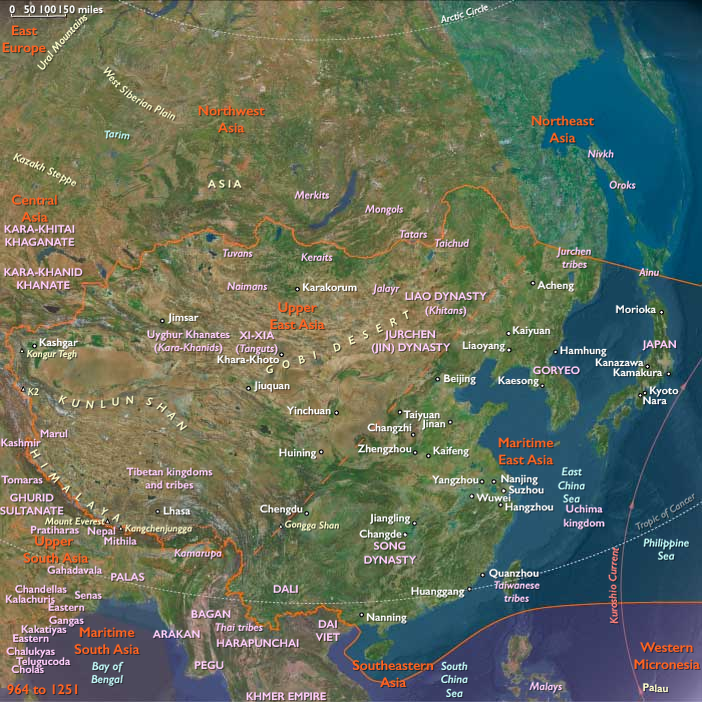
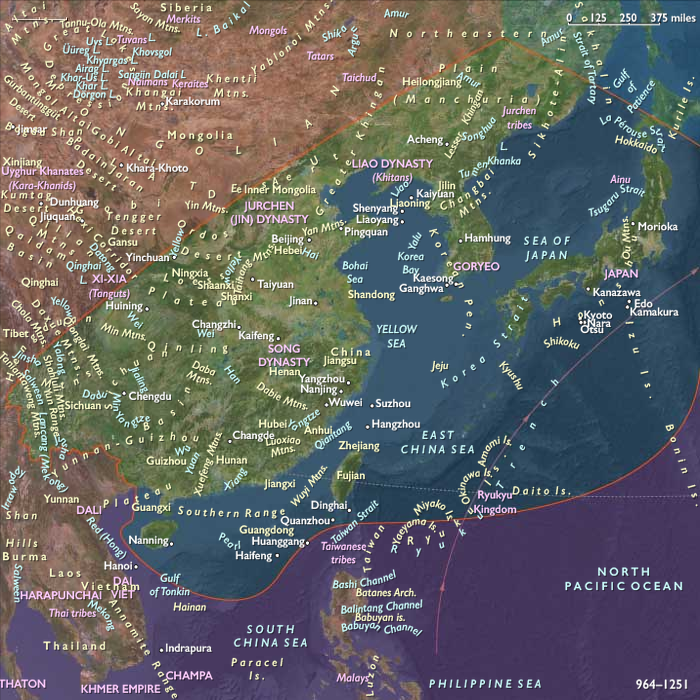
The iron industry in Song Dynasty China …
Years: 1078 - 1078
The iron industry in Song Dynasty China is by 1078 producing a total weight of one hundred and twenty-seven million kilograms (one hundred and twenty-five thousand tons) of iron product per year.
Locations
Groups
Commodoties
Subjects
Regions
Subregions
Related Events
Filter results
Showing 10 events out of 45 total
Reactions to the peace are mixed in Austria.
The Pragmatic Sanction of 1713 had been issued by Holy Roman Emperor Charles VI to alter the law of succession of the Habsburg family, allowing his daughter Maria Theresa to inherit the Habsburg lands.
Ostensibly the source of the long, bitter War of Austrian Succession, this sanction is upheld by the Treaty of Aix-la-Chapelle.
The monarchy, led by Maria Theresa's foreign affairs chancellor Wenzel Anton, Prince of Kaunitz-Rietberg, has survived a disastrous crisis that could have brought its destruction, and the Habsburg preeminence is confirmed in Germany.
The Austrians have saved Bohemia and the duchy of Milan, conceding only minor concessions in Italy.
Maria Theresa is also happy that France has given back the Austrian Netherlands that it had conquered.
Overall, she refers to the war as a miracle as she has saved her Empire from destruction.
However, she is very upset by the loss of the rich province of Silesia to Prussia.
Britain's support for this repossession at Aix-la-Chapelle had spurned Kaunitz to establish an unprecedented alliance with Austria's traditional enemy, France, following the establishment of the treaty.

The new territorial settlement and the accession of the peaceful Ferdinand VI of Spain will allow the Aix settlement to last until the outbreak of the French Revolutionary Wars in 1792.
European powers have long pursued control of the Americas, viewing them as well-needed resources and proof of power.
Spain, the Netherlands, France and Britain all had had unresolved tensions following settlements like the Treaty of Breda (1667), the Treaty of Westminster (1672) and the Treaty of Nijmegen.
The islands of Saint Lucia and Tobago had by 1713 become the subjects of Anglo-Franco conflict.
However, the Treaty of Aix-la-Chapelle declares neutrality in Tobago, Grenada, Saint Vincent and Dominica, allowing all European powers unfettered economic access and forbidding garrisons.
In addition, France gains Saint Lucia as a colony.
Following the War of the Austrian Succession, during which she has lost the valuable province of Silesia, the Austrian Empress Maria Theresa had tried to gain British support for a proposed military action to reclaim it.
The results of the War of Austrian Succession are clear, however: Britain no longer views Austria as powerful enough to check French power but is content to build up smaller states like Prussia.
When the British government refused, the Empress had become disenchanted with them—and in 1756 makes an alliance with France.
The British, suddenly without a major ally in continental Europe, hastily conclude a similar pact with Frederick II of Prussia, who is receiving reports of the clashes in North America.
Both signatories hope the alliance will forestall a major European war by maintaining the European Balance of Power.
Prussia has a number of leading British supporters including William Pitt.
The Convention of Westminster, a treaty of neutrality, is signed on January 16, 1756, between Frederick II and King George II.
British fears of French attacks on Hanover, the family seat of the British monarch under his title as the duke of Brunswick-Lüneburg, had been responsible for the development of the treaty.
Based on the terms of the agreement, both Prussia and Britain will prevent any other foreign power passage through Germany, and that Britain will not aid Austria in a renewed conflict for Silesia if Prussia agrees to protect Hanover from France.
Protection of Hanover is important to Britain because it is a possession of its king.
Britain feels that with Prussia's growing strength, it will be more able to defend Hanover than Austria.
The Westminster Convention and the resultant Anglo-Prussian alliance are part of the so-called Diplomatic Revolution.
Maria Theresa, recognizing the futility of renewed alliance with Britain, sets out to align Austria with France, who can replace Britain as a valuable ally.
The Empress knows that without a powerful ally such as France, she can never hope to reclaim Silesia from Frederick.
Kaunitz had approached Madame de Pompadour, Louis XV's mistress, to intervene in the negotiations.
However, Louis XV had proved reluctant to agree to any treaty presented by Kaunitz.
Only with renewed aggression between France and Britain is Louis made to align with Austria.
Furthermore, Austria no longer surrounds France; instead, Frederick II has managed to end the prospect of Habsburg-German dominion bordering French lands.
Therefore, France no longer sees Austria as an immediate threat and so enters into a defensive alliance with Austria.
In response to the Westminster Convention, Louis XV’s ministers and Kaunitz conclude the First Treaty of Versailles on May 1, 1756, both sides agreeing to remain neutral and to provide twenty-four thousand troops if either one gets into conflict with a third party.
He intends this as a bold preemption of an anticipated Austro-French invasion of Silesia.
Frederick has three goals in his new war on Austria.
First, he will seize Saxony and eliminate it as a threat to Prussia, then use the Saxon army and treasury to aid the Prussian war effort.
His second goal is to advance into Bohemia, where he might set up winter quarters at Austria's expense.
Thirdly, he wants to invade Moravia from Silesia, seize the fortress at Olmütz, and advance on Vienna to force an end to the war.
Accordingly, leaving Field Marshal Count Kurt von Schwerin in Silesia with twenty-five thousand soldiers to guard against incursions from Moravia and Hungary, and leaving Field Marshal Hans von Lehwaldt in East Prussia to guard against Russian invasion from the east, Frederick sets off with his army for Saxony.
The Prussian army marches in three columns.
On the right is a column of about fifteen thousand men under the command of Prince Ferdinand of Brunswick.
On the left is a column of eighteen thousand men under the command of the Duke of Brunswick-Bevern.
In the center is Frederick II himself, with Field Marshal James Keith commanding a corps of thirty thousand troops.
Ferdinand of Brunswick is to close in on the town of Chemnitz.
The Duke of Brunswick-Bevern is to traverse Lusatia to close in on Bautzen, while Frederick and Keith make for Dresden.
Realizing that the siege will take some time, he is compelled to leave a covering force around Pirna and head south through the rough Mittel-Gebirge of northern Bohemia to establish a winter base in the rich Bohemian plain.
Following Frederick's occupation of the Saxon capital, Dresden, on September 9, ...
Browne has been in secret communication with the Saxon prime minister, Heinrich Count Bruhl, and has planned a rescue mission up the right bank of the Elbe to Königstein, near Pirna, to help the Saxon army escape across the river and join its allies.
On the 28th, Browne receives an enthusiastic agreement from Bruhl on his proposal; the date of the rendezvous of the two forces is to be the night of 11/12 October.
Frederick and his twenty-eight thousand men are meanwhile making their way through the Mittel-Gebirge toward the Bohemian plain.
Browne's intelligence tells him that the Prussians will exit from the mountains at Lobositz (present Lovosice in the Czech Republic), a few miles northwest of his fortified base at Budin.
He recalls his small relief force up the Elbe and races with thirty-three thousand men up to Lobositz on the 28th to lay an ambush for Frederick as he debouches from the narrow passes of the mountains.