The Proto-Iranians are traced to the Bactria-Margiana …
Years: 1917BCE - 1774BCE
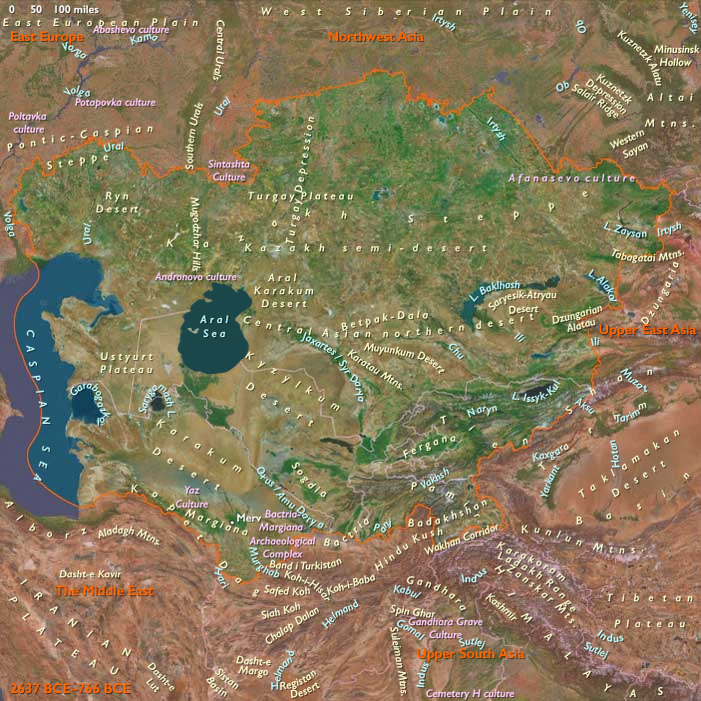
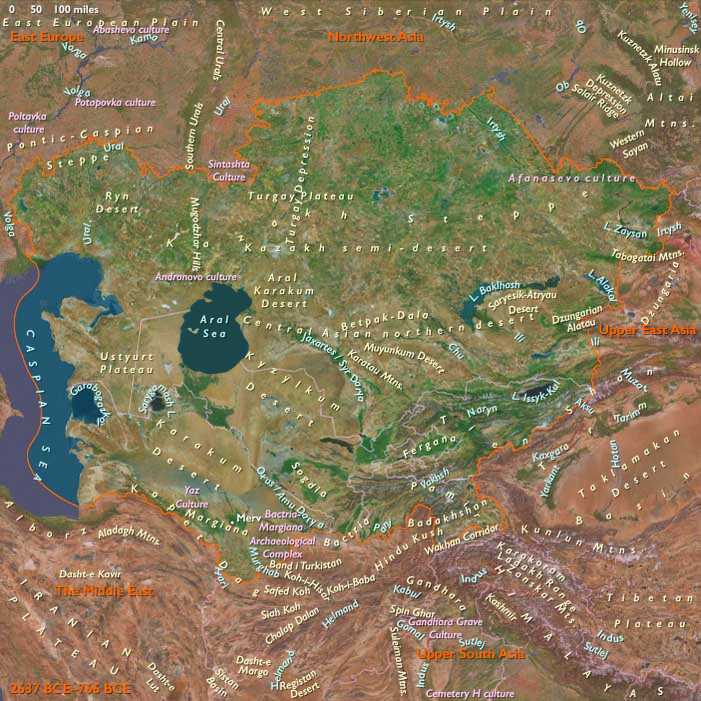
The Proto-Iranians are traced to the Bactria-Margiana Archaeological Complex (BMAC), a Bronze Age culture of Central Asia.
The area between northern Afghanistan and the Aral Sea is hypothesized to have been the region where the Proto-Iranians first emerged, following the separation of Indo-Iranian tribes.
Related Events
Filter results
Showing 10 events out of 67922 total
Maritime East Asia (1917–1774 BCE): The Erlitou Culture and Early Bronze Age Developments
Between 1917 BCE and 1774 BCE, Maritime East Asia—comprising lower Primorsky Krai, the Korean Peninsula, the Japanese Archipelago below northern Hokkaido, Taiwan, and southern, central, and northeastern China—sees significant cultural and technological developments marked prominently by the rise and spread of the influential Erlitou culture. This early Bronze Age society, named after its principal archaeological site at Erlitou in Yanshi, Henan Province, represents a crucial stage in the evolution of complex urban societies and metallurgy in ancient China.
Rise and Spread of the Erlitou Culture
The Erlitou culture flourishes roughly between 2000 BCE and 1500 BCE, with its largest and most influential site located at Erlitou itself, spanning approximately three kilometers in diameter. This prominent settlement likely serves as a central hub for ritual, political, and economic activity, notably monopolizing the sophisticated production of ritual bronze vessels. These vessels become distinctive markers of Erlitou craftsmanship, signaling the emergence of specialized metallurgy and advanced artisan traditions during China’s early Bronze Age.
Geographic Expansion and Regional Influence
Originating from antecedent late-Neolithic Longshan cultural traditions, Erlitou rapidly expands its cultural influence beyond Henan Province, spreading significantly throughout neighboring regions including Shanxi, and subsequently influencing areas of Shaanxi and Hubei provinces. The widespread geographic distribution of Erlitou cultural artifacts—particularly ritual bronzes—suggests extensive regional networks of trade, cultural exchange, and possibly political alliances or control extending throughout central and northeastern China.
The Erlitou Culture and the Xia Dynasty Debate
A significant scholarly debate centers on Erlitou’s potential association with the legendary Chinese Xia Dynasty, traditionally described in historical texts but not conclusively linked to archaeological sites. Most Chinese archaeologists consider Erlitou the physical manifestation of the Xia Dynasty, citing chronological alignment and geographic coherence with textual descriptions. In contrast, many Western archaeologists remain cautious, emphasizing the absence of written records directly linking the Erlitou archaeological findings with the historical narrative of the Xia Dynasty.
This debate underscores the importance of Erlitou as a key archaeological culture bridging prehistoric traditions and historical accounts, regardless of its direct dynastic connections.
Legacy of the Era: Foundations of Urbanization and Bronze Technology
Thus, the period from 1917 BCE to 1774 BCE marks a pivotal chapter in the historical trajectory of Maritime East Asia, particularly within China’s central and northeastern regions. The emergence and regional expansion of the Erlitou culture signify critical transitions toward urban complexity, sophisticated metallurgical practices, and increased social stratification. These innovations lay lasting foundations for subsequent cultural and historical developments across Lower East Asia.

Trade in goods formerly considered exotic increases in this age, in conjunction with organized exploitation of natural and native resources by colonizing nations.
Cross-cultural pollination occurs in religion and philosophy, as well as in technologies and the arts.
The Erlitou culture, a name given by archaeologists to an Early Bronze Age society that exists in China from 2000 BCE to 1500 BCE, is named after the site discovered at Erlitou in Yanshi, Henan Province.
Erlitou, at three kilometers in diameter the largest site associated with the culture, apparently monopolizes the production of ritual bronze vessels.
The Erlitou culture, which may have evolved from the Longshan culture, is widely spread throughout Henan and Shanxi Province, and will later appear in Shaanxi and Hubei Province.
Most Chinese archaeologists identify the Erlitou culture as the site of the Xia Dynasty, while most Western archaeologists remain unconvinced of the connection between the Erlitou culture and the Xia Dynasty since there are no extant written records linking Erlitou with the official history.
The Tarim Basin, surrounded by mountains, may be one of the last places in Asia to have become inhabited.
Its aridity required the development of technology for water transport and storage before people could live here.
The lake system into which the Tarim River and Shule River empty is the last remnant of the historical post-glacial Tarim Lake, which once covered more than ten thousand square kilometers (thirty-nine hundred square miles) in the Tarim Basin.
Lop Nur, a group of small, now seasonal salt-lake sand marshes between the Taklamakan and Kuruktag deserts in the southeastern portion of Xinjiang Uygur Autonomous Region in the People's Republic of China, is hydrologically endorheic—it is landbound and there is no outlet.
The lake from around 1800 BCE supports a thriving Tocharian culture that will last until the ninth century.
Archaeologists have discovered the buried remains of settlements, as well as several of the Tarim mummies, along the ancient shoreline of Tarim Lake.
Some of the mummies are frequently associated with the presence of the Indo-European Tocharian languages in the Tarim Basin, although the evidence is inconclusive.
DNA studies of mummies from the Xiaohe burial site, located in Lop Nur, suggest that an admixed population of both west and east Eurasian origin lived in the Tarim basin since the early Bronze Age.
The maternal lineages were predominantly east Eurasian haplogroup C with smaller numbers of H and K, while the paternal lines were all west Eurasian R1a1a.
The admixture likely took place in south Siberia before the population's migration into the Tarim Basin.
The earliest Tarim mummies, found at Qäwrighul and dated to 1800 BCE, are of a Caucasoid physical type.
Their closest affiliation is to the Bronze Age populations of southern Siberia, Kazakhstan, Central Asia, and the Lower Volga.
Kurgan cemeteries of the Vaksh and Bishkent type appear in the highlands above the Bactrian oases in Tajikistan, with pottery that mixes elements of the late BMAC and Andronovo-Tazabagyab traditions.
The walled BMAC centers decrease sharply in size about 1800 BCE.
Each oasis develops its own types of pottery and other objects.
Also pottery of the Andronovo-Tazabag'yab culture to the north appears widely in the Bactrian and Margian countryside.
Many BMAC strongholds continue to be occupied and Andronovo-Tazabagyab coarse incised pottery occurs within them (along with the previous BMAC pottery) as well as in pastoral camps outside the mudbrick walls.
There is a substratum in Proto-Indo-Iranian which can be plausibly identified with the original language of the BMAC, as argued by Michael Witzel and Alexander Lubotsky.
Moreover, Lubotsky points out a larger number of words apparently borrowed from the same language, which are only attested in Indo-Aryan and therefore evidence of a substratum in Vedic Sanskrit.
Some BMAC words have now also been found in Tocharian.
Michael Witzel points out that the borrowed vocabulary includes words from agriculture, village and town life, flora and fauna, ritual and religion, so providing evidence for the acculturation of Indo-Iranian speakers into the world of urban civilization.
The Bactria-Margiana complex has attracted attention as a candidate for those looking for the material counterparts to the Indo-Iranians, a major linguistic branch that split off from the Proto-Indo-Europeans.
Sarianidi himself advocates identifying the complex as Indo-Iranian, describing it as the result of a migration from southeastern Iran.
Bactrian Margiana material has been found at Susa, Shahdad, and Tepe Yahya in Iran, but Lamberg-Karlovsky does not see this as evidence that the complex originated in southeastern Iran.
Western archaeologists are more inclined to see the culture as begun by farmers in the Near Eastern Neolithic tradition, but infiltrated by Indo-Iranian speakers from the Andronovo culture in its late phase, creating a hybrid.
In this perspective, Proto-Indo-Aryan developed within the composite culture before moving south into the Indian subcontinent.
The Iranian peoples, having descended from the Aryans (Proto-Indo-Iranians), separate from the Indo-Aryans, Nuristanis and Dards in the early second millennium BCE.
The Iranian languages form a sub-branch of the Indo-Iranian sub-family, which is a branch of the family of Indo-European languages.
The Iranian peoples stem from early Proto-Iranians, themselves a branch of the Indo-Iranians, who are believed to have originated in either Central Asia or Afghanistan circa 1800 BCE.
The Iranian peoples, having descended from the Aryans (Proto-Indo-Iranians), separate from the Indo-Aryans, Nuristanis and Dards in the early second millennium BCE.
The Iranian languages form a sub-branch of the Indo-Iranian sub-family, which is a branch of the family of Indo-European languages.
The Iranian peoples stem from early Proto-Iranians, themselves a branch of the Indo-Iranians, who are believed to have originated in either Central Asia or Afghanistan circa 1800 BCE.