
Egypt, as a pashalik of the Ottoman …
Years: 1684 - 1827
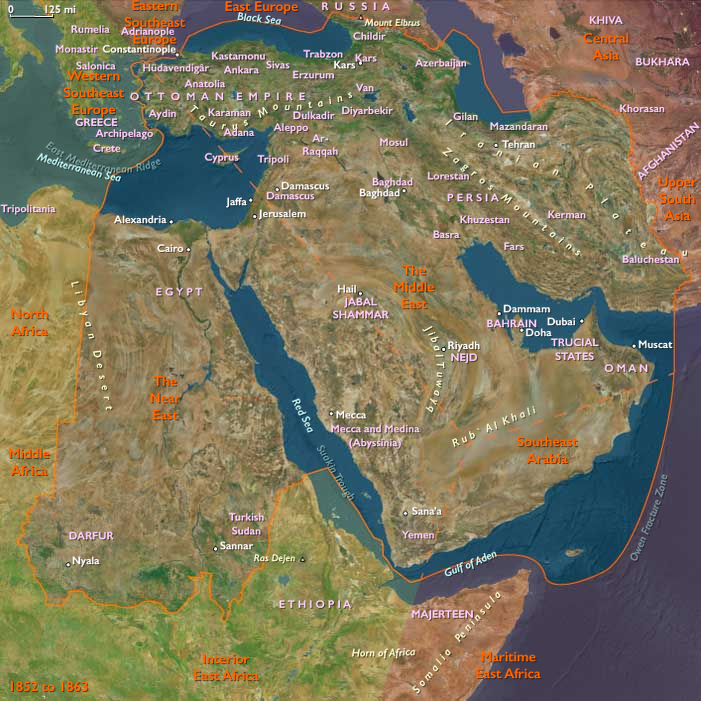
Egypt, as a pashalik of the Ottoman Empire, is divided into several provinces, each of which is placed under a Mamluk bey (governor) responsible to the pasha, who in turn answers to the Porte, the term used for the Ottoman government referring to the Sublime Porte, or high gate, of the grand vizier's building.
No fewer than one hundred pashas will succeed each other in approximately two hundred years years of Ottoman rule
Their authority become tenuous in the eighteenth century as rival Mamluk beys become the real power in the land.
The struggles among the beys continue until 1798 when the French invasion of Egypt alters the situation.
Combined British and Turkish military operations force the withdrawal of French forces in 1801, introducing a period of chaos in Egypt.
The Ottomans seek to restore order in 1805 by appointing Muhammad Ali as Egypt's pasha.
With the help of ten thousand Albanian troops provided by the Ottomans, Muhammad Ali purges Egypt of the Mamluks.
He launches a seven-year campaign in Arabia in 1811, supporting his suzerain, the Ottoman sultan, in the suppression of a revolt by the Wahhabi, an ultraconservative Muslim sect.
To replace the Albanian soldiers, Muhammad Ali plans to build an Egyptian army with enslaved Sudanese recruits.
Although a part of present-day northern Sudan is nominally an Egyptian dependency, the previous pashas had demanded little more from the kashif who rules here than the regular remittance of tribute; this changes under Muhammad Ali.
A party of the Mamluks, after he defeats them in Egypt, escapes and flees south.
These Mamluks establish a state at Dongola in 1811 as a base for their slave trading.
Locations
People
Groups
- Nubians
- Makuria, Kingdom of
- Christians, Monophysite
- Christianity, Chalcedonian
- Coptic Orthodox Church of Alexandria
- Alodia, or Alwa (Subah, or Soba), Kingdom of
- Islam
- Muslims, Sunni
- Albanians
- Fur people (Nilo-Saharan tribe)
- Funj people
- Ottoman Empire
- Sennar, Funj Sultanate of
- Egypt, Ottoman eyalet of
- Britain, Kingdom of Great
- Wahhabism
- French First Republic
- Britain (United Kingdom of Great Britain and Ireland)
- Egypt, (Ottoman) Viceroyalty of
Commodoties
Subjects
Regions
Subregions

Years: 1684 - 1827
Locations
People
Groups
- Nubians
- Makuria, Kingdom of
- Christians, Monophysite
- Christianity, Chalcedonian
- Coptic Orthodox Church of Alexandria
- Alodia, or Alwa (Subah, or Soba), Kingdom of
- Islam
- Muslims, Sunni
- Albanians
- Fur people (Nilo-Saharan tribe)
- Funj people
- Ottoman Empire
- Sennar, Funj Sultanate of
- Egypt, Ottoman eyalet of
- Britain, Kingdom of Great
- Wahhabism
- French First Republic
- Britain (United Kingdom of Great Britain and Ireland)
- Egypt, (Ottoman) Viceroyalty of
Commodoties
Subjects
Regions
Subregions