The inhabitants of the region of present …
Years: 45BCE - 99
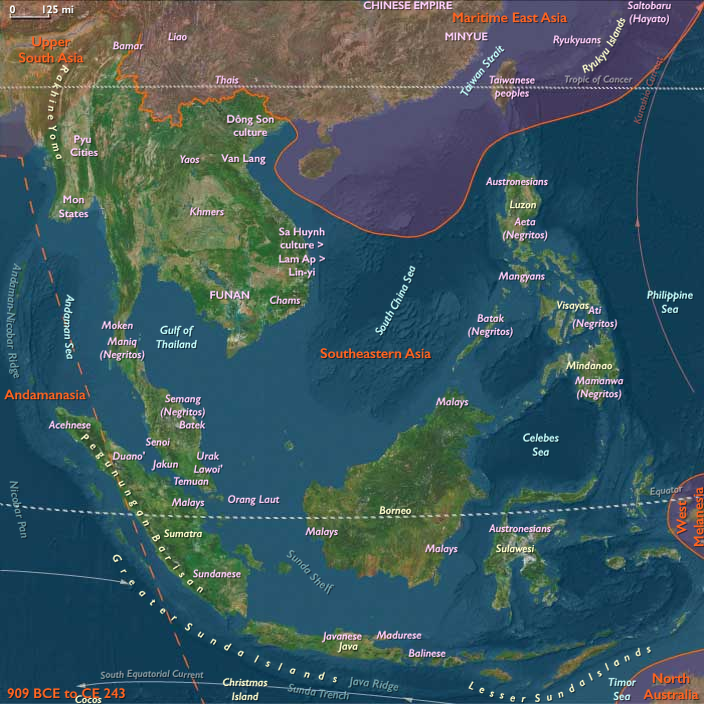
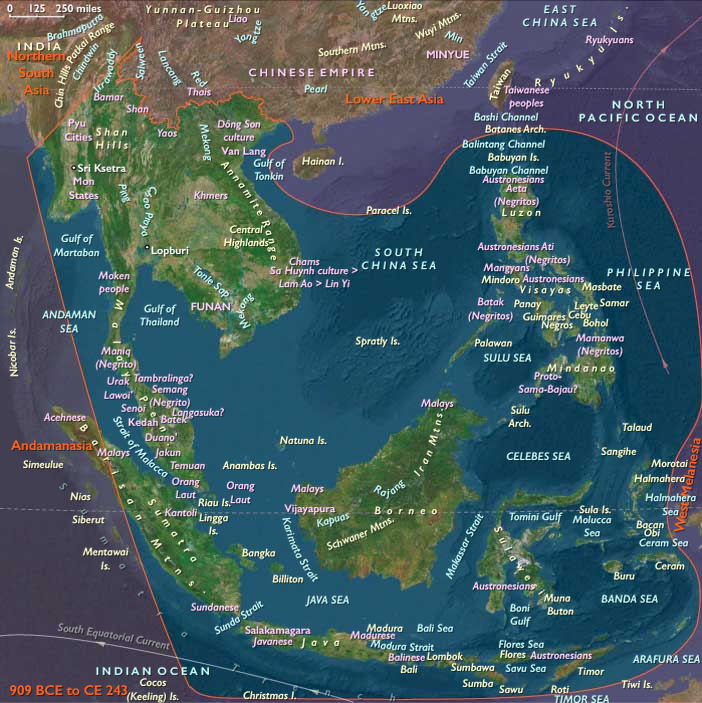
The inhabitants of the region of present Cambodia have by the first century CE developed relatively stable, organized societies that have far surpassed the primitive stage in culture and technical skills.
The most advanced groups live along the coast and in the lower Mekong River valley and delta regions where they cultivate rice and keep domesticated animals.
The Khmer, like the other early peoples of Southeast Asia such as the Pyu, Mon, Cham, Malay and Javanese, are influenced by Indian and Sri Lankan traders and scholars, adapting their religions, sciences, and customs and borrowing from their languages.
The Khmer also acquire the concept of the Shaivite Deva Raja (God-King) and the great temple as a symbolic holy mountain.
Locations
Groups
Topics
Commodoties
Subjects
Regions
Subregions
Related Events
Filter results
Showing 10 events out of 80 total
Atlantic West Europe (1108 – 1251 CE): The Angevin Empire, Champagne–Flanders Circuits, and Aquitaine under the English Crown
Geographic and Environmental Context
Atlantic West Europe spans northern France and the Low Countries.
-
Anchors: Paris–Seine–Reims, Upper Loire (Orléans–Blois–Tours), Anjou/Angers–Maine–Le Mans, Poitou/Poitiers–La Rochelle–Saintes, Bordeaux–Gironde–Bayonne, Flanders/Bruges–Ghent–Ypres, Low Countries delta.
Climate and Environmental Shifts
-
High-medieval peak supported population and urbanization; river improvements eased up-country grain and wine traffic.
Societies and Political Developments
-
Eleanor of Aquitaine married Louis VII (1137), annulled (1152), then married Henry II Plantagenet (1152)—creating the Angevin Empire (from Anjou/Normandy to Aquitaine).
-
Capetian–Angevin rivalry dominated: Philip II conquered Normandy (1204), but Aquitaine/Guyenne largely remained under English suzerainty; La Rochelle and Bordeaux became Angevin pillars.
-
Flanders and Champagne fairs integrated Mediterranean–northern circuits; communes of Bruges, Ghent, Ypres asserted charters.
-
Brittany navigated between Plantagenets and Capetians.
Economy and Trade
-
Bordeaux claret exports to England boomed; La Rochelle shipped salt and wine; Nantes handled salt fish and grain.
-
Flanders/Champagne fairs: Italian capital met northern cloth; Bruges emerged as a banking mart.
-
Upper Loire and Anjou–Touraine supplied wine/grain to Paris and ports.
Belief and Symbolism
-
Gothic beginnings in Chartres, Paris; pilgrimage roads of Poitou–Bordeaux remained crowded.
Long-Term Significance
By 1251, Aquitaine was England’s continental anchor; Flanders the cloth workshop; Paris–Loire the Capetian core—poised for 13th–14th-century contests.
The Western Schism (1378–1417): A Divided Papacy
The Western Schism was a major crisis in the Roman Catholic Church that lasted from 1378 to 1417, during which there were two, and later three, rival popes, each claiming legitimate authority. This deep division shattered Catholic unity, weakened papal authority, and destabilized European politics.
Origins of the Schism (1378)
- The crisis began in 1378 following the death of Pope Gregory XI, who had recently returned the papacy from Avignon to Rome after nearly 70 years of papal residency in France (1309–1377).
- Amid intense pressure from the Roman populace, the College of Cardinals elected Urban VI, an Italian, as pope.
- Many French cardinals, unhappy with Urban VI's temperament and reforms, declared his election invalid and elected Clement VII, who returned the papal court to Avignon.
- This resulted in two rival popes, each claiming to be the true successor of St. Peter.
The Rival Papacies and Their Alliances
- Rome (Pope Urban VI and successors) – Supported by England, the Holy Roman Empire, Portugal, and most of Italy.
- Avignon (Pope Clement VII and successors) – Supported by France, Scotland, Castile, and Aragon.
For nearly 40 years, Catholic Europe was divided, with each pope excommunicating the followers of the other and maintaining his own Sacred College of Cardinals and Curia.
The Three-Pope Crisis (1409–1417)
- In 1409, the Council of Pisa attempted to resolve the schism by deposing both rival popes and electing a new pope, Alexander V.
- However, instead of resolving the issue, this resulted in three competing popes, as the two deposed popes refused to step down.
- The crisis deepened, discrediting the moral and political authority of the papacy.
The Council of Constance and the End of the Schism (1417)
- The crisis was finally resolved at the Council of Constance (1414–1418).
- In 1417, all three competing popes were either deposed or resigned, and the council elected Martin V, restoring a single papacy in Rome.
- This ended the Western Schism, but the Church’s credibility suffered lasting damage, fueling anti-clerical sentiment and calls for reform that later contributed to the Protestant Reformation (1517).
Impact of the Western Schism
- Weakened Papal Authority – The schism shattered the idea of an unquestionable pope, reducing the Church’s influence over European monarchs.
- Rise of Conciliarism – The crisis strengthened the belief that Church councils, not just the pope, should have ultimate authority, a notion that clashed with papal supremacy.
- Political Consequences – The division deepened national rivalries, as popes became aligned with secular rulers, entangling the papacy in dynastic struggles.
The Western Schism was one of the most damaging crises in Church history, exposing the political nature of the papacy and laying the groundwork for future religious upheavals in Europe.
Atlantic West Europe (1372–1383): Renewed Conflict, Rising Burgundy, and Social Upheaval
Between 1372 and 1383, Atlantic West Europe—including the Low Countries, Brittany, Normandy, Burgundy, Aquitaine, central France, Alsace, and Franche-Comté—experienced renewed warfare, the rise of powerful regional states, social unrest, and evolving economic dynamics. The resumption of the Hundred Years’ War, the further consolidation of Burgundy under Philip the Bold, and intensifying urban and rural tensions significantly shaped this turbulent era.
Political and Military Developments
-
France and England: The War Resumes
- Hostilities in the Hundred Years' War resumed fully in 1372, reversing the temporary peace established by the Treaty of Brétigny. French naval victories, notably the Battle of La Rochelle (1372), marked a turning point, weakening English control in Aquitaine.
- Under Charles V (r. 1364–1380) and his talented constable, Bertrand du Guesclin, France gradually recaptured large territories previously ceded to England.
-
Aquitaine and Gascony: English Retreat and Regional Turmoil
- Aquitaine suffered increasing turmoil as the English lost significant ground. Revolts among regional nobility and towns undermined English rule, weakening the position of the Black Prince (Edward of Woodstock), who died in 1376, further destabilizing English governance.
-
Burgundy, Alsace, and Franche-Comté: Burgundian Consolidation
- Philip the Bold, Duke of Burgundy (r. 1363–1404), significantly expanded his territories and influence. Through marriage alliances and strategic diplomacy, Philip integrated the County of Burgundy (Franche-Comté) and reinforced his control over key regions, positioning Burgundy as a major European power.
- Alsace remained an influential buffer zone, managing local autonomy despite pressure from French, Imperial, and Burgundian interests.
-
Low Countries: Urban Revolts and Economic Rivalries
- Flanders faced severe social upheaval, notably the Revolt of Ghent (1379–1385), where urban populations rebelled against the Count of Flanders, Louis de Male, over oppressive taxation and governance issues. The conflict profoundly destabilized the region's economic and political landscape.
-
Brittany and Normandy: Continued Autonomy and Stability
- Brittany maintained relative autonomy under Duke John IV (Jean de Montfort, r. 1364–1399), carefully balancing neutrality with alliances to both France and England.
- Normandy continued its economic and administrative recovery under closer integration into French royal structures, despite occasional local tensions.
Economic and Social Developments
-
Economic Struggles and Social Unrest
- Heavy taxation due to renewed warfare led to widespread unrest across rural and urban areas, notably triggering peasant rebellions like the Harelle revolt in Rouen (1382), reflecting escalating social tensions.
- Trade disruptions severely impacted Flemish cities, exacerbating social grievances among urban populations, and fueling revolts against noble authority.
-
Urban-Rural Divide
- Increasing economic disparities between urban elites and rural populations intensified, manifesting in widespread discontent and periodic revolts across France, Burgundy, and the Low Countries.
Cultural and Intellectual Developments
-
Royal Patronage and Cultural Renewal
- Under Charles V, Paris emerged as a vibrant cultural and intellectual hub, attracting scholars, poets, and artists. This era saw an expansion of vernacular literature and historiography, exemplified by the chronicler Jean Froissart, whose writings documented the era’s significant events and courtly culture.
-
Artistic Flourishing
- The patronage of Burgundy’s Philip the Bold significantly advanced Gothic artistic developments, particularly evident in the Charterhouse of Champmol in Dijon, marking Burgundy’s emergence as a key European cultural center.
Religious Developments
- Popular Piety and Ecclesiastical Criticism
- Disillusionment with the Church’s wealth and corruption intensified, fueling growing movements advocating religious reform and personal spirituality, notably through the continued spread of mendicant orders (Dominicans, Franciscans) and lay confraternities.
- Clerical reform movements arose, questioning papal authority, particularly in response to the onset of the Western Schism (1378), dividing European loyalties between rival popes in Avignon and Rome.
Legacy and Significance
Between 1372 and 1383, Atlantic West Europe witnessed renewed warfare and significant shifts in regional power dynamics. France’s strategic gains against England, the rise of Burgundy under Philip the Bold, urban revolts in the Low Countries, and widespread social unrest defined the period. These developments deepened political divisions, reshaped regional alliances, and set the stage for future conflicts, laying critical groundwork for subsequent transformations in European political and cultural history.
Louis's attention again turns to Italy when the Western Schism breaks out in 1378.
Louis helps his protégé Charles of Durazzo conquer Naples and supplant its queen, Joan, who declares herself in favor of the antipope Clement VII.
His objective the domination of all of Dalmatia, Louis allies with Genoa against that city-state's longtime commercial rival, Venice, and mounts a military campaign to force the Venetians from the Dalmatian coast.
Holy Roman Emperor Charles IV dies in Prague on November 29, 1378, having procured the election of his own son Vaclav, or Wenceslas, to succeed him—the first imperial father-son succession since the Hohenstaufen period.
Vaclav/Wenceslas, although possessed of some ability, also has grave defects, particularly a weakness for alcohol.
The empire faces serious problems, such as the independence of the towns and the depredations of the petty nobility, but Wenceslas will become distracted by controversies provoked by his brothers Sigismund/Zsigmond of Luxembourg and John of Gorlitz and his cousin Jobst of Moravia, as well as by the papal schism that began earlier in this year.
The French cardinals return with their “antipope” to Avignon, thereby initiating the so-called Western Schism or Papal Schism (also known as the Great Schism of Western Christianity).
Clement's supporters include Queen Joan I of Naples and forty-seven-year-old Spanish churchman Pedro de Luna, who had been appointed cardinal in 1375 by Pope Gregory XI and had participated in the controversial conclave that had elected Gregory's successor.
Western, or Roman, Catholics have continuously debated the convoking and authority of councils.
Although all the bishops and theologians agree that the pope should have special prerogatives, reformers, who have for centuries claimed that protesters can appeal their grievances from the pope to a council, have formulated a theory of conciliarism: the idea that a council is ultimately above the pope.
The Western Schism in 1378 brings this debate to a head, since there are now two (and will later be three) popes.
Bartolomeo Prignano, born in Itri, is a devout monk and learned casuist, trained at Avignon.
On March 21, 1364 he had been consecrated Archbishop of Acerenza in the Kingdom of Naples.
He had become Archbishop of Bari in 1377.
Prignano had developed a reputation for simplicity and frugality and a head for business when acting Vice-Chancellor for resolute Pope Gregory XI, who, having endeavored to pacify the papal states and to make possible the return to Rome after seventy years at Avignon, dies here on March 27, 1378.
A Roman mob surrounds the papal conclave to demand a Roman pope.
The cardinals being under some haste and great pressure to avoid the return of the Papal seat to Avignon, the able Prignano is unanimously chosen Pope on April 8, 1378 as acceptable to the disunited majority of French cardinals, taking the name Urban VI.
Not being a Cardinal, he is not well known.
Immediately following the conclave, most of the cardinals flee Rome before the mob can learn that not a Roman (though not a Frenchman either), but a subject of Queen Joan I of Naples, has been chosen.
Though the coronation has been carried out in scrupulous detail, leaving no doubt as to the legitimacy of the new pontiff, the French are not particularly happy with this move and begin immediately to conspire against this Pope.
Urban VI does himself no favors; whereas the cardinals had expected him pliant, he is considered arrogant and angry by many of his contemporaries.
Dietrich of Nieheim reports the opinion of the cardinals that his elevation had turned his head, and Froissart, Leonardo Aretino, Tommaso de Acerno nd St. Antoninus of Florence record similar conclusions.
Immediately following his election, the new pontiff—who had not been a cardinal, but had served in the Curia—begins preaching intemperately to the cardinals (some of whom think the delirium of power has made Urban mad and unfit for rule), insisting that the business of the Curia should be carried on without gratuities and gifts, forbidding the cardinals to accept annuities from rulers and other lay persons, condemning the luxury of their lives and retinues, and the multiplication of benefices and bishoprics in their hands.
Nor will he remove again to Avignon, thus alienating King Charles V of France.
He behaves in such a high-handed manner that he alienates the cardinals, and questions are raised about his sanity.
Urban disdains the advice of others, can be ruthless if opposed or questioned, and is committed to reform through an extreme reduction of the powers of the cardinals, who for decades have been almost corulers with the popes in Avignon.
The majority of cardinals, led by the powerful Frenchmen, gradually withdraw from the papal court.

The French cardinals, mortally offended by the new pontiff’s behavior, meet at Anagni five months after Urban’s election and invite Urban, who realizes that he will be seized and perhaps slain.
In his absence they issue a manifesto of grievances on August 9 that declares his election invalid because, they allege, under pressure and fear for their lives, they had been cowed by the mob into electing an Italian.
Letters to the missing Italian cardinals follow on August 20 declaring the papal throne vacant (sede vacante).
Then at Fondi, secretly supported by the king of France, the French cardinals proceed to elect Robert of Geneva as Pope on September 20.
Robert, a militant cleric who had succeeded Albornoz as commander of the papal troops, takes the name Clement VII, beginning the Western Schism, which will divide Catholic Christendom until 1417.
Urban is declared excommunicated by the French antipope and is called "the Antichrist", while Catherine of Siena, defending Pope Urban, calls the cardinals "devils in human form."
Coluccio Salutati identifies the political nature of the withdrawal: "Who does not see," the Chancellor openly addresses the French cardinals, "that you seek not the true pope, but opt solely for a Gallic pontiff."
John Wycliffe (or Jean Wyclif) teaches at Oxford University, where he has gained renown as a brilliant scholastic theologian and the most respected debater of his age.
Wycliffe had entered royal service in 1374, when, at fifty-six, he had been sent to Bruges to negotiate with papal representatives on the issue of tribute payments to Rome.
He had shortly become an important figure in the anticlerical party of John of Gaunt, attacking the rights claimed by the church and calling for a reformation of its wealth, corruption, and abuses.
Wycliffe views the king as the legitimate authority for church purification.
His views become more radicalized after the Great Papal Schism begins in 1378.
His De potestate papae ("On Papal Power"), published in this year, rejects the biblical basis of papal authority, insists on the primacy of Scripture, and advocates extensive theological reform.
His denial of transubstantiation and advocacy of a vernacular Bible bring him into further conflict with the church and cost him support.
The church in 1382 will condemn ten conclusions drawn from his writings, and his Oxford disciples will be forced to recant; but Wycliffe himself will be neither tried nor personally condemned.