
The increased influence of the Turkish notables …
Years: 1444 - 1444
June
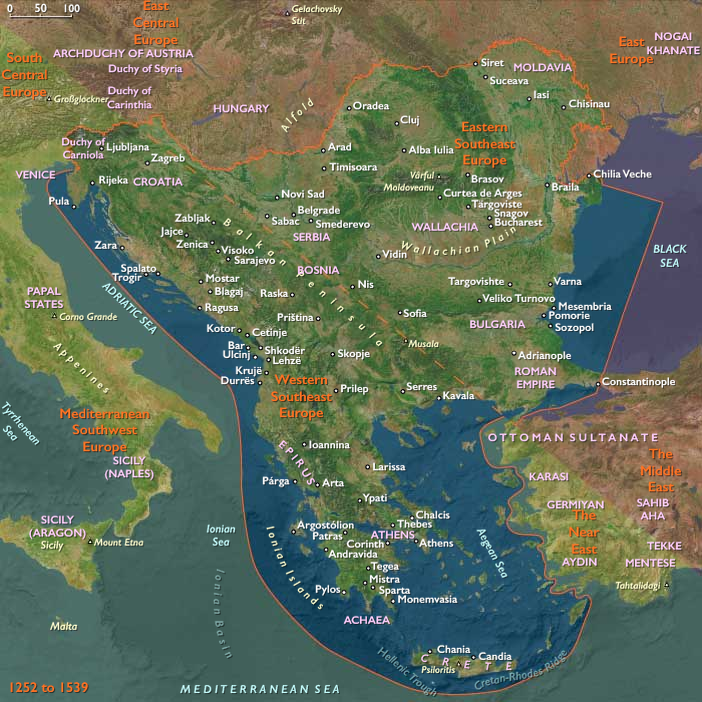
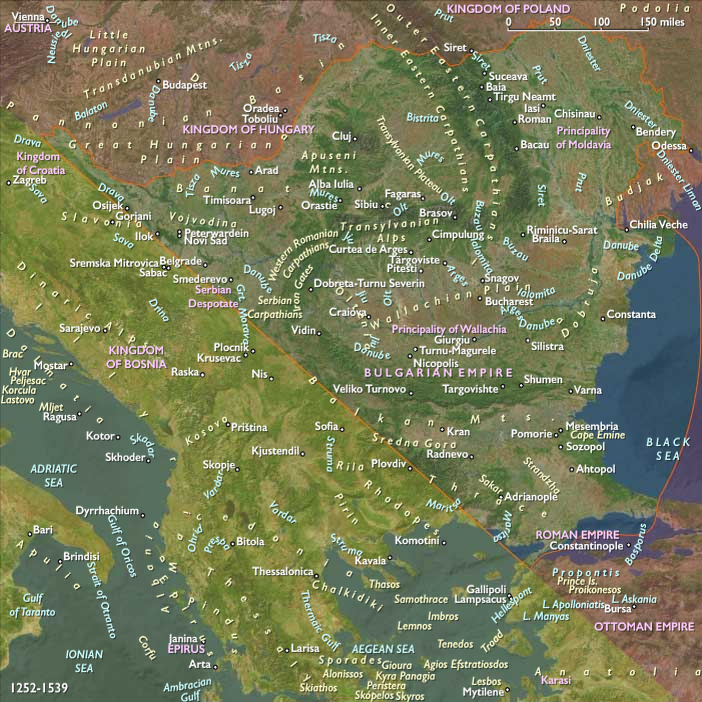
The increased influence of the Turkish notables at Murad's court lead the sultan to agree to the Peace of Edirne, by which Serbia is to regain its autonomy, Hungary is to keep Wallachia and Belgrade, and the Ottomans are to promise to end their raids north of the Danube.
Early negotiations result in the release of Mahmud Bey, who arrives in Edirne around early June 1444.
Wladyslaw's ambassador Stojka Gisdanić arrives soon after, along with, as required by a law signed by King Albert, the brilliant general John Hunyadi's representative Vitislav, and two representatives for Branković.
At the behest of Pope Eugene IV, the antiquarian Ciriaco Pizzicolli is also present to monitor the progress of crusade plans.
During the negotiations, the most contentious point is the possession of Danubian fortresses, especially Golubac and Smederevo, which the Ottomans wish to retain.
However, on June 12, 1444, after three days of discussion, the treaty is hastily completed because Ibrahim of Karaman has invaded Murad's lands in Anatolia.
The final terms state that Murad is to return twenty-four Serbian cities, including the large fortresses of Golubac and Smederevo, to the exiled Branković.
Murad is also obliged release Branković's two blinded sons, Grgur and Stefan.
The restored Serbian Despotate is vassalaged to the Ottomans, however, so has to pay taxes and offer military aid.
A ten-year truce is established with Hungary, and Vlad Dracul, Voivode of Wallachia, is no longer obliged to attend Murad's court, although he is still required to pay tribute.
Once Murad has sworn an oath to observe the treaty, it is sent to Hungary with Baltaoğlu Süleyman and a Greek, Vranas, for ratification by Wladyslaw, Hunyadi, and Branković.
Locations
People
- Ciriaco de' Pizzicolli
- Ibrahim II
- John Hunyadi
- Mehmed II
- Murad II
- Pope Eugene IV
- Vlad II Dracul
- Wladyslaw III
- Çandarli Halil Pasha
- Đurađ Branković
Groups
- Islam
- Christians, Roman Catholic
- Christians, Eastern Orthodox
- Hungary, Kingdom of
- Karamanids
- Rumelia Eyalet
- Poland of the Jagiellonians, Kingdom of
- Macedonia, Ottoman Vardar
- Wallachia, Principality of
- Ottoman Empire
- Serbian Despotate
Topics
- Turkoman-Ottoman Wars of 1400-73
- Ottoman-Hungarian War of 1441-44
- Varna, Crusade of
- Ottoman-Hungarian War of 1444-56
- Varna, Battle of
Commodoties
Subjects
Regions
Subregions
Related Events
Showing 7 events out of 7 total
Years: 1444 - 1444
June
Locations
People
- Ciriaco de' Pizzicolli
- Ibrahim II
- John Hunyadi
- Mehmed II
- Murad II
- Pope Eugene IV
- Vlad II Dracul
- Wladyslaw III
- Çandarli Halil Pasha
- Đurađ Branković
Groups
- Islam
- Christians, Roman Catholic
- Christians, Eastern Orthodox
- Hungary, Kingdom of
- Karamanids
- Rumelia Eyalet
- Poland of the Jagiellonians, Kingdom of
- Macedonia, Ottoman Vardar
- Wallachia, Principality of
- Ottoman Empire
- Serbian Despotate
Topics
- Turkoman-Ottoman Wars of 1400-73
- Ottoman-Hungarian War of 1441-44
- Varna, Crusade of
- Ottoman-Hungarian War of 1444-56
- Varna, Battle of
Commodoties
Subjects
Regions
Subregions