
The imperial Greek forces crush the recently …
Years: 1262 - 1262
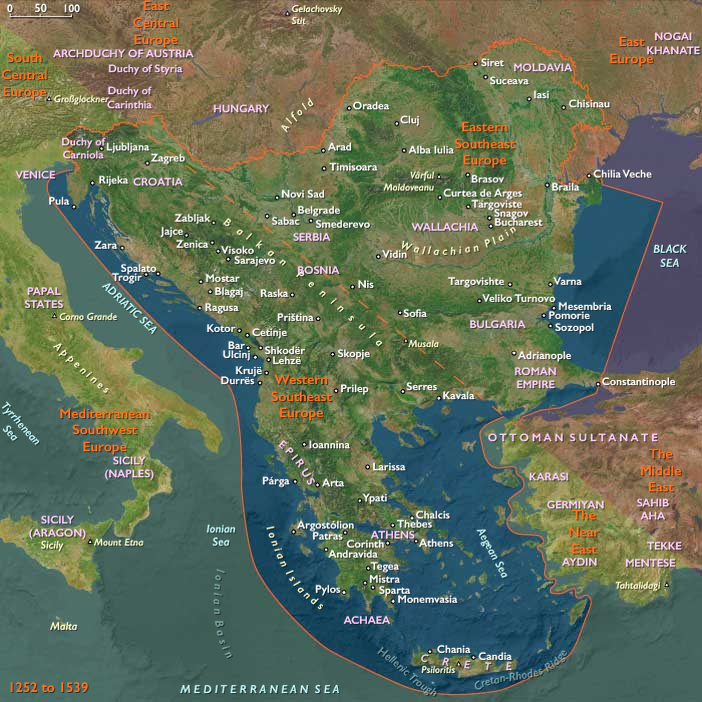
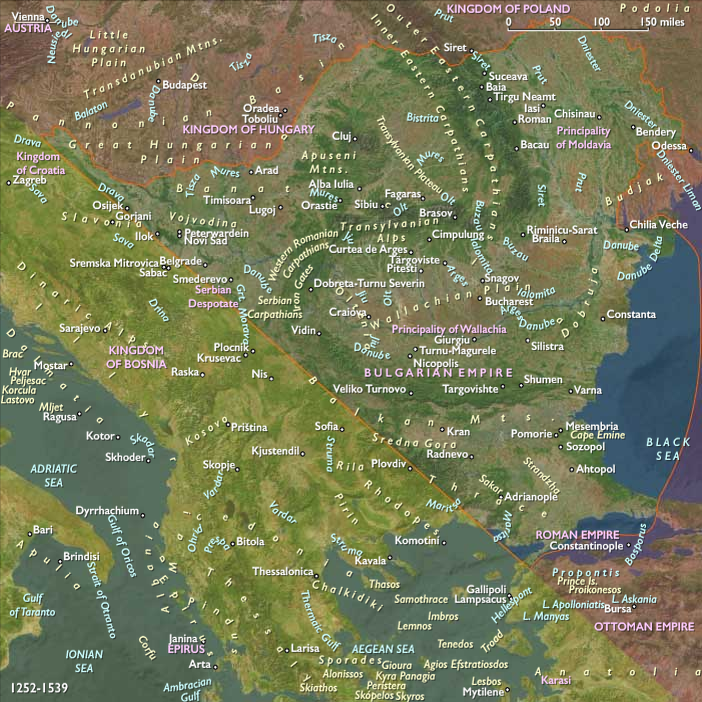
The imperial Greek forces crush the recently rejuvenated Bulgarian state by 1262.
Locations
People
Groups
- Greeks, Medieval (Byzantines)
- Bulgarians (South Slavs)
- Bulgarian Empire (Second), or Empire of Vlachs and Bulgars
- Roman Empire, Eastern: Palaiologan dynasty
Topics
Commodoties
Subjects
Regions
Subregions
Related Events
Filter results
Showing 10 events out of 45968 total
Mangrai, born in Chiang Saen as son of the local ruler Lao Meng and Princess Ua Ming Chommuong, from the ruling family of the Thai Lue of Chiang Rung, Yunnan, had in 1259 succeeded his father and become the first independent Lao King of unified Lao city states in what is today northern Thailand and northern Laos.
The kingdom, Lanna, or Lannathai, grows quickly by unifying local Tai rulers of the area under his leadership.
Mangrai founds Chiang Rai in 1262 as the first capital of the kingdom; it will ultimately lose this status, however, to a new city built by Mangrai at Chiang Mai.
Subsequently, Chiang Rai will be conquered by the Burmese and remain under their rule for several hundred years.
Hariphunchai, a Mon kingdom in the north of present Thailand in the centuries before the Thais moved into the area, has its capital at Lamphun, which at this time is also called Hariphunchai.
The chronicles say that the Khmer unsuccessfully besieged Hariphunchai several times during the eleventh century.
It is not clear if the chronicles describe actual or legendary events, but the other Dvaravati Mon kingdoms did in fact fall to the Khmers at this time.
The early thirteenth century has been a golden time for Hariphunchai, as the chronicles speak only of religious activities or constructing buildings, not about wars.
Jayavarman VII had been the last of the great kings of Angkor, the largest pre-industrial urban center in the world, not only because of the successful war against the Cham, but also because he did not rule with the tyranny of his immediate predecessors, because he unified the Khmer empire, and above all because of the building projects carried out under his rule, including the new capital now called Angkor Thom (literally: "Great City").
The empire's official religions included Hinduism and Mahayana Buddhism, until Theravada Buddhism prevailed after its introduction from Sri Lanka in the thirteenth century.
The history of the Khmer kingdom, or Kambuja, after Jayavarman VII is very unclear.
The Khmer had withdrawn in the year 1220 from many of the provinces previously conquered from Champa.
Before the death of Indravarman II, one of Jayavarman’s successors, in 1243, his Thai subjects in the West had rebelled, establishing the first Thai kingdom at Sukhothai and pushing back the Khmer.
In the following two hundred years, the Thais will become the chief rivals of Kambuja.
During the dark thirteenth century also, most of the Buddha statues in the empire (archaeologists estimate the number at over ten thousand of which few traces remain) will be destroyed and Buddhist temples converted to Hindu temples.
The empire's legacy will greatly influence the cultures not only of its successor Cambodia but the cultures of Thailand and Laos as well.
The Great Khan claimant Ariq Böke had in 1260 appointed Chagatai Khan's son Alghu, and by the following year Alghu had assumed control over much of the Khanate.
When Alghu revolts against Ariq Böke in 1262, Organa supports him.
In attempting to intervene in the affairs of the White Horde, the Mongol khanate north of the Aral Sea, Ariq Böke evokes a military response from Hulagu, the Il-Khan ruler of Persia.
Nogai has converted to Islam, as has his great-uncle, Berke Khan, but it is not known exactly when his conversion occurred, probably soon after Berke converted, in the 1250s.
His name is included on the list of new converts sent by Berke to the Mamluk Sultan al-Malik az-Zahir in 1262/1263.
(Almost a decade later, in 1270/1271, Nogai himself will claim that he embraced Islam in a letter to the Sultan of Egypt.)
Hulagu’s forces march north to surprise and defeat Nogai's army, only to lose when ice on the Terek River collapses during a crossing attempt, drowning many thousands of Hulagu’s troops and forcing the survivors to withdraw into Azerbaijan.
Reinforcements arrive from the Rhineland in January 1262 , led by Wilhelm VII, Duke of Jülich, who had been obliged by Pope Alexander IV to fulfill his crusader duties in Prussia.
This army lifts the Siege of Königsberg but as soon as the army returns home, the Sambians resume the siege and are reinforced by Herkus Monte and his Natangians.
Herkus is subsequently injured and the Natangians retreat, leaving the Sambians unable to prevent supplies from reaching the castle and the siege eventually fails.
The Prussians are more successful in capturing castles deeper into the Prussian territory (with an exception of Wehlau, now Znamensk), and the Knights are left only with strongholds in Balga, Elbing, Chełmno, Toruń, and Königsberg.
The Prussians also receive help from Lithuanians and Sudovians.
Treniota leads an army to Cēsis in the summer of 1262 and battles Mazovia, killing Duke Siemowit I, and raiding Chelmno Land, provoking Pogesanians to join the uprising.
Teniota hopes to encourage all the conquered Baltic tribes to rise up against the Christian orders and unite under Lithuanian leadership.
David VI had given shelter in 1261, to David VII Ulu, who in his turn had attempted to end the Mongol dominance.
However, David Ulu makes peace with the Mongols and returns to Tbilisi in 1262.
Thus, Georgia splist into two parts.
However, both rulers continued to be titled king of Georgia.
Möngke and Batu's official, Arghun, harshly punish the Georgian and Armenian nobles, plundering their cities and executing their prominent leaders.
He divides the Georgians into six tumens.
However, David Narin surrenders to Hulegu, thus becoming a nominal vassal of the Ilkhans in 1262.
The Kingdom of Ormus, located within the Persian Gulf and extending as far as the Strait of Hormuz, had been established by Arab princes in the tenth century who in 1262 come under the suzerainty of Il-Khanid Persia.
The kingdom receives its name from the fortified port city which serves as its capital, one of the most important ports in the Middle East as it controls sea lanes through the Persian Gulf to India and East Africa.
This port is probably located on the island of Hormoz, which is located near the modern city of Bandar-e Abbas.
The city-state of Ormus controls the slave market from Africa and Arabia to Khorasan in Persia.
The Greek rulers of Epirus and Thessaly, like the emperors in Trebizond, refuse to recognize Michael VIII as emperor.
Trebizond continues as a separate state after the Nicaean Greeks recover control of Constantinople.
The empire’s eponymous capital, which has formed the basis of several states, has throughout history been an important meeting point for international trade and cultural exchange due to its strategic location which controls the east-west (Asia-Europe) and north-south (Russia-Middle East) trading routes.
It becomes a major commercial center, and is today the capital of Turkey’s Trabzon Province.
Years: 1262 - 1262
Locations
People
Groups
- Greeks, Medieval (Byzantines)
- Bulgarians (South Slavs)
- Bulgarian Empire (Second), or Empire of Vlachs and Bulgars
- Roman Empire, Eastern: Palaiologan dynasty
