
…the imperial forces are unable to dislodge …
Years: 885 - 885
…the imperial forces are unable to dislodge the Saracens from Sicily.
The fourteen-year war between the Empire and the Calphate ends, and …
Locations
People
Groups
- Arab people
- Lombards (West Germanic tribe)
- Christianity, Chalcedonian
- Greeks, Medieval (Byzantines)
- Benevento, Lombard Duchy of
- Muslims, Sunni
- Sicily (theme)
- Saracens
- Sicily, Emirate of
- Abbasid Caliphate (Samarra)
- Roman Empire, Eastern: Macedonian dynasty
Topics
Commodoties
Subjects
Regions
Subregions
Related Events
Filter results
Showing 10 events out of 53765 total
Arnulf does not make peace with Svatopluk until late 885, by which time the Moravian is a man of the emperor.
Some scholars see this war as destroying Arnulf's hopes at succeeding Charles.
Methodius, who seems to have been in Svatopluk's train at Kaumberg, dies in 885.
In his last days he had indicated Gorazd, one of his Moravian disciples, as most worthy to succeed him.
Gorazd, however, does not or cannot immediately submit his candidature for ratification of the Holy See, because Bishop Witching of Nitra soon hurries to Rome.
He persuades Pope Stephen V that Methodius had ignored Pope John VIII's orders in the matter of Slavonic liturgy, thus upon his initiative the pope prohibits the Slavonic liturgy in Moravia.
The pope also sends a letter (Quia te zelo) to Svatopluk, urging him to accept the addition of filioque to the Creed and to give up such peculiar Greek practices as fasting on Saturday.
Witching having arrived back from Rome, Svatopluk summons Gorazd, Clement and Methodius's other disciples to submit to the papal directions.
When they refuses to do so, Svatopluk gives Witching a free hand to take action against them.
Some of them are first thrown into prison, and soon expelled from Moravia, while others, among them Naum, are sold as slaves.
The expulsion of Methodius's disciples from Moravia signals the end of the Slavonic liturgy in Central Europe.
The exiles, however, subsequently find refuge in the Bulgarian Empire where they are able to carry on their work.
Pratihara monarch Bhoja dies in 885 after a successful fifty-four-year reign, during which he has restored the Gurjara empire to the borders ruled by his grandfather.
His son Mahendrapala succeeds him.
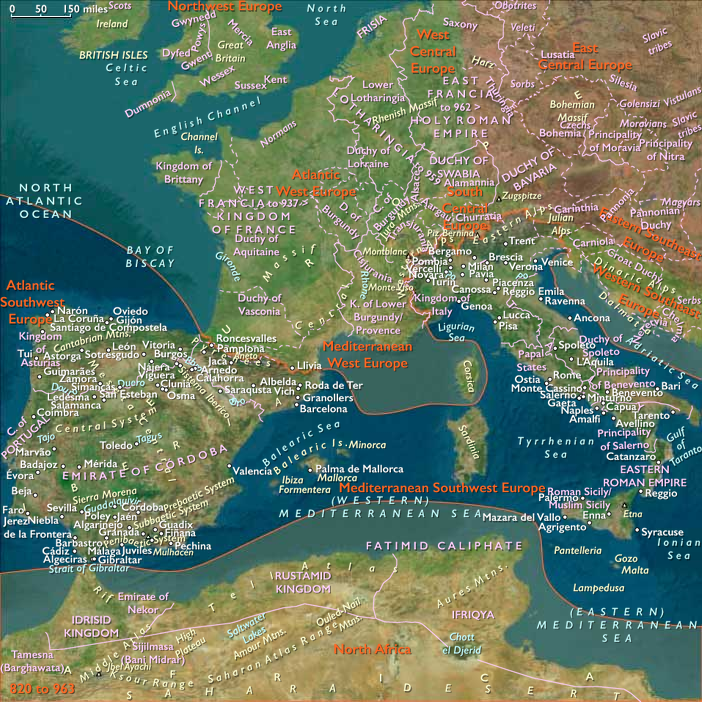
Constantinople’s conquest of Calabria in 885 succeeds in driving the Saracens from southern Italy, which is organized into the provinces of Calabria and Langobardia, but …
…Taranto is made a refuge for Christians driven from Sicily by the Muslims.
Ibn Hafsun was born around 850 in the mountains near Parauta, in what is now Málaga province.
A wild youth, he had a very violent temper and was involved in a number of disputes, even a homicide around the year 879.
He had joined a group of brigands and was captured by the wali (governor) of Málaga, who had merely imposed a fine (having not been informed of the homicide).
The governor had subsequently lost his post.
Ibn Hafsun had fled, possibly to the Maghreb, but had soon returned to Andalusia, albeit as an outlaw, and joined the bandits who are in rebellion against the caliphate, wherein he had soon risen to a leadership position.
Originally he had settled in the ruins of the old Bobastro castle, rebuilding it and fortifying the nearby town of Ardales, Malaga.
He has allied disaffected muwallads and mozárabs to the cause, playing off resentment at the unfair, heavy taxation and humiliating treatment they have received at the hands of Abd ar-Rahman and his successors.
He has acquired castles and lands in a wide area, not only in Malaga, but including portions of the provinces of Cádiz, Granada known then as Elvira, Jaén, and Seville.
By 883, he had become the leader of the rebels in the provinces to the south and west of the Emirate of Cordoba.
The year before, in 882, he is said to have fought the Emir in a battle in which ally García Íñiguez of Pamplona was killed.
About 885, in order to be more centrally located and quicker to respond to external threats, ibn Hafsun moves his headquarters to the town of Poley, which is now known as Aguilar de la Frontera.
The Fall of Godfrid and Hugh of Alsace: The Conference at Spijk (885)
By 885, Emperor Charles the Fat finds himself increasingly threatened by Viking incursions and the ambitions of his own nobles. Among those he fears most are:
- Godfrid, the Viking ruler of Frisia, who had previously sworn allegiance to Charles but remained a dangerous and unpredictable figure.
- Hugh, Duke of Alsace, Lothair II’s illegitimate son, who posed a potential rival for power in Lotharingia.
To neutralize both threats, Charles arranges a conference at Spijk, near Lobith (modern-day Netherlands), where he lures Godfrid into a trap.
The Conference at Spijk (885) and the Fall of Godfrid
- Charles summons Godfrid under the pretense of negotiations, likely promising him new lands or recognition of his rule in Frisia.
- When Godfrid arrives at Spijk, he falls into the emperor’s ambush.
- The Viking leader is captured and executed, eliminating one of the most formidable Norse warlords in the region.
The Fate of Hugh of Alsace
- Hugh, who had allied himself with Godfrid, is also betrayed and captured at Spijk.
- As punishment, he is blinded and sent to the monastery of Prüm, removing him as a political threat in Lotharingia.
Impact of the 885 Betrayal
- Charles the Fat temporarily secures Frisia, weakening Viking influence in the region.
- The blinding of Hugh removes a powerful Carolingian rival, consolidating Charles’ control over Lotharingia.
- However, Charles’ tactics of deception and treachery further alienate the Frankish nobility, many of whom are already disillusioned with his rule.
- The Viking threat is not eradicated—even as Godfrid is killed, other Norse warbands continue their raids into Francia, culminating in the Siege of Paris later that year.
A Short-Lived Victory
Though Charles successfully eliminates two dangerous rivals, his failure to strengthen his empire means that his rule remains fragile. His passive handling of Viking invasions, particularly the Siege of Paris (885–886), will soon lead to his deposition in 887, marking the final collapse of a united Carolingian Empire.
The Viking Siege of Paris (885–886): Charles the Fat’s Failure and the Rise of Odo
By 885, West Francia remains under severe Viking pressure, particularly in the Seine Valley, where Norse fleets continue to raid inland settlements. That year, a massive Viking fleet, led by Sigfred, sails up the Seine River and lays siege to Paris, marking one of the most significant and prolonged Viking attacks on the city.
The Viking Siege Begins (885)
- Sigfred’s fleet, composed of hundreds of ships and thousands of warriors, arrives at Paris, a strategically vital city on the Seine.
- This is the first major Viking attack on Paris in years, and the Norse leader demands tribute in exchange for sparing the city.
- However, unlike previous rulers, Charles the Fat refuses to pay a bribe, likely attempting to avoid further incentivizing Viking raids.
Odo of Paris and the Call for Reinforcements
- At the time of the Viking invasion, Charles the Fat is in Italy, leaving West Francia without centralized leadership.
- Odo, Count of Paris, and Bishop Gozlin organize the city’s defense, refusing to surrender to the Norsemen.
- Odo secretly sneaks a group of men through Viking lines to request military assistance from Charles.
- In response, Charles dispatches Henry of Saxony to relieve the siege.
The Siege Intensifies
- The Vikings launch multiple assaults against the fortified bridges of Paris, but the defenders hold strong, repelling attack after attack.
- The siege will last over a year, becoming one of the greatest tests of Frankish resilience against the Vikings.
Significance of the Siege of Paris
- Odo emerges as a heroic leader, rallying the defenders and proving his military competence, which will later lead to his election as King of West Francia (888).
- The Carolingian monarchy’s inability to protect its key cities further erodes Charles the Fat’s authority, contributing to his downfall in 887.
- The siege becomes legendary, symbolizing the determination of the Franks against Viking aggression and the gradual shift of power from the Carolingians to local lords.
The Siege of Paris (885–886) marks a turning point in Viking-Frankish relations, highlighting both the growing autonomy of regional rulers like Odo and the declining influence of the Carolingian emperors in the face of repeated Viking invasions.
Charles, childless by his marriage to Richgard, tries to have his illegitimate son by an unknown concubine, Bernard, recognized as his heir in 885, but meets the opposition of several bishops.
He has the support of Pope Adrian III, whom he invites to an assembly in Worms in October 885, but who dies on the way, just after crossing the river Po.
Adrian was going to depose the obstructing bishops, as Charles doubted he could do this himself, and legitimize Bernard.
Based on the unfavoring attitude of the chronicler of the Mainz continuation of the Annales Fuldenses, the chief of Charles's opponents in the matter was probably Liutbert, Archbishop of Mainz.
Because Charles had called together the "bishops and counts of Gaul" as well as the pope to meet him at Worms, it seems likely that he planned to make Bernard King of Lotharingia.
Alfred, successfully resisting an attempted Danish invasion of Kent in 885, defeats the Danes at Harwich, situated on the estuary produced by the Rivers Orwell and Stour in Essex.
Years: 885 - 885
Locations
People
Groups
- Arab people
- Lombards (West Germanic tribe)
- Christianity, Chalcedonian
- Greeks, Medieval (Byzantines)
- Benevento, Lombard Duchy of
- Muslims, Sunni
- Sicily (theme)
- Saracens
- Sicily, Emirate of
- Abbasid Caliphate (Samarra)
- Roman Empire, Eastern: Macedonian dynasty
