The imperial army takes possession of three …
Years: 962 - 962
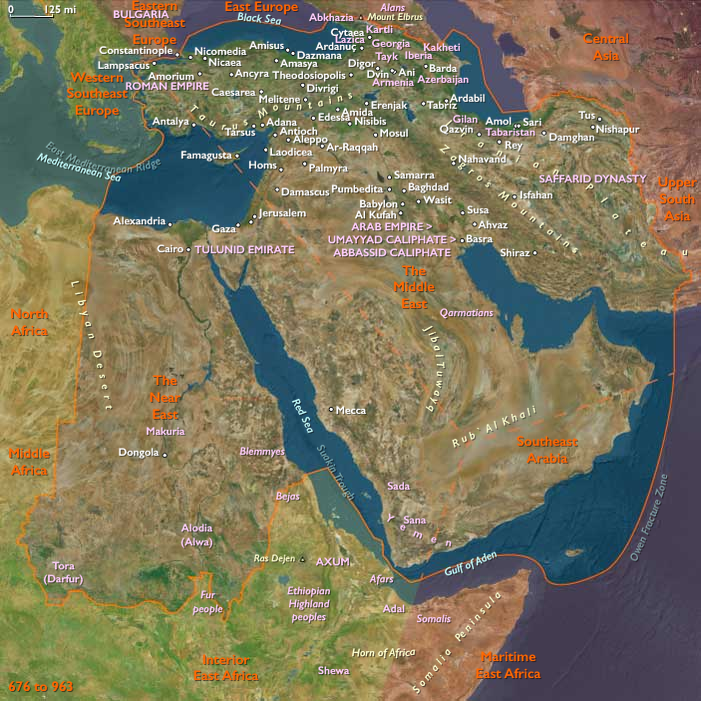
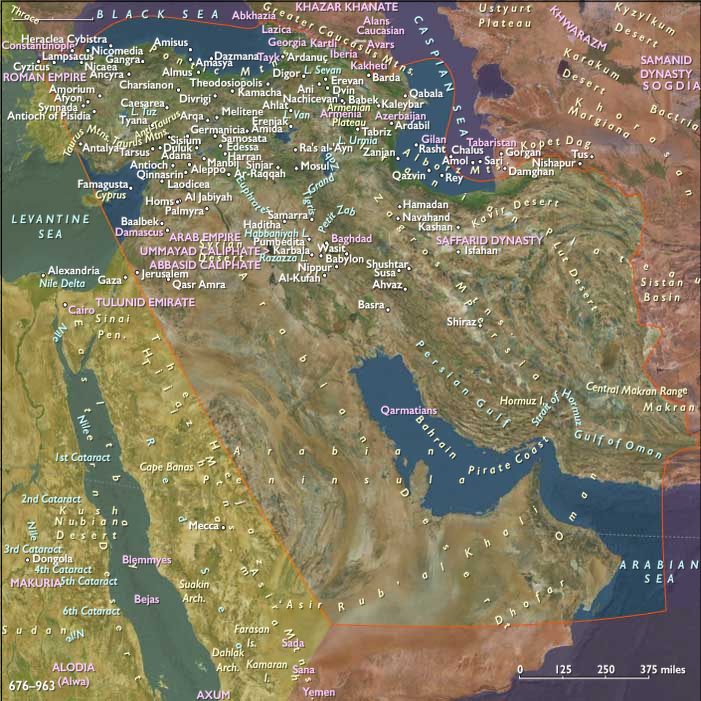
The imperial army takes possession of three hundred and ninety thousand silver dinars, two thousand camels, and fourteen hundred mules during the capture of Aleppo in December 962,
Nikephoros’s aim has not been to conquer the emirate, but to terminate its role as a regional power—the city of Aleppo is thoroughly sacked and its forces destroyed, but its territories are not annexed.
Locations
People
Groups
- Arab people
- Christianity, Chalcedonian
- Islam
- Roman Empire, Eastern: Macedonian dynasty
- Hamdanid Dynasty
- Aleppo, Hamdanid Emirate of
Topics
Commodoties
Subjects
Regions
Subregions
Related Events
Filter results
Showing 10 events out of 52812 total
Nikephoros, upon returning to Constantinople from his successful expedition against the Emirate of Crete, had been denied the usual honor of a triumph, permitted only a mere ovation in the Hippodrome.
He soon returns to the east with a large and well-equipped army, attacking the Arabs of Cilicia and Syria at the beginning of 962, capturing more than sixty fortresses.
Two military families—the Simjurids and Ghaznavids—have arisen from the Turkic slave-guards of the Samanids; they will ultimately prove disastrous to the Samanids.
The Simjurids had received an appanage in the Kohistan region of eastern Khorasan (northern Afghanistan).
Samanid generals Alp Tigin and Abu al-Hasan Simjuri had competed for the governorship of Khorasan and control of the Samanid empire by placing on the throne emirs they could dominate after the death of 'Abd al-Malik I in 961 CE, creating a succession crisis between 'Abd al-Malik I's brothers.
Abu had al-Hasan died in 961, but a new rival, Fa'iq, arose, and eventually Mansur I had been elected by the court ministers.
Alp Tigin, having backed the wrong candidate, had prudently retired from Khorasan to Ghazni, where he has dispossessed a local ruling family, thus starting the Ghaznavid dynasty in 962 CE.
Coins of the era, however show that he still nominally acknowledges the Samanid authority.
Otto’s 955 victory over the Magyars has brought the Slavs of Bohemia and Moravia and those of the Elbe and Oder basin into the sphere of empire, which the Germans declare themselves to be after swallowing the Kingdom of Italy—Pope, Papal States and all—in 961.
Otto now hopes to extend his influence east into Poland and Kievan Russia.
The forces of John XII had been defeated in the war against Pandolfo Testa di Ferro of Capua, and at the same time many strongholds in the Papal States are occupied by Berengar of Ivrea, effectively if not completely legally King of Italy, and his son Adalbert.
In this dilemma, the pope has recourse to Otto, who reappears in Italy at the head of a powerful army, as he had in the previous decade, now ostensibly as a papal champion.
Berengar, however, does not risk an encounter, but retired to his fortified castles.
Thus, without conclusive military encounters, on January 31, 962, Otto reaches Rome.
He takes an oath to recognize John as pope and ruler of Rome; to issue no decrees without the pope's consent; and, in case he should deliver the command in Italy to any one else, to exact from such person an oath to defend to the utmost of his ability the pope and the Patrimony of Peter.
The pope for his part swears to keep faith with Otto and to conclude no alliance with Berengar and Adalbert.
Consequently, Otto is solemnly crowned Holy Roman Emperor by the pope on February 2.
At a Roman synod ten days later, John, at Otto's desire, founds the Archbishopric of Magdeburg and the Bishopric of Merseburg, bestows the pallium on the Archbishop of Salzburg and Archbishop of Trier, and confirms the appointment of Rother as Bishop of Verona.
The next day, the emperor issues a decree, the famous Diploma Ottonianum, in which he confirms the Roman Church in its possessions, particularly those granted by the Donation of Pepin and by Charlemagne, and provides at the same time that in future the popes should be elected in canonical form, though their consecration is to take place only after the necessary pledges had been given to the emperor or his ambassadors.
In essence, the Emperor is to be the guarantor of papal independence, but to retain the right to confirm papal elections.
Historians debate, in terms of power and prestige, whether the Diploma Ottonianum was a prestigious advantage for the papacy or a political triumph for the emperor.
The emperor marches out of Rome with his army on February 14 to resume the war against Berengar and Adalbert.
From now on, the affairs of the German kingdom will be intertwined with those of Italy and the Papacy.
Otto's coronation as Emperor makes the German kings successors to the Empire of Charlemagne, which through translatio imperii, also makes them successors to Ancient Rome.

Pope John XII now quickly changes his mind, while Otto on his part presses his imperial authority to excessive limits, and the brief alliance dissolves in wrangling.
John sends envoys to the Magyars and Constantinople to form a league against Otto, who returns to Rome in November 963, and convenes a synod of bishops that uncanonically deposes John (who had fled to Tibur) and crowns Pope Leo VIII, a layman, as pope on December 4, 963.
In the space of a day, Leo is ordained Ostiarius, Lector, Acolyte, Subdeacon, Deacon and Priest by Sico, the cardinal-bishop of Ostia, who then proceeds to consecrate him as Bishop of Rome on December 6, 963.
Born in Rome in the region around the Clivus Argentarius, Leo is the son of John who held the office of Protonotary, and a member of an illustrious noble family.
Although a layperson, he had been the protoscriniarius (or superintendent of the Roman public schools for scribes) in the papal court during the pontificate of John XII.
Earlier in 963, he had been included in a party that was sent by John to Otto I, who was besieging Berengar II at the castle of St. Leo in Umbria.
His instructions had been to reassure the emperor that the pope was determined to correct the abuses of the papal court, as well as protesting about Otto’s actions in demanding that cities in the Papal States take an oath of fidelity to the emperor instead of the pope.
The Founding of Luxembourg: Siegfried of Ardennes and Lucilinburhuc (963)
The recorded history of Luxembourg begins in 963, when Siegfried, Count of Ardennes, acquires Lucilinburhuc (modern Luxembourg Castle) through an exchange act with St. Maximin’s Abbey in Trier. This marks the foundation of what will become the Duchy of Luxembourg, a strategically vital state in medieval Europe.
The Acquisition of Lucilinburhuc
- Lucilinburhuc, meaning "Little Fortress", was a fortified stronghold on the Bock rock, a naturally defensive site.
- Siegfried of Ardennes, a powerful noble in Lotharingia, secures control of this strategic location through an exchange with St. Maximin's Abbey in Trier.
- This acquisition lays the foundation for the development of a town and, eventually, a powerful state.
The Rise of Luxembourg
- A settlement gradually develops around the fortress, growing into a center of trade and military activity.
- Due to its strategic location between France, Germany, and the Low Countries, Luxembourg will become a highly contested region throughout medieval history.
- Over time, the Counts of Luxembourg expand their influence, eventually becoming Dukes of Luxembourgand playing a key role in Holy Roman Imperial politics.
Strategic and Historical Significance
-
A Military Stronghold
- The Bock rock provides a natural defense, making Luxembourg one of the most fortified cities in medieval Europe.
-
A Crucial Trade and Political Hub
- Positioned between France, the Holy Roman Empire, and Flanders, Luxembourg develops into an important political and economic center.
-
The Beginning of a Powerful State
- The dynasty of Luxembourg rises to prominence, later producing Holy Roman Emperors and influential European rulers.
Conclusion: The Birth of Luxembourg
The acquisition of Lucilinburhuc in 963 by Siegfried of Ardennes marks the beginning of Luxembourg’s recorded history. From a small fortress, it grows into a key medieval state, influencing European history for centuries to come.
Richard I of Normandy’s Alliance with the Capetians and the Battle of Rouen (962)
By 962, Richard I of Normandy had strengthened his political position through his marriage to Emma, the daughter of Hugh the Great and Hedwig of Saxony, connecting him to the rising Capetian dynasty. This dynastic alliance reinforced Norman ties to West Francia’s most powerful noble family, further securing Normandy’s integration into Frankish politics.
Theobald of Blois Attacks Rouen (962)
- Theobald I, Count of Blois, launches an assault on Rouen, Richard’s capital and the heart of Norman power.
- The attack is likely motivated by Theobald’s rivalry with Normandy and his desire to weaken Richard’s influence.
- However, the Normans successfully repel Theobald’s forces, preventing them from crossing the Seine and dealing a humiliating defeat to Blois’ army.
King Lothair Intervenes to Prevent Further War
- Following Theobald’s failed attack, King Lothair of West Francia steps in to prevent a prolonged conflictbetween Normandy and Blois.
- Lothair’s intervention suggests that he:
- Seeks to maintain stability in northern France, avoiding a protracted noble war.
- Recognizes Richard’s growing power, as Normandy’s alliance with the Capetians strengthens his political legitimacy.
- Prefers to mediate between rival nobles, preventing either Blois or Normandy from gaining too much influence.
Consequences of the Battle of Rouen (962)
-
Normandy Emerges Victorious and Strengthens Its Position
- Richard I’s defeat of Theobald reinforces Norman military strength and political autonomy.
- Normandy remains a key power in northern France, expanding its influence within West Francia.
-
Theobald of Blois Suffers a Major Setback
- Having failed to take Rouen, Theobald’s ambitions in Normandy are permanently thwarted.
- His defeat ensures that Normandy remains independent of Blois’ influence.
-
Strengthening Norman-Capetian Ties
- Richard’s marriage to Emma of Capet ties him directly to Hugh Capet’s family, foreshadowing the growing alliance between Normandy and the future Capetian monarchy.
Conclusion: Normandy Holds Its Ground
The Battle of Rouen in 962 marks a critical moment in Norman history, as Richard I successfully defends his domain against Theobald of Blois. With King Lothair stepping in to prevent further conflict, Normandy’s political stability is ensured, allowing Richard to further strengthen Norman autonomy and his ties to the Capetian dynasty—an alliance that will shape the future of French and English history.
The Troubled History of the Duchy of Burgundy Begins (c. 952–1002)
The Duchy of Burgundy, which will experience centuries of contested rule, begins its long and complex history under Hugh the Black (d. 952). His rule and succession shape the duchy’s political trajectory, particularly in relation to the Robertians and the Capetians, who seek to assert dominance over Burgundy but ultimately fail to incorporate it into their domains.
Hugh the Black and the Succession of Gilbert of Chalon (c. 952)
- Hugh the Black, brother of King Rudolph of West Francia, ruled Burgundy until his death in 952.
- It is uncertain whether Hugh ever married or had children, as he was succeeded by Gilbert of Chalon, who ruled Burgundy jure uxoris (by right of his wife, Ermengard).
- Ermengard was the daughter of Richard of Autun and the sister of Hugh the Black, ensuring that the ducal title remained within the Burgundian noble family.
Robertian Ambitions and the Struggle for Burgundy
- The Robertian family, rulers of Neustria and Francia, seek to bring Burgundy under their control to strengthen their position against the Carolingians.
- However, their efforts to subject Burgundy to their suzerainty fail, as the duchy remains an autonomous political entity.
- The Robertians are forced to abandon the direct annexation of Burgundy, instead maintaining it as a separate duchy, while ensuring that it remains under Capetian influence.
Capetian Dukes of Burgundy: Otto and Henry the Venerable
- As the Capetian dynasty rises to power in France, two brothers of Hugh Capet, the first Capetian king, take control of Burgundy:
- Otto (Duke of Burgundy, 956–965) → Maintains Burgundian independence while remaining loyal to his brother Hugh Capet.
- Henry the Venerable (Duke of Burgundy, 965–1002) → His reign continues Burgundy’s semi-independent status, balancing Capetian influence with local Burgundian autonomy.
- Both Otto and Henry ensure that Burgundy remains a distinct political unit, rather than being absorbed directly into the Capetian royal domain.
The Defining Moment: The Death of Henry the Venerable (1002)
- The death of Henry the Venerable without children in 1002 marks a major turning point in Burgundian history.
- His lack of an heir creates a succession crisis, leading to contested claims over the duchy.
- This event sets the stage for a long struggle over Burgundian independence, shaping its role in medieval French and European politics.
Conclusion: Burgundy’s Complex Relationship with the Capetians
Though the Robertians and later the Capetians sought to incorporate Burgundy into their domain, the duchy remains independent under local rulers. The death of Henry the Venerable in 1002 will spark a defining moment in Burgundian history, leading to rival claims and further struggles for control. Burgundy’s distinct identityensures that it remains a powerful feudal state, playing a key role in the political conflicts of medieval France.
The background for the creation of the newly palisaded town of Hedeby had been to protect the interests of trade.
Without peace and security merchants will stay away.
It is up to the king to enforce market peace and take steps to do whatever possible to keep buccaneers from raiding the ships bringing goods to the market.
In return for this protection he can collect dues from the merchants.
Ibrahim ibn Yaqub al-Tartushi, a traveler from Cordoba, provides one of the most colorful and often quoted descriptions of life in Hedeby, which may be a significant hub by Scandinavian standards, but lacks the wealth and comfort of al-Andalus.
Al-Tartushi is unimpressed: "Slesvig (Hedeby) is a very large town at the extreme end of the world ocean....
The inhabitants worship Sirius, except for a minority of Christians who have a church of their own there....
He who slaughters a sacrificial animal puts up poles at the door to his courtyard and impales the animal on them, be it a piece of cattle, a ram, billygoat or a pig so that his neighbors will be aware that he is making a sacrifice in honor of his god.
The town is poor in goods and riches.
People eat mainly fish which exist in abundance.
Babies are thrown into the sea for reasons of economy.
The right to divorce belongs to the women....
Artificial eye make-up is another peculiarity; when they wear it their beauty never disappears, indeed it is enhanced in both men and women.
Further: Never did I hear singing fouler than that of these people, it is a rumbling emanating from their throats, similar to that of a dog but even more bestial."
Information is lacking from Nigeria's "silent millennium" (first millennium CE) that follows the Nok ascendancy, apart from evidence of iron smelting on Dala Hill in Kano from about 600 to 700.
It is assumed, however, that trade linking the Niger region with North Africa plays a key role in the continuing development of the area.
Certainly by the beginning of the second millennium CE, there is an active trade along a north- south axis from North Africa through the Sahara to the forest, with the savanna people acting as intermediaries in exchanges that involve slaves, ivory, salt, glass beads, coral, cloth, weapons, brass rods, and other goods.
Athanasius, born in Trebizond and patronized by Michael Maleinos, had studied at Constantinople and become famous there as Abraham, a fervent preacher who holds great authority with Michael's nephew, Nikephorus Phokas.
Ill at ease with the lax morals of the monks living in the capital, Abraham had changed his name to Athanasius and joined the monks at Mount Kyminas in Bithynia.
He had relocated in 958 to Mount Athos.
He has helped defend the hermits, or sketes, here against the Saracens, and also started to incorporate the sketes already there into what will eventually become known as the Great Lavra, which Athanasius builds with the financial assistance of Nicephorus.
This monastery, dedicated in 963, is still in use today, and is often referred to by people of the area simply as "Lavra", or "The Monastery".
Years: 962 - 962
Locations
People
Groups
- Arab people
- Christianity, Chalcedonian
- Islam
- Roman Empire, Eastern: Macedonian dynasty
- Hamdanid Dynasty
- Aleppo, Hamdanid Emirate of