
The Great Berber Revolt finally begins in …
Years: 740 - 740
The Great Berber Revolt finally begins in 740 after the Ifriqiyan army has safely departed.
Maysara assembles his coalition of Berber armies, heads shaven in the Kharajite fashion, Qur'ans hanging from their spears, and leads them bearing down on Tangiers.
The city quickly falls into their hands and the hated governor Omar al-Moradi is put to death.
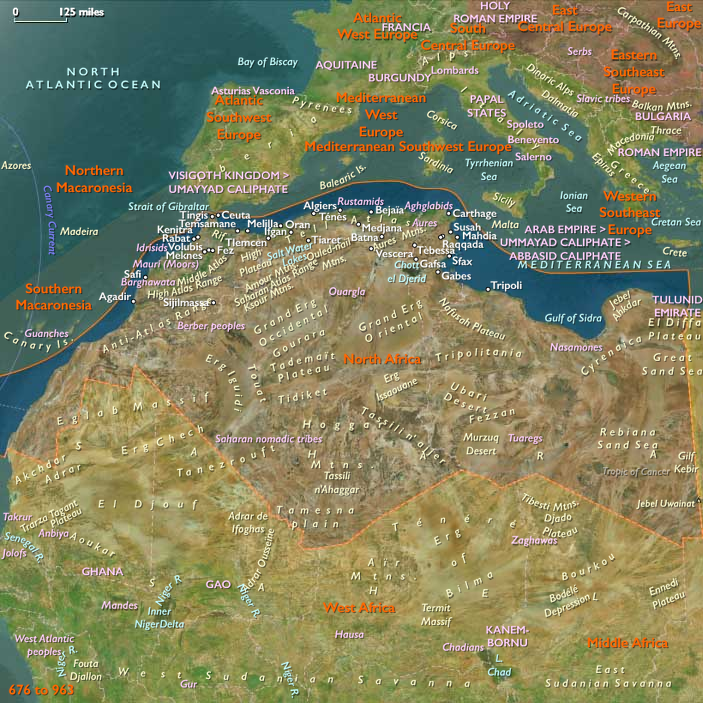
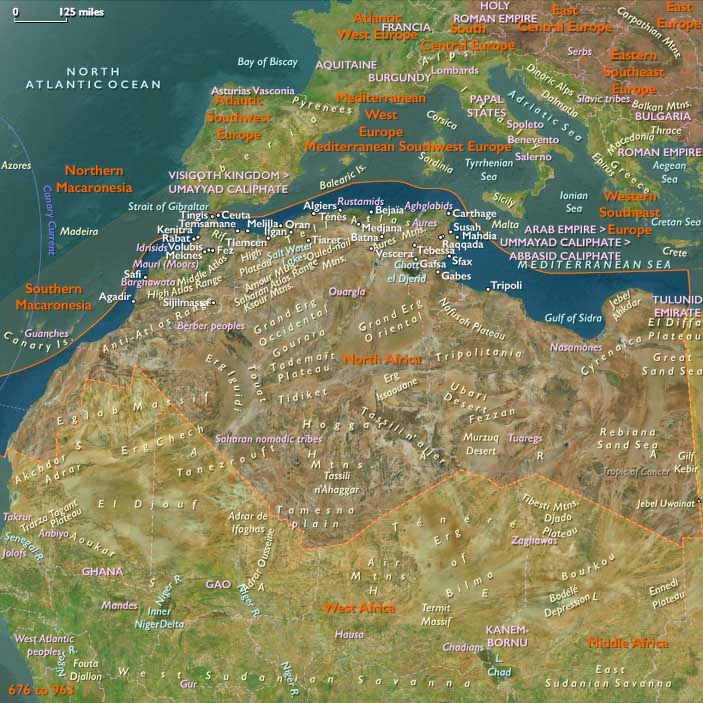
Maysara places the Berber garrison in Tangiers under the command of a converted Christian, Abd al-Allah al-Hodeij al-Ifriqi, then proceeds to sweep down western Morocco, overwhelming Umayyad garrisons clear down to the Sous valley.
In a very short time, the whole length of western Morocco, from the Straits of Gibraltar to the Anti-Atlas, are in the hands of Maysara's rebels.
It is said that Maysara took up the title of amir al-mu'minin ('Commander of the Faithful', or 'Caliph') after his victory at Tangiers (or perhaps a little earlier).
This is probably the first time that a non-Arab lays claim to the supreme Muslim title.
Indeed, it might have been the first time anyone not connected by blood to the Prophet's Quraish tribe, had dared lay such a claim.
To orthodox Muslims of the time, the idea of a 'Berber caliph' must have seemed like an absurdity.
The rumor that Maysara was a lowly 'water-carrier' probably got started around this, if only to make the caliphal pretension seem even more self-aggrandizingly ridiculous, and consequently the entire rebellion misguided.
Because this step seemed to open the rebels to mockery, some have wondered whether the story of Maysara taking up the caliphal title was not fabricated, from start to finish, by Umayyad propagandists.
However, this rebellion has been fired up and led by Sufrite Kharijites, and one of the central tenets of Kharijite ideology is precisely that the caliphal title is open to any good pious Muslim, regardless of dynastic or tribal qualifications.
Moreover, this was, at least on the ideological plane, a Muslim uprising, open to all true Muslims, and not a Berber liberation movement.
Consequently, Maysara, as the commander of the true Muslims, could have no other title but 'caliph'.
To keep the Berber rebels in check until the Sicilian expedition army returns, Obeid Allah assembles a cavalry-heavy column composed largely of the aristocratic Arab elite of Kairouan, and places it under the command of Khalid ibn Abi Habib.
This column is dispatched immediately to Tangiers and instructed to serve as the vanguard until the Sicilian expeditionary force under Habib disembarks and catches up with them.
The Berbers now depose Maysara on account of cowardice, for having hastily ordered a retreat after the skirmish with the Arab column, and place the rebel army in the hands of a more experienced military commander, the Zenata chieftain Khalid ibn Hamid.
They later execute Maysara.
Khalid ibn Abi Habib encounters the Berber rebel army in the outskirts of Tangiers, and after a couple of skirmishes, forces them to pull back.
As per the instructions he has been given, Khalid holds his position south of Tangiers, awaiting the reinforcements from Sicily.
But before junction can be made, the Berber rebel army, under Khalid ibn Hamid al-Zanati, falls upon the Arab column in October/November 740.
Khalid ibn Abi Habib and his column, the flower of the Ifriqiyan nobility, are annihilated by the Berbers in what will become known as the Battle of the Nobles.
Locations
People
- Abd al-Rahman ibn Habib al-Fihri
- Hisham ibn Abd al-Malik
- Khalid ibn Hamid al-Zanati
- Maysara al-Matghari
- Obeid Allah ibn al-Habhab al-Mawsili
Groups
- Arab people
- Berber people (also called Amazigh people or Imazighen, "free men", singular Amazigh)
- Moors
- Islam
- Muslims, Sunni
- Muslims, Kharijite
- Umayyad Caliphate (Damascus)
- Zenata (Berber tribal confederacy)
- Sicily (theme)
- Ifriqiya, Ummayad
- al-Andalus (Andalusia), Muslim-ruled
- Roman Empire, Eastern: Isaurian dynasty
- Barghawata Confederacy (Masmuda Berber tribal confederacy)
Topics
Commodoties
Subjects
- Commerce
- Environment
- Labor and Service
- Fashion
- Conflict
- Mayhem
- Faith
- Government
- Technology
- Movements
Regions
Subregions
Years: 740 - 740
Locations
People
- Abd al-Rahman ibn Habib al-Fihri
- Hisham ibn Abd al-Malik
- Khalid ibn Hamid al-Zanati
- Maysara al-Matghari
- Obeid Allah ibn al-Habhab al-Mawsili
Groups
- Arab people
- Berber people (also called Amazigh people or Imazighen, "free men", singular Amazigh)
- Moors
- Islam
- Muslims, Sunni
- Muslims, Kharijite
- Umayyad Caliphate (Damascus)
- Zenata (Berber tribal confederacy)
- Sicily (theme)
- Ifriqiya, Ummayad
- al-Andalus (Andalusia), Muslim-ruled
- Roman Empire, Eastern: Isaurian dynasty
- Barghawata Confederacy (Masmuda Berber tribal confederacy)
Topics
Commodoties
Subjects
- Commerce
- Environment
- Labor and Service
- Fashion
- Conflict
- Mayhem
- Faith
- Government
- Technology
- Movements
Regions
Subregions