
The Hyksos (Egyptian heqa khasewet, "foreign …
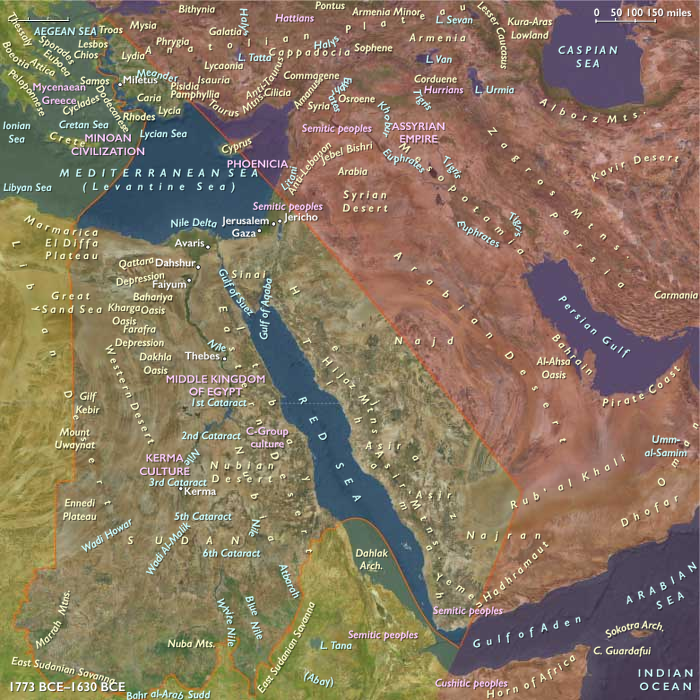
Years: 1773BCE - 1630BCE
The Hyksos (Egyptian heqa khasewet, "foreign rulers", later rendered by Greek writers as Hyksos, the name by which they are known today), rule from Avaris (Egyptian: Hatwaret), built atop the ruins of a Middle Kingdom town that had been captured by the Hyksos and thought to be the modern Tell ed-Dab'a/Khata'na, a few miles from Qantir.
After their takeover, the Hyksos had heavily fortified the city and ruled the country using new technology, specifically the chariot, which the Egyptians had never been witnessed before.
The later Thirteenth Dynasty king Merneferre Ay, who rules from around 1700 BCE to 1677 BCE, appears to have been a mere vassal of the Hyksos princes ruling from Avaris; his successors will hold onto their diminished office until about 1633 BCE.
The outlines of the traditional account of the "invasion" of the land by the Hyksos is preserved in the Aegyptiaca of Manetho, an Egyptian priest who wrote in the time of Ptolemy II Philadelphus.
Manetho recorded that it was during the reign of one "Tutimaios" (who has been identified with Dudimose I, an Egyptian king of the Second Intermediate Period) that the Hyksos overran Egypt, led by Salitis, the founder of the Fifteenth Dynasty, who began to rule Egypt around 1648 BCE, although the precise dates of his rule are unknown.
Forming the Fifteenth and possibly the Sixteenth Dynasties of Egypt, (from about 1648 BCE to 1540 BCE), the Hyksos will rule Lower and Middle Egypt for one hundred and eight years, preferring to reside in northern Egypt.
The two Hyksos dynasties—the great kings of the Fifteenth dominating the vassal chiefs of the Sixteenth—will rule over a time of peace and prosperity in Egypt.
The Hyksos pharaohs respect Egyptian religion and use Egyptian as the language of government, the administration of which is staffed largely by Egyptians.
Locations
Groups
- Egyptians
- Egypt (Ancient), Middle Kingdom of
- Egypt (Ancient), Second Intermediate Period of
- Hyksos, Kingdom of
Topics
Commodoties
Subjects
Regions
Subregions
Years: 1773BCE - 1630BCE
Locations
Groups
- Egyptians
- Egypt (Ancient), Middle Kingdom of
- Egypt (Ancient), Second Intermediate Period of
- Hyksos, Kingdom of
Topics
Commodoties
Subjects
Regions
Subregions