The Hussites of Bohemia publish hymnbooks in …
Years: 1501 - 1501
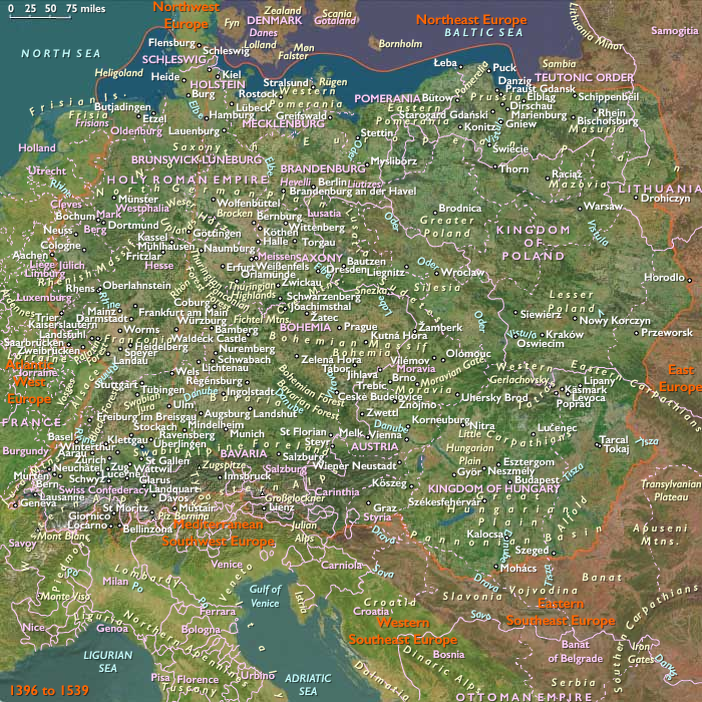
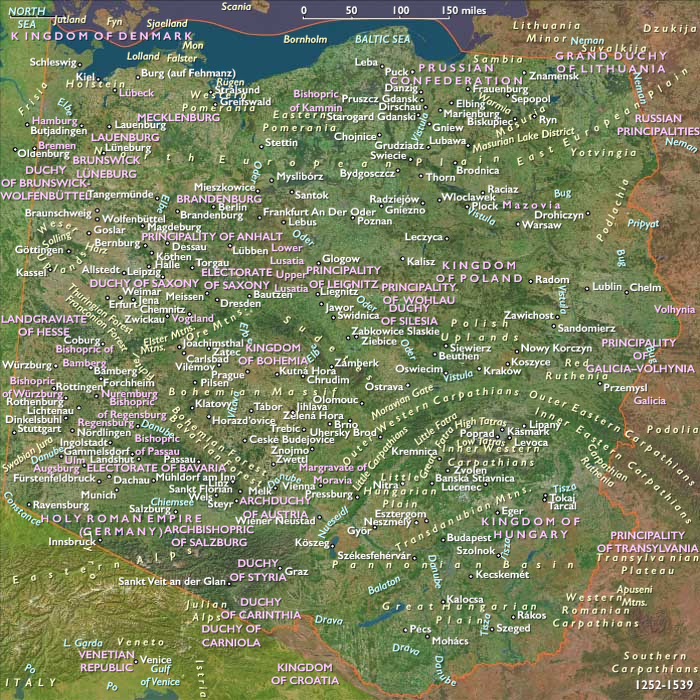
The Hussites of Bohemia publish hymnbooks in the vernacular as early as 1501, the first in any language.
Locations
Groups
Topics
Subjects
Regions
Subregions
Related Events
Filter results
Showing 10 events out of 39880 total
Babur lays siege to Samarkand in 1501 once more, but is soon defeated by his most formidable rival, Muhammad Shaybani, khan of the Uzbeks.
Samarkand, which is to be his lifelong obsession, is lost again.
Christian, the son of the Kalmar Union’s King John, leads others in fomenting rumors that Sten Sture the Elder, newly created Grand Master, plans to seize John’s throne.
Summoned by John to explain himself, Sture appears at Stockholm with a large retinue of heavily armed troops.
A fearful John flees to his citadel, then departs for Denmark, leaving his queen to hold the citadel with a thousand-man garrison.
Sture, aided by troops from Lübeck and other Hanseatic ports, leads Swedish troops to capture Orebro and lay siege to Stockholm, forcing the surrender of John’s queen.
Dürer and his assistants execute the Seven Sorrows Polyptych, commissioned by Frederick III of Saxony in 1496, around 1500.
The Venetians, worn down by Ottoman Turk assaults, evacuate Durrës in 1501.
The defeats trigger a great exodus of Albanian refugees, most of whom belong to the Orthodox Church, to southern Italy, especially to the kingdom of Naples, as well as to Sicily, Greece, Wallachia, and Egypt.
João da Nova, sailing for the Portuguese crown, is believed to have discovered a volcanic island about ten degrees below the equator in the South Atlantic between Africa and South America; he names it Ilha de Nossa Senhora da Conceição.
Pierre d’Aubusson, as cardinal, reforms the Order of St. John, strengthens its authority in Rhodes, and eliminates Judaism from the island by expelling all adult Jews and forcibly baptizing their children.
Aubusson in 1501, two years before his death, fails in trying to organize a large international crusade against the Turks.
Giovanni Bellini, famous for his portraiture, helps make this art form especially popular in Venice, perhaps inaugurating what is to be a tradition of painting formal portraits of its rulers dressed in state robes.
His 1501 portrait of Leonardo Loredan, Doge of Venice from 1501 to 1521, is painted in the style of the sculpted portrait busts popular at the time and often inspired by Roman sculpture.
Bellini portrays the doge in his ceremonial garments.
Shown here wearing his robes of state for this formal portrait, the hat and ornate buttons are part of the official wardrobe.
The sitter can be identified as Doge Loredan by comparing his features with portrait medals of him.
The shape of the hat comes from the hood of a doublet; called a 'corno', it is worn over a linen cap.
Alsus Manutius has designed a celebrated roman typeface and is, in 1501, the first to introduce an italic typeface, which he bases on Italian cursive hand.
Venetian publisher Ottaviano Petrucci, born in Fossombrone (Pesaro), and probably educated at Urbino, had gone to Venice around 1490 to learn the art of printing, and in 1498 he had petitioned the Doge for the exclusive right to print music for the next twenty years.
The right was very probably granted, since no examples of printed music from other Venetian printers are known before 1520.
In 1501, Petrucci publishes his first collection, ninety-six chansons in his “Odhecaton,” the first book of polyphonic music to be printed.
The contents show the chanson changing from a treble-dominated piece to one with equality of voices in imitative counterpoint, increasing from three voices to four.
Petrucci also prints more than fifty volumes of secular and sacred vocal music as well as a few volumes of music for the lute.
Sandro Botticelli in his later life had been one of the followers of the deeply moralistic friar Savonarola, though the full extent of Savonarola's influence remains uncertain.
In his gloomy The Mystical Nativity, painted around 1500 of 1501, Botticelli builds up the image using oil on canvas.
It is his only signed work, and has an unusual iconography for a Nativity.
The Greek inscription at the top translates as: "This picture, at the end of the year 1500, in the troubles of Italy, I Alessandro, in the half-time after the time, painted, according to the eleventh [chapter] of Saint John, in the second woe of the Apocalypse, during the release of the devil for three-and-a-half years; then he shall be bound in the twelfth [chapter] and we shall see [him buried] as in this picture".
Botticelli believes himself to be living during the Tribulation, possibly due to the upheavals in Europe at the time, and is predicting Christ's Millennium as stated in Biblical text.
It has been suggested that the painting may be connected with the influence of Savonarola, whose influence appears in a number of late paintings by Botticelli, though the contents of the image may have been specified by the person commissioning it.
The painting uses the medieval convention of showing the Virgin Mary and infant Jesus larger both than other figures, and their surroundings; this is certainly done deliberately for effect, as earlier Botticellis use correct graphical perspective.
He produces in 1501 another brooding painting, his “Pietá".
With Leonardo da Vinci‘s return to Florence the previous year, Florentine painting begins to move rapidly in new directions, further eclipsing Botticelli.
The authorities of the Cathedral of Florence in 1501 commission Michelangelo to create a monumental marble statue of David.
Michelangelo must work, however, with a marble block that had been damaged during the 1460s.

Bosch's Seven Deadly Sins and the Moral Vision of Late Medieval Art (c. 1500)
Around 1500, Flemish painter Hieronymus Bosch completed the allegorical masterpiece, Seven Deadly Sins, reflecting the era’s intense fascination with morality, judgment, and the afterlife. In this remarkable rectangular panel, Bosch presents a vivid and complex visual meditation on human vice, virtue, and eternal judgment, encapsulating central moral concerns of late medieval Europe.
The painting's central feature is a detailed circular motif depicting the Seven Deadly Sins: pride, greed, lust, envy, gluttony, wrath, and sloth, each vividly portrayed in everyday scenes. Encircling this central motif is an inscription warning viewers of divine omniscience, emphasizing moral accountability: “Cave cave dominus videt” (“Beware, beware, God sees”). At each corner of the panel, Bosch depicts traditional eschatological scenes prevalent in medieval devotional literature: Deathbed, Last Judgment, Heaven, and Hell—motifs recurrently explored by Bosch throughout his artistic career.
This piece exemplifies Bosch’s distinctive approach to religious art, merging complex symbolism, vivid realism, and moral allegory to engage viewers directly in contemplation of spiritual consequences. The work, most likely created for private devotion and moral reflection, echoes contemporary devotional literature, reinforcing themes common to widely circulated moral handbooks and preaching manuals of the period.
Cultural and Artistic Significance:
Bosch’s innovative blending of narrative realism with allegorical intensity deeply reflects the spiritual and moral anxieties prevalent in late medieval society. The painting's sophisticated visual language underscores Bosch's role as both moral commentator and artistic innovator, contributing significantly to the artistic tradition of Northern Renaissance painting.
Consequences and Legacy:
Bosch's profound imaginative power and moral messaging in Seven Deadly Sins had a lasting impact on European art, profoundly influencing subsequent generations of painters and laying the foundations for new approaches to symbolic and moralistic imagery. His exploration of vice, judgment, and redemption continues to resonate, maintaining a central position in art-historical scholarship on late medieval and early modern moral imagination.