
…the Hungarians reach Baia, where Corvinus meets …
Years: 1467 - 1467
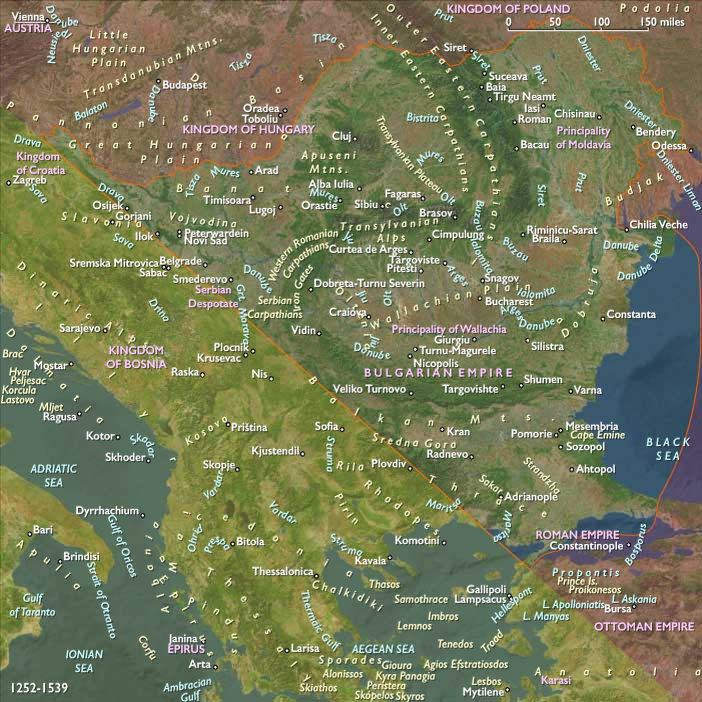
…the Hungarians reach Baia, where Corvinus meets with a Hungarian by the name of Sythotus, who reveals to him the Moldavian position, their numbers (twelve thousand), and their plan to attack before dusk.
The Moldavians are encamped further north, between Moldova River and Șomuz creek.
Corvinus orders the city to be fortified as the men are told to be prepared for battle and guards are sent to man strategic points.
On December 15, when dusk is approaching, Stephen sends smaller detachments that set the town on fire from three different places: noise and confusion set in.
Stephen orders his men to dismount; soon after, they launch their attack and battle until dawn.
Descriptions of the battle say that the fire made the night equally light as the day and that many Hungarians were consumed by the flames.
The two armies start to butcher each other at the gate of the city; the fierce fighting then continued onto the streets.
The Moldavians gain the upper hand and launch another attack against the royal guard, which consists of two hundred heavily armed knights, the aristocrats and Corvinus.
Many Moldavians are killed in the tumult that followd, as Báthory and the rest of the knights try to defend the entrance to the market.
Corvinus is wounded by three arrows in the back and has to be carried from the battlefield.
Around ten thousand Hungarians are said to have been killed; most of the barons escape with their king.
A Hungarian chronicle mentions seven thousand casualties for the Moldavians.
This chronicle is disputed, due to it being the only one mentioning the Moldavian casualties in numbers; and because the Hungarians do not have the opportunity to calculate the numbers of their fallen enemy.
The entire conflict, with the Hungarian invasion and retreat, takes around forty days.
The retreating Hungarian army, on its way to Transylvania, is stopped by a blockade; here they decide to bury the five hundred cannon and other valuables, so that the Moldavians will be unable to capture them.
Some of the captured Hungarian standards come with great troves of booty that are sent to Casimir as proof of Stephen's victory.
Locations
People
Groups
- Transylvania, region of
- Romanians
- Hungary, Kingdom of
- Moldavia, Principality of
- Wallachia, Principality of
- Transylvania (Hungarian governate)
- Ottoman Empire
Topics
Commodoties
Subjects
Regions
Subregions
Years: 1467 - 1467
Locations
People
Groups
- Transylvania, region of
- Romanians
- Hungary, Kingdom of
- Moldavia, Principality of
- Wallachia, Principality of
- Transylvania (Hungarian governate)
- Ottoman Empire
Topics
Commodoties
Subjects
Regions
Subregions