The Hundred Schools of Thought are philosophers …
Years: 621BCE - 478BCE
The Hundred Schools of Thought are philosophers and schools that flourish from 770 to 221 BCE during the Spring and Autumn period and the Warring States period, an era of great cultural and intellectual expansion in China.
This period, fraught with chaos and bloody battles, is also known as the Golden Age of Chinese philosophy because a broad range of thoughts and ideas are developed, discussed freely, and refined during this period, in a phenomenon that has been called the Contention of a Hundred Schools of Thought.
This will profoundly influence lifestyles and social consciousness up to the present day in East Asian countries.
Itinerant scholars, who are often employed by various state rulers as advisers on the methods of government, war, and diplomacy, characterize the intellectual society of this period.
Groups
Topics
Subjects
Regions
Subregions
Related Events
Filter results
Showing 10 events out of 66140 total
The founder of the Vietnamese nation, according to the earliest traditions, was Hung Vuong, the first ruler of the semilegendary Hung dynasty (2879-258 BCE, mythological dates) of the kingdom of Van Lang.
Hung Vuong, in Vietnamese mythology, was the oldest son of Lac Long Quan (Lac Dragon Lord), who came to the Red River Delta from his home in the sea, and Au Co, a Chinese immortal.
Lac Long Quan, a Vietnamese cultural hero, is credited with teaching the people how to cultivate rice.
The Hung dynasty, which according to tradition ruled Van Lang for eighteen generations, is associated by Vietnamese scholars with Dong Sonian culture.
An important aspect of this culture by the sixth century BCE is the tidal irrigation of rice fields through an elaborate system of canals and dikes.
The fields are called Lac fields, and Lac, mentioned in Chinese annals, is the earliest recorded name for the Vietnamese people.
Maritime East Asia (621–478 BCE): Age of Philosophy and Technological Advancements
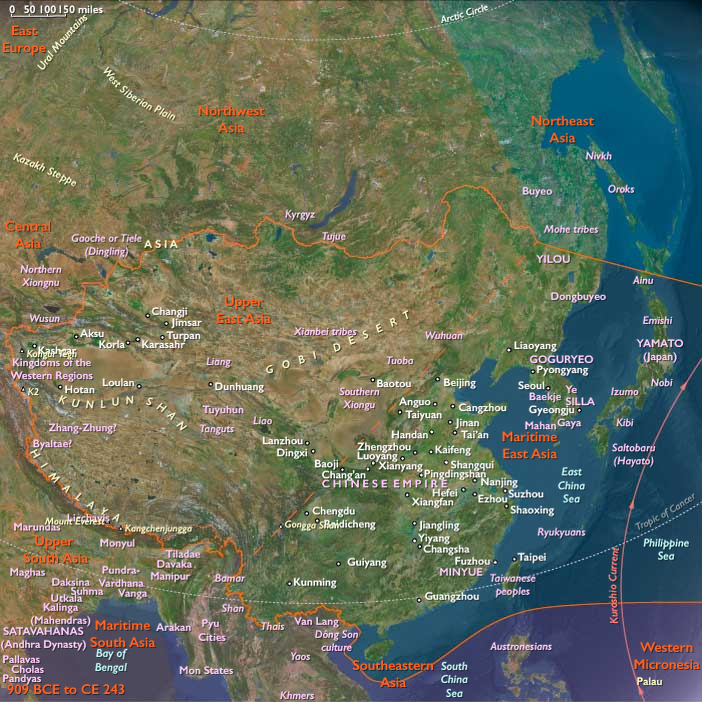
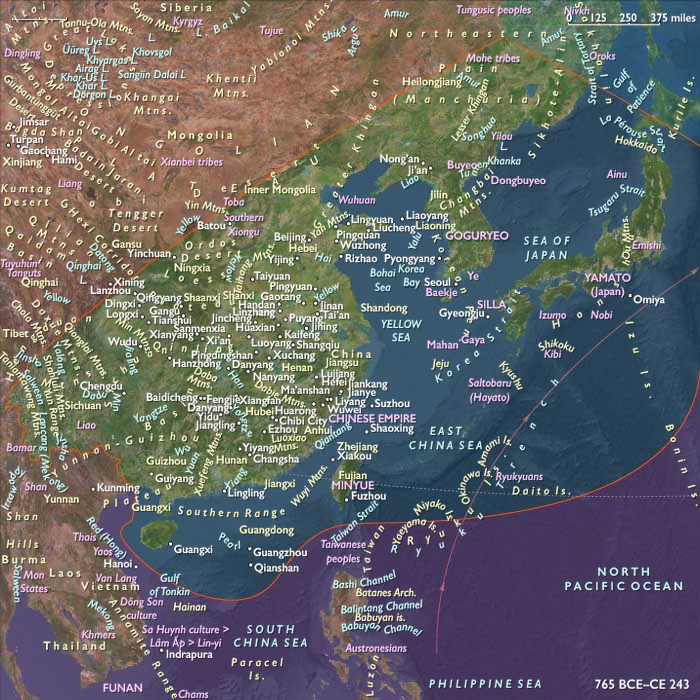
Between 621 BCE and 478 BCE, Maritime East Asia—comprising lower Primorsky Krai, the Korean Peninsula, the Japanese Archipelago below northern Hokkaido, Taiwan, and southern, central, and northeastern China—experiences profound philosophical development, significant technological innovations, and continued political decentralization during the late Spring and Autumn period.
Confucius and the School of Literati
The philosophical tradition with the most lasting impact on Chinese civilization emerges prominently in this era: the School of Literati (ru), more commonly known in the West as Confucianism. Founded by Confucius (551–479 BCE), also known as Kong Zi or Master Kong, this school advocates an ethical society modeled after the early Zhou Dynasty’s idealized social and political order. Confucius teaches that societal harmony relies upon clearly defined roles and relationships, famously summarizing his philosophy as, "Let the ruler be a ruler and the subject a subject." However, he emphasizes that rulers must embody virtue and moral rectitude.
Confucian teachings crystallize around the figure of the junzi, originally meaning "ruler's son" but later evolving to signify a morally superior, cultivated gentleman. The written foundations of Confucian thought are preserved in the Confucian Classics, which become the ideological backbone for traditional Chinese society for millennia.
Iron Age and Technological Progress
Technological advancement accelerates significantly during this period, marked by the widespread adoption of ironworking around 600 BCE. Iron technology transforms agriculture, warfare, and daily life through the production of durable weapons, tools, and farm implements. This technological leap is accompanied by an increased emphasis on formal education, particularly among officials and the elite classes, spurring intellectual and administrative sophistication that supports expanding bureaucracies.
Hundred Schools of Thought
Amidst ongoing fragmentation and military conflict among competing feudal states, a flourishing intellectual environment emerges, later known as the era of the Hundred Schools of Thought. This period, spanning the Spring and Autumn through Warring States periods, sees intense philosophical debate and the rise of itinerant scholars who serve as advisers to regional rulers on governance, military strategy, and diplomacy. This intellectual vibrancy profoundly shapes cultural and social values in China and throughout East Asia, influencing thought systems that endure into modern times.
Cultural and Social Developments
The literary and cultural landscape evolves, exemplified by compilations like the Shih Jing, an anthology of poems and songs reflecting life in northern China between approximately 1000 and 600 BCE. These texts offer critical insights into the language and society of early China. Additionally, historical records from the Zhou dynasty indicate that institutions such as prostitution are already established within Chinese society, reflecting complex social dynamics.
Artistic craftsmanship continues to thrive, with late Zhou bronzes becoming increasingly sophisticated, notably featuring ornate gold and silver inlays, especially on decorative bronze mirrors crafted from about 600 BCE onward.
Decline of Centralized Zhou Power
Politically, the Eastern Zhou kings maintain nominal control over a limited royal domain centered on Luoyang, while real power is exercised by increasingly independent hereditary nobles. Important political decisions and military actions are deliberated at regular assemblies of prominent feudal princes, with one occasionally elevated as hegemon to lead collective forces. Nonetheless, centralized authority steadily erodes as vassal states grow stronger and more contentious, laying the groundwork for further fragmentation.
Legacy of the Age: Intellectual and Technological Transformation
Thus, the age from 621 to 478 BCE marks a significant period of intellectual innovation, technological advancement, and deepening political fragmentation. The emergence of Confucian thought and the Hundred Schools philosophy profoundly shape future social structures, governance, and cultural developments, establishing a lasting legacy that continues to influence Maritime East Asia profoundly.

The body of thought that will have the most enduring effect on subsequent Chinese life is that of the School of Literati (ru), often called the Confucian school in the West.
The written legacy of the School of Literati is embodied in the Confucian Classics, which are to become the basis for the order of traditional society.
Confucius (551-479 BCE), also called Kong Zi, or Master Kong, looks to the early days of Zhou rule for an ideal social and political order.
He believes that the only way such a system can be made to work properly is for each person to act according to prescribed relationships.
"Let the ruler be a ruler and the subject a subject." he says, but he adds that to rule properly a king must be virtuous.
To Confucius, the functions of government and social stratification are facts of life to be sustained by ethical values.
His ideal is the junzi (ruler's son), which comes to mean gentleman in the sense of a cultivated or superior man.
Ironworking technology appears in China by about 600 BCE, at which point formal education becomes more widespread among Chinese officials and members of the wealthier classes.
China’s Iron Age is taken to last until the beginning of Early Imperial China and the rise of the Qin Dynasty in the third century BCE.
The Spring and Autumn period in China enters its final age.
The name of the period, which roughly corresponds to the first half of the Eastern Zhou dynasty (from the second half of the eighth century BCE to the first half of the fifth century BCE), comes from the Spring and Autumn Annals, a chronicle of the state of Lu between 722 BCE and 481 BCE, which tradition associates with Confucius.
China is ruled by a feudal system, under which the Zhou dynasty kings hold nominal power over a small Royal Domain, centered on their capital (modern Luoyang), and grant fiefdoms over the rest of China to several hundreds of hereditary nobles, descendants of members of the Zhou clan, close associates of the founders of the dynasty, or local potentates.
The most important feudal princes (known later as the twelve princes) meet during regular conferences, where important matters, such as military expeditions against foreign groups or offending nobles are decided.
One prince is sometimes declared hegemon during these conferences and assumes leadership over the armies of all feudal states.
The vassal states grow strong and belligerent as the Zhou kings lose control.
Late Zhou bronzes, including the backs of bronze mirrors produced from about 600 BCE, are sometimes inlaid with gold and silver.
Old Chinese has been reconstructed from a large number of poems and songs, many of which are anthologized in the Shih Jing, an anthology of northern Chinese songs, compiled between about 1000 and about 600 BCE.
The earliest historical reference to prostitution in China dates from the Zhou dynasty, by which time it is already a well-established institution.
Kung-Fu-tzu, or Confucius, who teaches social ethics in China in the late sixth and early fifth centuries BCE, founds the ethical system that bears his name, basing his doctrine on the recognition of individual fate.
He incorporates elements of traditional Chinese folk religions and emphasizes aristocratic social virtues and behavior in accord with divine principles.
Central Asia (621–478 BCE): Achaemenid Influence, Scythian Integration, and Cultural Exchange
Between 621 and 478 BCE, Central Asia experienced deeper integration into broader Eurasian dynamics, prominently marked by the westward expansion of the Achaemenid Persian Empire and the continued dominance and cultural integration of Scythian pastoralist societies. This era witnessed heightened economic connectivity, cross-cultural interactions, and significant political realignment as Central Asia emerged as an essential nexus between the Persian heartland, eastern steppes, and the distant emerging Chinese states.
Expansion of Achaemenid Persian Authority
The rise of the Achaemenid Empire under Cyrus the Great (559–530 BCE) and his successors, notably Darius I (522–486 BCE), significantly impacted Central Asia:
-
Bactria, Sogdiana, and Margiana were incorporated as Persian satrapies, governed by local satraps accountable to Persian central authority. Major cities, including Balkh (Bactra), Marakanda (Samarkand), and Merv, became vital administrative and economic centers within the Persian imperial framework.
-
Persian administration facilitated unprecedented stability, enhancing trade, taxation efficiency, and local governance, establishing a robust bureaucratic infrastructure that integrated Central Asia into a wider economic and political network extending from the Mediterranean to India.
Interaction and Integration with Scythian Nomads
The Persian Empire skillfully managed relations with powerful Scythian nomadic tribes inhabiting the northern steppes (modern Kazakhstan and Kyrgyzstan):
-
Persian rulers generally maintained diplomatic relations with Scythian elites, often relying on them as allies, mercenaries, or trading partners, thus stabilizing frontier regions and securing critical trade routes.
-
Scythians themselves increasingly participated in trade networks fostered by Persian administration, providing horses, livestock products, and valuable commodities in exchange for Persian manufactured goods, textiles, metals, and agricultural products.
Enhanced Economic Networks and the Silk Road Precursors
Central Asia’s economic significance grew notably, with Persian integration fostering unprecedented levels of trade connectivity and regional prosperity:
-
Central Asian oasis cities became crucial nodes in burgeoning trade networks stretching from Persia to East Asia. Early forms of the Silk Road began to crystallize, connecting emerging Chinese states, Indian kingdoms, Persia, and even Greek cities of Anatolia and the Mediterranean.
-
Notably, Sogdiana (particularly Samarkand) became a critical intermediary, facilitating exchanges of silk, precious stones, spices, metals, and horses, reinforcing its historical position as a vibrant commercial crossroads.
Cultural and Religious Developments
The era was marked by dynamic cultural exchanges and significant religious developments, shaped profoundly by Persian administrative and cultural influence:
-
Zoroastrianism expanded into the region through Persian administrators and settlers, especially in urban centers such as Balkh and Merv. Zoroastrian practices coexisted and interacted with local Iranian beliefs, setting the stage for later widespread acceptance of Zoroastrian traditions throughout Central Asia.
-
Scythian nomads maintained their shamanistic traditions, yet also adopted elements of Persian culture, particularly visible in decorative arts, weaponry, and burial customs, signifying significant cultural exchange and hybridization.
Technological and Artistic Advancements
Central Asia experienced substantial technological innovations and artistic flourishing, stimulated by Persian patronage and cultural exchanges:
-
Advancements in irrigation, infrastructure, and urban planning occurred under Persian oversight, enhancing agricultural productivity and urban prosperity in oasis cities.
-
Artisans produced intricate metalwork, elaborate pottery, textiles, and jewelry blending Scythian animal motifs with Persian artistic sensibilities, reflecting Central Asia’s unique position as a melting pot of diverse influences.
Societal Changes and Urbanization
Urban centers in Central Asia continued to thrive and grow under Persian administration, fostering increased social complexity and economic specialization:
-
Cities such as Balkh, Samarkand, and Merv expanded significantly, with more complex administrative structures, improved urban planning, fortified walls, palaces, and temples.
-
The urban elite, including Persian administrators and local rulers, wielded substantial influence, shaping local governance and facilitating significant urban-rural integration and economic specialization.
Long-Term Significance and Legacy
The era from 621 to 478 BCE profoundly shaped Central Asia’s subsequent historical trajectory:
-
Persian integration solidified Central Asia’s enduring role as a central hub of Eurasian trade and cultural exchange, providing vital infrastructure and political frameworks that endured beyond the Achaemenid period.
-
The strengthened regional trade networks and early Silk Road connections became foundational to Central Asia’s long-standing role in global commerce, facilitating future imperial and cultural interactions.
-
The cultural syncretism between Persian, Scythian, and local traditions significantly enriched Central Asian society, fostering lasting artistic and religious traditions that defined the region’s unique identity.
By 478 BCE, Central Asia was firmly established as a vibrant, interconnected region, intricately woven into broader Persian imperial networks, thriving culturally and economically, and poised to play a critical role in Eurasian history for centuries to come.