
The Huainanzi, a second century BCE …
Years: 141BCE - 130BCE
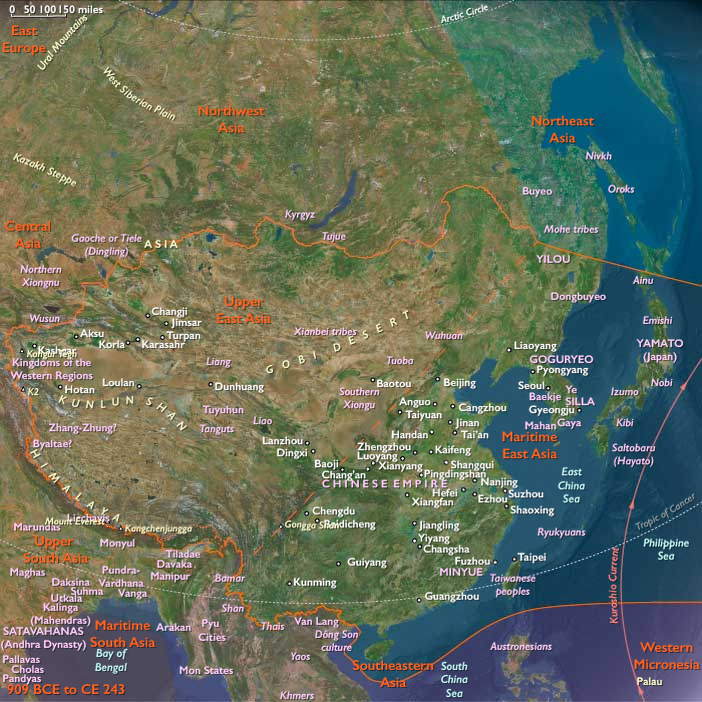
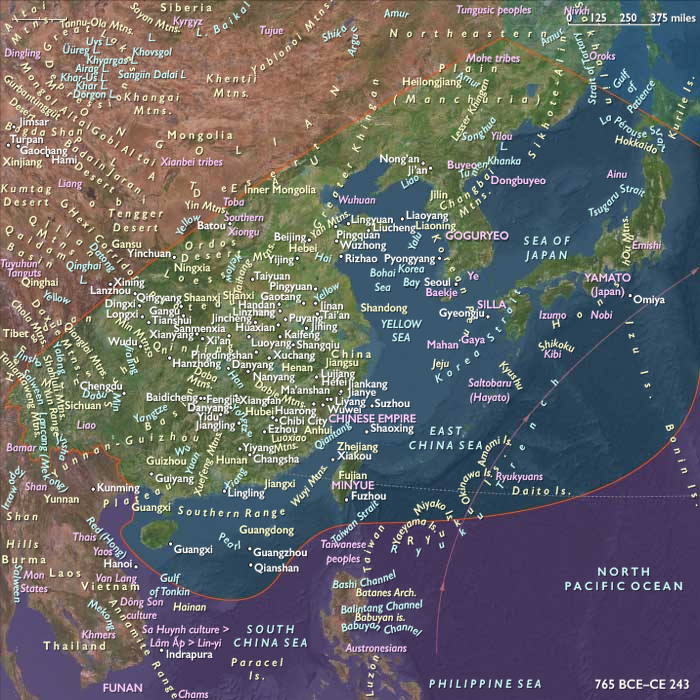
The Huainanzi, a second century BCE Chinese philosophical classic from the Han dynasty that blends Taoist, Confucianist, and Legalist concepts, including theories such as Yin-Yang and the Five Phases, is written under the patronage of Liu An, Prince of Huainan.
Advisor to his nephew, Emperor Wu of Han, Liu An is a legendarily prodigious author.
The text, also known as the Huainan honglie ("The Great Brilliance of Huainan"), is a collection of essays presented as resulting from literary and philosophical debates between Liu and guests at his court, in particular the scholars known as the Eight Immortals of Huainan.
The Huainanzi is the first Chinese classic text to use the Pythagorean comma, and to precisely analyze twelve-tone tuning in Chinese music (McClain and Ming 1979:213, 206), although the latter had been preceded by bronze inscriptions on the (433 BCE) bells of the Marquis Yi of Zeng (Temple 1986:199).
The date of composition for the Huainanzi is more certain than for most early Chinese texts.
Both the Book of Han and Records of the Grand Historian record that when Liu An paid a state visit to his nephew the Emperor Wu of Han in 139 BCE, he presented a copy of his "recently completed" book in twenty-one chapters.
An eclectic compilation of chapters or essays that range across topics of mythology, history, astronomy, geography, philosophy, science, metaphysics, nature, and politics, the Huainanzi discusses many pre-Han schools of thought (especially Huang-Lao Daoism), and contains more than eight hundred quotations from Chinese classics.
Locations
People
Groups
Topics
Subjects
- Writing
- Performing Arts
- Faith
- Government
- Scholarship
- Arcanum
- Mythology
- Mathematics
- Astronomy
- Philosophy and logic
- History
- Geography
Regions
Subregions
Years: 141BCE - 130BCE
Locations
People
Groups
Topics
Subjects
- Writing
- Performing Arts
- Faith
- Government
- Scholarship
- Arcanum
- Mythology
- Mathematics
- Astronomy
- Philosophy and logic
- History
- Geography
Regions
Subregions