
The House of Wisdom, or House of …
Years: 1004 - 1004
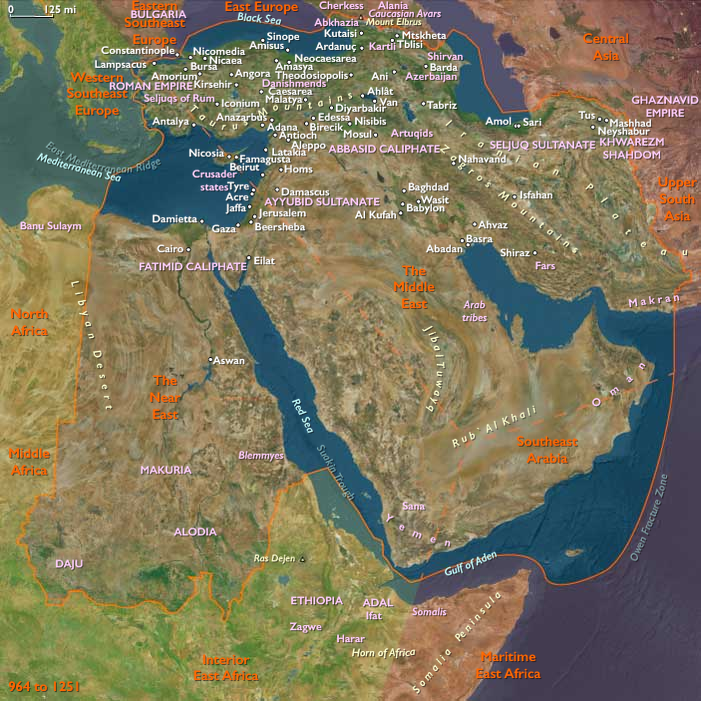
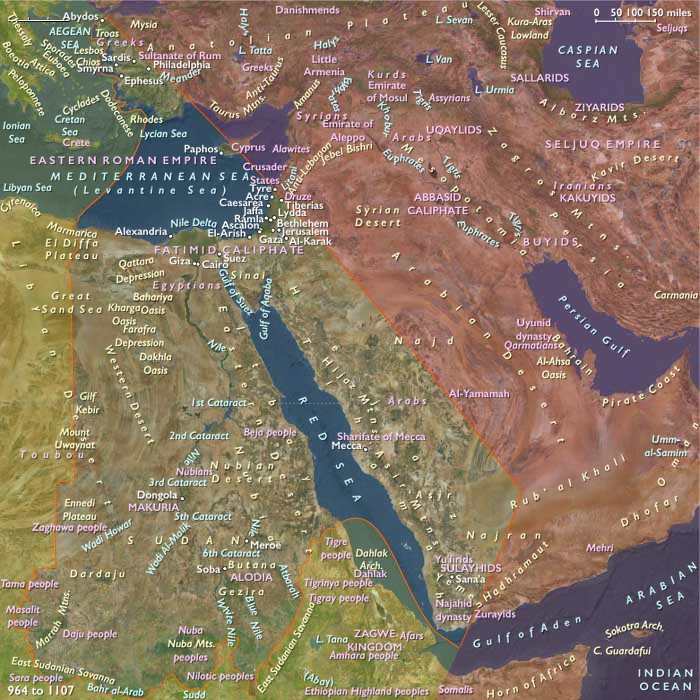
The House of Wisdom, or House of Knowledge, is built in 1004 in Cairo as a library and in the same year converted by the Fatimid Imam-Caliph Al-Hakim bi-Amr Allah to a state university.
Locations
People
Groups
Subjects
Regions
Subregions
Related Events
Filter results
Showing 10 events out of 51925 total
The Song dynasty, under their third emperor, Zhenzong, have continued their war against the Khitans in the north.
They have suffered occasional reversals, but have gradually reconquered much of the former Chinese territory north of the Hwang He.
After many years of fighting with each other, the the Northern Sung and the Liao Dynasties finally decide to negotiate a truce, which is achieved in 1004 through the treaty of Shanyuan, the pivotal point in relation between the Sung and the Liao.
The signing of the Shanyuan Treaty is the first time that the Liao are able to force the Song, who consider themselves the natural heirs to the Central Kingdom (Zhong Yuan), to recognize them as peers.
The Khitans agree to abandon southern Hebei to the Chinese in exchange for …
…northern regions of Shanxi and an annual tribute of one hundred thousand ounces of silver and around two hundred thousand rolls of silk.
After the treaty is signed, the nature of the relationship between these two states changes from one of purely political rivalry to a supposed fraternal relationship.
For the first time in Chinese history there are two Sons of Heaven, recognized by each other.
Poland’s annexation of Bohemia has brought Boleslaw into direct conflict with Henry.
Although Henry’s first attack had not been successful, the German forces depose the Polish king from the Bohemian throne in the autumn of 1004.
Boleslaw had taken the rest of Moravia in 1003-04, and, despite his surrender of the Bohemian throne, does manage to keep Moravia and Slovakia, over which he will exercise control until 1018.
Henry II had promised to install Henry of Schweinfurt, Margrave of Nordgau, as his successor to the Duchy of Bavaria in exchange for supporting his claim to the German crown.
Upon assuming the throne, however, Henry II had refused to honor his promise, and instead supported the rights of the Bavarians to elect their own duke.
With Henry II's support, Count Henry I of Luxembourg becomes the Duke of Bavaria as Henry V. Margrave Henry, thus betrayed by Henry II, allies with Duke Boleslaw I of Poland against the king.
However, his rebellion is soon quashed and the Nordgauian Margrave is deposed in 1004.
Henry II now abolishes the March of Nordgau.
He will establish the Diocese of Bamberg in 1007, and transfer secular authority over the March's former territory to the Diocese in order to prevent further uprisings.
Samuel reacts to the Empire’s campaign with a daring stroke; he launches a large-scale raid into the heart of imperial Thrace and surprises the major city of Adrianople.
Samuel, returning homeward from Adrianople with his extensive plunder, is intercepted near the town of Skopje by an imperial army commanded by the emperor.
Basil's forces storm the Bulgarian camp, inflicting a severe defeat on the Bulgarians and recovering the plunder of Adrianople.
Skopje surrenders shortly after the battle, and its governor, Romanos, is treated with overt kindness by the Emperor.
Tradition names García Sánchez II the Tremulous as one of the Christian leaders at the 1002 Battle of Calatañazor, which resulted in the death of Almanzor and the consequent crisis in the Caliphate of Córdoba, but there is no contemporary record of him after 1000, while his cousin Sancho Ramírez of Viguera may have been ruling in Pamplona in 1002.
García was certainly dead by 1004, when his young son Sancho Garcés III first appears as king.
This gap has led to speculation as to whether there was an interregnum, while one document shows Sancho Ramírez of Viguera reigning in Pamplona in 1002, perhaps ruling as had Jimeno Garcés during the youth of García Sánchez I three generations earlier.
Sancho, born around 992 to García and Jimena Fernández, daughter of Fernando Bermúdez, count of Cea on the Galician frontier, had been raised in Leyre.
On his succession, Sancho initially rules under a council of regency led by the bishops, his mother Jimena, and grandmother Urraca Fernández.
Henry II, responding to calls for aid from Italian bishops, leads an invasion into Italy against Arduin in 1004, gathering his troops at Augsburg and marching through the Brenner Pass to Trento in Italy.
After initial military successes, much of the Italian clergy and some noble families swear allegiance to Henry II, including Arbishop Arnulf II of Milan.
Archbishop Arnulf, joining Henry II in Bergamo, crowns him as King of Italy on May 14, 1004, in Pavia.
Unlike his predecessors, Henry II will wear two crowns (one for Germany and one for Italy) from this date instead of a common crown for both realms.
The following night, the inhabitants of Pavia revolt against the rule of Henry II, who II order his troops to massacre the population in response.
The city is nearly destroyed.
After receiving the homage of the remaining Italian nobles, Henry II returns to Germany in the early summer of 1004 without first traveling to Rome to claim the Imperial crown.
This is most likely due to opposition from Pope John XVIII.
Henry II will not return to Italy for a decade, leaving the kingdom to govern itself.
Henry II returns to Germany to take military action against the rebellious Duke Boleslaw I of Poland.
This frees Arduin to attack the bishops who had backed the German invaders.
