
The House of Habsburg had coveted the …
Years: 1315 - 1315
November
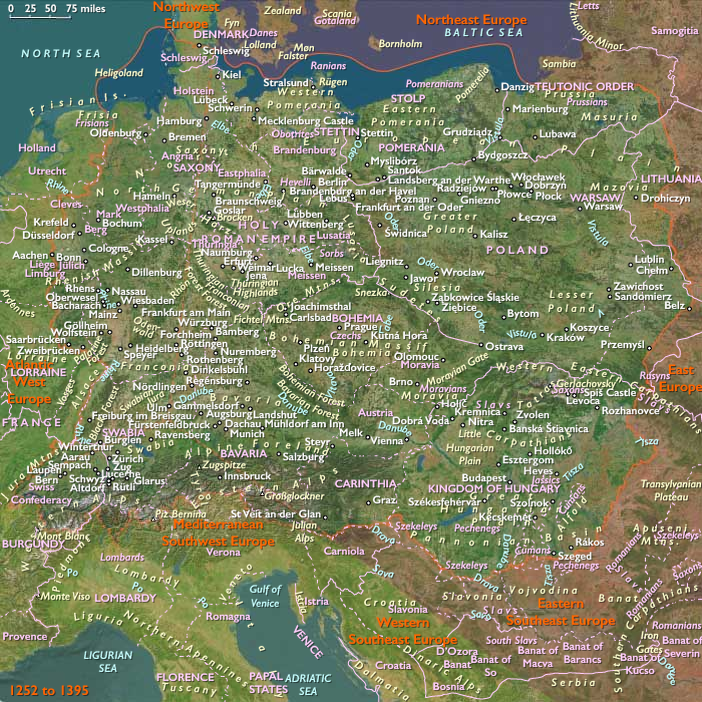
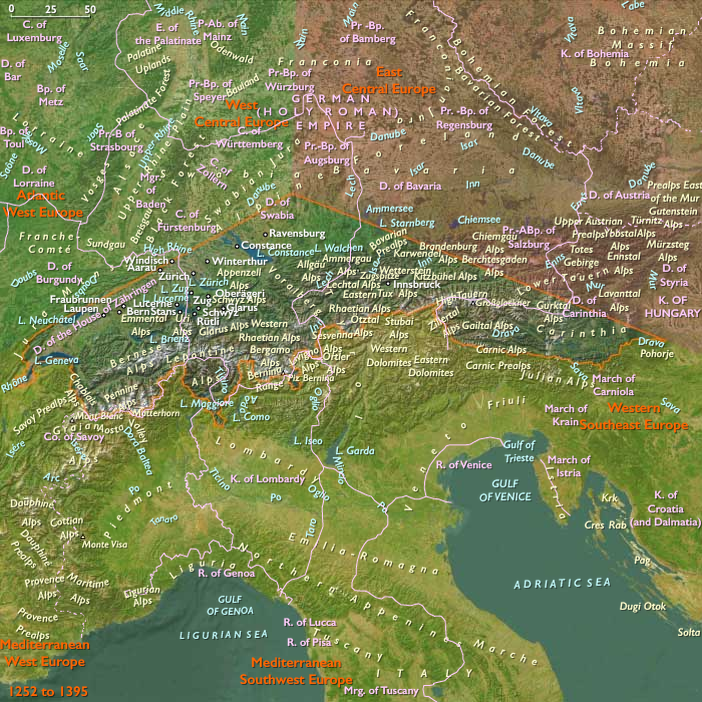
The House of Habsburg had coveted the area around the Gotthard Pass as it offers the shortest passage to Italy, but the Confederates of Uri, Schwyz and Unterwalden, who had formalized the Swiss Confederacy in 1291, hold imperial freedom letters from former Habsburg emperors granting them local autonomy within the empire.
Tensions between the Habsburgs and Confederates had heightened in 1314 when Duke Louis IV of Bavaria (who will become Louis IV, Holy Roman Emperor) and Frederick the Handsome, a Habsburg prince, each claimed the crown of the Holy Roman Emperor.
The Confederates support Louis IV because they fear the Habsburgs will annex their lands, which they had tried to do in the late thirteenth century.
War eventually breaks out after the Confederates of Schwyz raid the Habsburg-protected Einsiedeln Abbey, as a result of a dispute regarding access to pastures.
Frederick's brother, Leopold of Austria, leads a large army, including a small number of knights, to crush the rebellious Confederates.
He plans a surprise attack from the south via Ägerisee (also known as Lake Äegen or Lake Aegeri) and the Morgarten Pass, counting on complete victory.
Johannes von Winterthur's chronicle of the battle puts the Austrian forces at twenty thousand, although that number is now believed to be inaccurate.
Another account, by Rudolf Hanhart, states that there were nine thousand men in the Austrian army, while historian Hans Delbrück states that the Austrian army consisted of only two thousand to three thousand men, but that these were mainly well-trained and -equipped knights.
The Confederates of Schwyz, supported by the Confederates of Uri, fear for their autonomy, but are not supported by the Confederates of Unterwalden, who expect the army to approach from the west near the village of Arth, where they have erected fortifications.
The size of the Confederate army is also disputed, with estimates ranging from fifteen hundred to around three thousand or four thousand.
Nevertheless, regardless of their size, the Confederate militia lacks the training of the Habsburg knights, who are also better equipped.
According to a legend recounted in Tait's Edinburgh Magazine in 1852, one Habsburg knight, Henry Huenenberg, recognizing the superiority of his force and possibly concerned that victory over a "rabble" would be a disgrace, or in an act of chivalry, shot an arrow with a message attached into the Confederates' camp, telling them that the Austrians would advance through Morgarten on November 15 and that they should return to their homes.
In response, the Confederates prepare a roadblock and an ambush at a point between Lake Ägerisee and Morgarten Pass, where a small path leads between a steep slope and a swamp.
When the Confederates attack from above with rocks, logs and halberds, the Austrian knights have no room to defend themselves and suffer a crushing defeat, while the foot soldiers in the rear flee back to the city of Zug.
About fifteen hundred Habsburg soldiers are killed in the attack.
According to Karl von Elgger, the Confederates, unfamiliar with the customs of battles between knights, brutally butchered retreating troops and everyone unable to flee.
He records that some infantry preferred to drown themselves in the lake rather than face the brutality of the Swiss.
The defeat of the Austrians ensures independence for the Swiss Confederation.
Locations
People
Groups
- Austria, Archduchy of
- Swiss Confederacy, Old (Swiss Confederation)
- Uri, Swiss Canton of
- Schwyz, Swiss Canton of
- Unterwalden, Swiss Canton of
Topics
Commodoties
Subjects
Regions
Subregions
Related Events
Showing 10 events out of 44777 total
Years: 1315 - 1315
November
Locations
People
Groups
- Austria, Archduchy of
- Swiss Confederacy, Old (Swiss Confederation)
- Uri, Swiss Canton of
- Schwyz, Swiss Canton of
- Unterwalden, Swiss Canton of
Topics
Commodoties
Subjects
Regions
Subregions