
The Holy Roman Empire has become a …
Years: 1198 - 1198
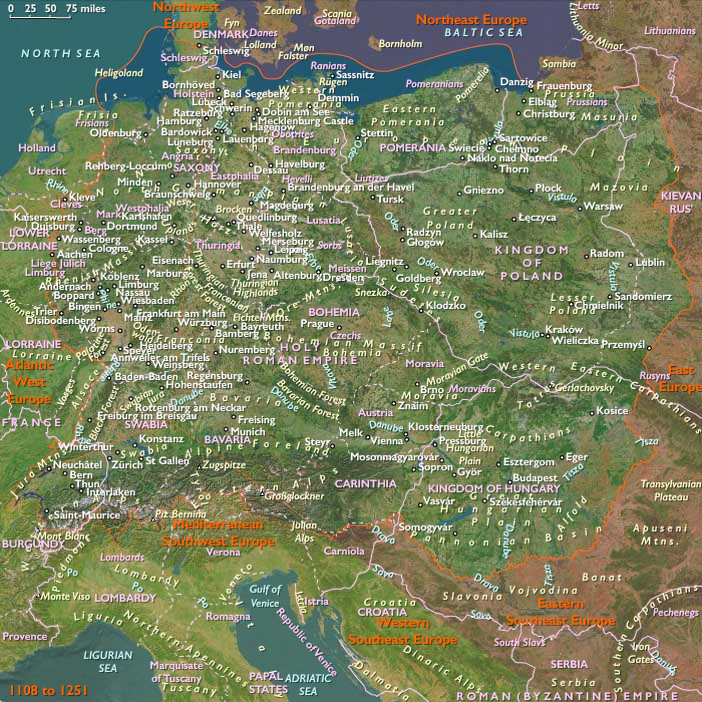
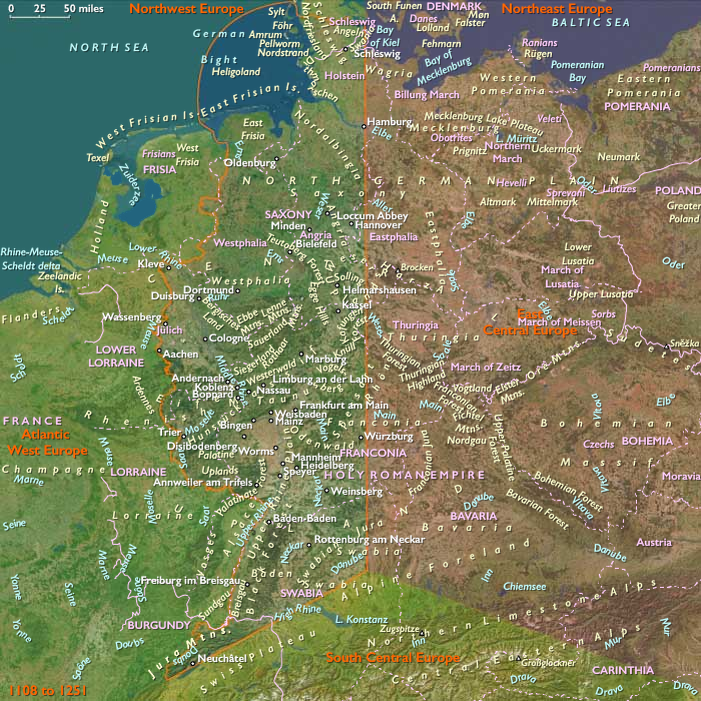
The Holy Roman Empire has become a patchwork of petty principalities.
The various city-states of northern Italy are, by this time, in no way subject to their ostensible Emperor.
The German princes and the pope had together in 1196 rejected Henry’s proposed plan to make the imperial crown a hereditary office, but following Henry’s death, the pro-Hohenstaufen princely majority, with the backing of Henry’s brother Duke Philip of Swabia, recognizes Henry’s three-year-old son, Frederick II, as their future king;.
Preferring, however, an adult ruler, they choose Philip on March 6, 1198, and later—irregularly—crown him king.
The anti-Hohenstaufen minority on June 9 elects Henry the Lion’s son, Otto of Brunswick, as king of Germany, in opposition to Philip.
Civil war between the two factions ensues.
Locations
People
Groups
Topics
Commodoties
Subjects
Regions
Subregions
Related Events
Filter results
Showing 10 events out of 47731 total
The early years of Ottokar, a younger son of King Vladislav II of Bohemia, had passed amid the anarchy which prevailed everywhere in the country.
After several struggles in which he had taken part, he had been recognized as ruler of Bohemia by Holy Roman Emperor Henry VI in 1192.
He was, however, soon overthrown for joining a conspiracy of German princes to bring down the Hohenstaufen monarchy.
In 1197, Ottokar had forced his brother, Duke Vladislaus III Henry, to abandon Bohemia to him and to content himself with Moravia.
Taking advantage of the German civil war between the Hohenstaufen claimant Philip of Swabia and the Welf candidate Otto IV, Ottokar declares himself hereditary King of Bohemia in 1198.
This title is supported by Philip of Swabia, who needs Czech military support against Otto.
Constantinople and Venice patch up their relations again in 1198, but the Venetians remain embittered.
The Cilician state known as Lesser, or Little, Armenia, established in the eleventh century by Armenian nobles and their followers in flight from the Turks, attains the status of a kingdom in 1198.
The Armenians of Cilicia, who have allied themselves with the European crusaders, develop a culture strongly influenced by the West.
Amalric has chosen to govern his two domains separately and to regard himself as merely Jerusalem's regent, and in Acre, he proves to be an excellent administrator.
As titular king of Jerusalem, Amalric is able to make peace with his Muslim neighbors, thanks to the struggle that had taken place among them after Saladin's death in 1193.
He also deals wisely with Saladin's brother, al-'Adil of Egypt.
The death of Emperor Henry VI from malaria on September 28, 1197, has caused an important change: a number of German crusaders who had arrived in Palestine decide to return home.
In order to fill the gap, the German princes and bishops, together with those of the Kingdom of Jerusalem, militarize the House of the Hospitallers of Saint Mary of the Teutons in Jerusalem in 1198, making it a religious order of knights.
The new order is put under a monastic and military rule like that of the Templars and Hospitallers.
It receives privileges from Popes Celestine III and Innocent III and extensive grants of land, not only in the kingdom of Jerusalem but also in Germany and elsewhere.
The members, who are nobles, take vows of poverty, chastity, and obedience, and come to be called the Teutonic Knights.
Cardinal D’Segni, the nephew of Pope Celestine, is elected pope on the day of his uncle's death in 1198, and takes the name Innocent III.
Involved in imperial affairs from the outset of his pontificate, the new pope recognizes as king of Sicily the son of the late Holy Roman Emperor Henry VI, following the widowed Constance of Sicily’s acceptance of papal sovereignty over Sicily.
At Constance’s death later in 1198, Innocent becomes regent for the infant Frederick.
The same year, Innocent makes his cousin, Ugolino dei conti di Segni, a native of Anagni, Italy, a cardinal deacon.
Innocent attempts to reorganize the Crusading efforts under papal auspices.
Despite manifold problems in the West, he is the first pope since Urban II to be both anxious and able to consider the Crusade a major papal concern.
In 1198, he broaches the subject of a new expedition through legates and encyclical letters.
He immediately lays an interdict on Laon in an attempt to stamp out independent beliefs there.
This will be followed by interdicts against France in 1199 and Normandy in 1203.
Frederick, the infant son of Holy Roman Emperor Henry VI and Constance, Queen of Sicily, had been elected King of the Germans in 1196, at Frankfurt am Main.
His rights in Germany had been disputed by Henry's brother Philip of Swabia and Otto of Brunswick.
At the death of his father in 1197, the two-year-old Frederick had been in Italy traveling towards Germany when the bad news reached his guardian, Conrad of Spoleto.
Frederick had been hastily brought back to his mother Constance in Palermo, Sicily, where he was crowned as King on May 17, 1198, now Frederick I of Sicily.
Constance of Sicily is in her own right queen of Sicily and she establishes herself as regent.
In Frederick's name, she dissolves Sicily's ties to Germany and the Empire that had been created by her marriage, sending home his German counselors and renouncing his claims to the German throne and empire.
Upon Constance's death in 1198, Pope Innocent III succeeds as Frederick's guardian.
Averroes displays clear, analytical thinking in his commentaries on the Greek philosophers.
Averroes’ guiding principle, reflected in all his writings, is that philosophy and religion must agree.
He regards philosophers as prophets who teach the same principles as religious prophets but in a higher, more abstract form.
As orthodox Muslims consider these views heretical, the Almohad caliph Mansur banishes him from the court in 1195.
Recalled from exile in 1198, he dies soon after in Marrakech, at the age of seventy-two.
Eudes de Sully: Bishop of Paris and Ecclesiastical Reformer (1198–1208 CE)
Eudes de Sully, Bishop of Paris from 1198 to 1208, was a major figure in both ecclesiastical reforms and the construction of Notre-Dame de Paris. A staunch advocate of Christian orthodoxy, he sought to further isolate the Jewish population economically and socially, while also introducing liturgical innovations that shaped medieval Catholic worship.
Anti-Jewish Decrees and Social Restrictions
- Eudes issued a decree forbidding Christians from buying meat from Jews or engaging in discussions with them, under threat of excommunication.
- This ruling was part of broader efforts by the Church to segregate Jewish and Christian communities, reducing Jewish economic influence and reinforcing social barriers.
- His measures contributed to the gradual legal and economic marginalization of Jews in France, continuing the policies set by Philip II, who had previously expelled Jews from the royal domain in 1182.
Contributions to Notre-Dame de Paris
- As Bishop of Paris, Eudes continued the construction of Notre-Dame de Paris, playing a significant role in its architectural and liturgical development.
- His tenure saw the advancement of the Gothic design, emphasizing grandeur and verticality in the cathedral’s interior.
Liturgical Innovations and Church Reform
-
Emphasis on the Elevation of the Host
- Eudes is credited as the first bishop to emphasize the elevation of the host during the Catholic Mass, a ritual that became a central moment in medieval Eucharistic devotion.
- This practice reinforced the doctrine of transubstantiation, which was later formalized at the Fourth Lateran Council in 1215.
-
Restrictions on the Reception of Communion
- In 1175, Eudes forbade communion for children, reflecting growing concerns about proper reverence and understanding of the sacrament.
- This ruling contributed to later Church practices that delayed First Communion until the recipient had reached an age of reason.
-
Custody of the Reserved Host
- Eudes issued a decree requiring a "clean pyx" (a sacred vessel) for the storage of the Eucharist.
- This rule had a lasting impact on English liturgical practices, influencing the handling and reverence of the consecrated host.
Social and Cultural Reforms
-
Regulation of Festivities
- Eudes attempted to control celebrations in his cathedral, particularly Christmas and the Feast of Fools, which had become increasingly irreverent and disorderly.
- His efforts aimed to curb excessive revelry and maintain the sanctity of church festivals.
-
Ban on Chess
- He tried to prohibit the playing of chess, likely viewing it as a distraction from religious duties or a game associated with gambling.
- This reflected a broader medieval clerical suspicion toward games of strategy and chance.
Support for Monasticism and Church Music
- Founder of Port-Royal Abbey – Eudes played a role in the establishment of the monastery that later became Port-Royal, which would have a lasting impact on French religious thought in later centuries.
- Promoter of Polyphony – He actively encouraged the use of polyphony in sacred music, supporting the works of Pérotin, one of the greatest medieval composers associated with the Notre-Dame school of polyphony.
Legacy of Eudes de Sully
Eudes de Sully was a highly influential bishop, whose impact extended across liturgy, architecture, religious law, and music. His anti-Jewish policies foreshadowed later systematic restrictions on Jewish life in France, while his liturgical reforms and architectural contributions shaped the medieval Catholic experience. His promotion of polyphony and his efforts to control public celebrations also demonstrate the expanding role of the Church in medieval society, both in sacred and secular affairs.
Richard I’s War Against Philip II and His Victories in France (1194–1198 CE)
Determined to defend Angevin territories from Philip II’s encroachment, particularly in the Vexin and Berry, Richard I of England devoted his military expertise and vast resources to waging war against the French king. Through a combination of strategic alliances and military victories, Richard turned the tide against Philip, severely weakening the Capetian position in northern France.
Richard’s Anti-Capetian Alliance
To counter Philip’s ambitions, Richard forged a broad coalition of allies:
- Baldwin IX, Count of Flanders – Strengthened Angevin influence in the north.
- Renaud, Count of Boulogne – Provided additional support against Philip’s forces.
- Sancho VI of Navarre (his father-in-law) – Launched raids into southern France, distracting Philip.
- Otto IV of Germany (his nephew) – Richard secured the Welf inheritance in Saxony, ensuring Otto was elected Holy Roman Emperor in 1198, creating an additional threat to Philip’s eastern flank.
By strengthening the Welf faction in the Holy Roman Empire, Richard weakened Philip’s diplomatic influence in Europe, making it harder for him to focus on the Angevin war.
Richard’s Military Victories Over Philip
-
Battle of Fréteval (1194)
- Shortly after Richard’s return from captivity, he rallied forces in Normandy and ambushed Philip at Fréteval.
- Philip fled the battlefield, leaving behind his entire archive of financial audits and documents, a devastating logistical loss.
-
Battle of Gisors / Courcelles (1198)
- Richard won a decisive victory against Philip’s forces.
- It was during this battle that Richard is said to have adopted the motto "Dieu et mon Droit" ("God and my Right"), symbolizing his belief that he owed allegiance only to God, not to Philip or the Emperor.
- This phrase remains the motto of the British monarchy to this day.
Impact of Richard’s Campaigns
- Richard successfully reversed Philip’s early territorial gains, reclaiming much of Normandy and the Vexin.
- His military success left Philip militarily and politically vulnerable, unable to expand as he had hoped.
- By securing Otto IV’s election, Richard turned the Holy Roman Empire into an Angevin ally, further isolating Philip in Europe.
Despite Philip’s earlier advances, by 1198, Richard had gained the upper hand, and the war was tilting in favor of the Angevins. However, his unexpected death in 1199 would dramatically alter the balance of power in the Capetian-Plantagenet struggle.
