
...the Holy League is dissolved by the …
Years: 1577 - 1577
September
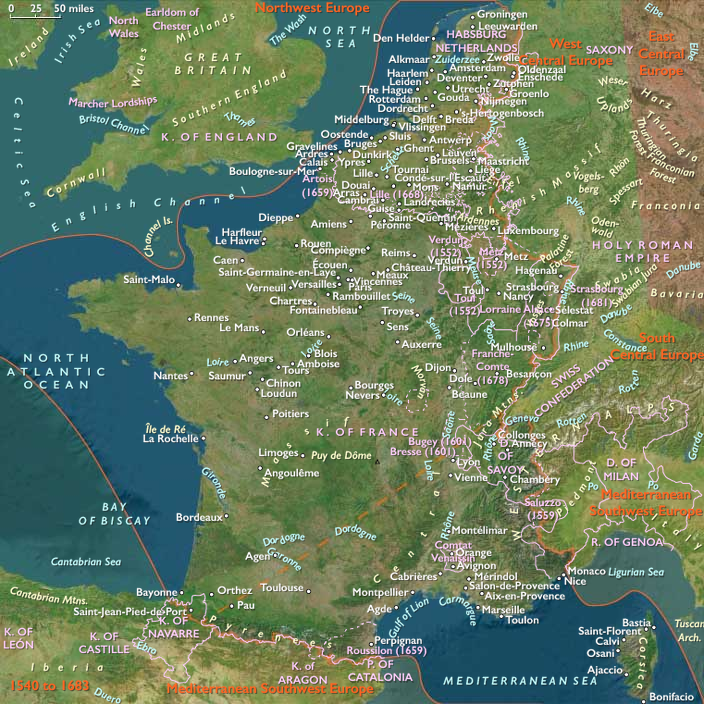
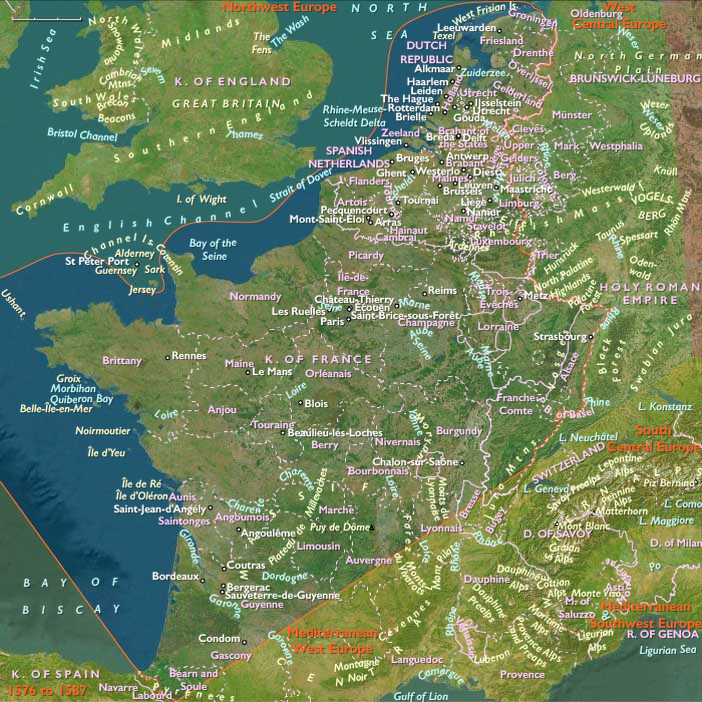
...the Holy League is dissolved by the order of Henry III, who has failed at an attempt to place himself at the head of the Catholic party.
Locations
People
Groups
- Christians, Roman Catholic
- France, (Valois) Kingdom of
- Huguenots (the “Reformed”)
- Holy, or Catholic, League, the (French)
Topics
- Protestant Reformation
- Counter-Reformation (also Catholic Reformation or Catholic Revival)
- Religion, Sixth War of
Commodoties
Subjects
Regions
Subregions
Related Events
Filter results
Showing 10 events out of 35098 total
Nagao Torachiyo was the third son of the head of Echigo province in northeastern Japan.
With the death of his father in 1543, the family's control of the area had begun to disintegrate.
Torachiyo had not only restored order to the area but also gained control of neighboring provinces, becoming one of the most powerful warriors on the Kanto Plain in central Honshu.
Uesugi Norimasa, who had inherited the position of kanrei, or governor-general, of Kanto and whose family had long been the most powerful in the area, had been defeated in 1552 by the Hojo clan and had taken shelter with Torachiyo, whom he had adopted as his son.
Torachiyo had then changed his surname to Uesugi.
He had received many of the hereditary vassals of the Uesugi family, and he had also become involved in a series of battles with the eastern warlords of the Hojo and Takeda families for control of the Kanto region.
Uesugi's battles with the noted general Takeda Shingen had resulted in no permanent gain for either side, however.
Meanwhile, Oda Nobunaga had become the strongest military leader in Japan, and in 1573 he had overthrown the shogunate and begun to consolidate his control over the capital.
The only warrior strong enough to challenge Oda is Uesugi, and in 1577 he agrees to undertake an expedition to restore the shogunate.
He dies, however, before the expedition can get under way.
Tycho compares the lack of diurnal parallax of the comet of 1577 with the well-known parallax of the Moon (the diurnal parallax is the apparent change of position in the sky relative to the distant stars due to the rotation of the Earth).
Tycho deduces that the comet is at least four times farther away than the Moon, establishing for the first time critical proof that comets are heavenly bodies.
Jost Amman, one of the most prolific and skilled book illustrators of the seventeenth century, had been educated in Zürich and worked for a short time in Basel, where he designed glass paintings for prominent families.
He had moved to Nürnberg in about 1560–61 but retains his citizenship of Zürich until 1577.
In numerous drawings, such as Entry of Maximilian II into Nürnberg in 1570, Amman has revealed himself as a brilliant and witty recorder of contemporary events.
His engravings include historical portraits, such as those of the kings of France; heraldic designs; title pages; and scenes of warfare, hunting, and pageantry.
He has also produced thousands of woodcuts for various works.
One of the most notable is a book on the arts and crafts with poems by the poet-dramatist Hans Sachs, entitled Eygentliche Beschreibung aller Stände auff Erden (1568; “Actual Description of All the Professions in the World”).
The Book of Concord, published in 1580, contains the three ancient creeds (Apostles', Nicene, and Athanasian), the Augsburg Confession, the Apology of the Augsburg Confession, Luther's Schmalkaldic Articles, Luther's Small and Large Catechism, Melanchton's Treatise on the Power and Primacy of the Pope, and the Formula of Concord.
This becomes the official teaching of the Lutheran churches but of these Lutheran symbols only the Augsburg Confession and Luther's Small Catechism are accepted by all Lutheran churches.
Protestants have continued to debate, among other issues, adiaphorism, the opinion that certain doctrines or practices in morals or religion are matters of indifference because they are neither commanded nor forbidden in the Bible.
After two political conferences in 1558 and 1561 had failed to produce agreement on the effort to heal the divisions in German Lutheranism after Martin Luther's death in 1546 and to keep the Lutheran churches from being absorbed into an all-Protestant union, the Lutheran rulers in Germany entrust the project to several theologians, who produce the Formula of Concord, essentially an interpretation of the Augsburg Confession.
Written primarily by the theologians Jakob Andreä and Martin Chemnitz, and put in final form in 1577, this work, which further defines the Lutheran position in reference to controversies both within and outside the ranks, inaugurates the era of Lutheran orthodoxy.
The Formula attempts to settle the matter of adiaphorism by stating that rites and ceremonies that are matters of religious indifference cannot be imposed during times of controversy.
The Drukpa and the Lhapa sects of the persecuted Kagyupa branch of Tibetan Buddhism have been struggling for control of western Bhutan since the twelfth century.
The Lhapa order has built the original dzongs, a distinctive type of fortress architecture, in Bhutan, including that of Punakha, established in 1577 on a relatively flat spit of land at the confluence of the Mo Chhu and Pho Chhu rivers.
The rivers surround the dzong on three sides, providing protection from attack.
By tradition, dzongs are constructed without the use of architectural plans.
Instead construction proceeds under the direction of a high lama who establishes each dimension by means of spiritual inspiration.
The the dzongs are built using corvée labor which is applied as a tax against each household in the district.
Under this obligation each family is to provision a decreed number of workers to work for several months at a time in the construction of the dzong.
Recent research by the prominent Bhutanese scholar C.T. Dorji suggests that the original 'model dzong' may not be Simtokha Dzong as commonly believed, but Dobji Dzong, built in 1531 at an altitude of sixty-six hundred meters on a cliff facing the gorge of the Wangchhu River.
Unlike the dzongs built in the seventeenth century under the direction of the Shabdrung for defensive purposes, Dobji dzong had been constructed to serve a religious purpose, marking the spot where Ngawang Chogyel "...followed a spring water which originated from beneath the throne of Jetsun Milarepa in Druk Ralung to find a suitable site for establishing a center to propagate drukpa kagyu teachings in Bhutan".
Portuguese Bishop Andre da Oviedo dies and is buried in Fremona 1577; his tomb becomes a shrine to the local Catholics.
Conflict with Christian Ethiopians and the Oromo in 1577 forces the removal of the capital of the Adal Sultanate from Harar to the Aussa desert one hundred miles (one hundred and sixty kilometers) north.
Bartolomé de Medina and the Formulation of Probabilism (1577)
Bartolomé de Medina (1527–1581) was a Dominican friar, theologian, and a staunch proponent of Thomism, who began teaching theology at the University of Salamanca in 1576. In 1577, he developed Probabilism, a moral theological system designed to resolve ethical dilemmas when certainty about sinfulness or permissibility is lacking.
The Concept of Probabilism
- Probabilism is a method for making moral decisions when uncertainty exists about whether an action is sinful or permissible.
- Medina argued that if there is a "probable opinion" supporting the permissibility of an action, one may follow it in good conscience, even if a more probable opinion suggests it is sinful.
Criteria for a Probable Opinion
An opinion is considered probable if it meets one of two conditions:
-
Intrinsic Probability
- The opinion is based on sound, logical arguments and reasoning.
-
Extrinsic Probability
- The opinion is supported by recognized authorities, such as Church Fathers, theologians, or canon law scholars.
Impact of Probabilism in Catholic Moral Theology
- Probabilism offered a flexible moral framework, allowing greater freedom of conscience while still adhering to the principles of Christian ethics.
- It became one of the dominant methods of moral reasoning within Catholic theology, influencing later Jesuit theologians.
- However, it also led to controversies—some critics argued that it weakened moral rigor, making it too easy to justify questionable actions.
Conclusion: Medina’s Legacy in Moral Theology
Bartolomé de Medina’s formulation of Probabilism in 1577 marked a significant development in Catholic moral theology, providing a rational approach to ethical uncertainty. His method remained influential in Jesuit casuistry and theological debates well into the 17th and 18th centuries, shaping the discourse on conscience and moral decision-making within the Catholic Church.
The goldsmith and miniaturist Nicholas Hilliard, recently married, had left in 1576 for France, despite the royal patronage, "with no other intent than to increase his knowledge by this voyage, and upon hope to get a piece of money of the lords and ladies here for his better maintenance in England at his return", carefully reported the English Ambassador in Paris, Sir Amyas Paulet, with whom Hilliard is to stay for much of the time.
Francis Bacon is attached to the embassy, and Hilliard had done a miniature of him in Paris.
He appears in the papers of the duc d'Alençon, a suitor of Queen Elizabeth, under the name of "Nicholas Belliart, peintre anglois" in 1577, receiving a stipend of two hundred livres.
Years: 1577 - 1577
September
Locations
People
Groups
- Christians, Roman Catholic
- France, (Valois) Kingdom of
- Huguenots (the “Reformed”)
- Holy, or Catholic, League, the (French)
Topics
- Protestant Reformation
- Counter-Reformation (also Catholic Reformation or Catholic Revival)
- Religion, Sixth War of
