The history of Parthia is obscure during …
Years: 81BCE - 70BCE
The history of Parthia is obscure during this period, but Orodes' reign seems to have ended, as it had begun, in civil war with an unknown claimant.
The name of his successor is also unknown, and it is only with the beginning of the reign of Sanatruces in about 77 BCE, that the line of Parthian rulers can again be reliably traced.
Orodes is mentioned as king of kings of the Arsacid dynasty in a Babylonian report of the lunar eclipse of April 11, 80 BCE.
Locations
People
Groups
Topics
Commodoties
Subjects
Regions
Subregions
Related Events
Filter results
Showing 7 events out of 7 total
The Middle East: 81–70 BCE
The Third Mithridatic War and the Rise of Parthia
Between 81 and 70 BCE, significant geopolitical shifts occur in the Middle East as Rome consolidates its dominance in the region and Parthia emerges as a significant power.
Peace is initially restored between Pontus and Rome on the orders of Lucius Cornelius Sulla, ending the Second Mithridatic War. However, stability proves fleeting, and the Third Mithridatic War (73–63 BCE) soon erupts as the last and most prolonged conflict between Mithridates VI of Pontus and his allies against the Roman Republic. The alliance formed between Mithridates VI and Quintus Sertorius, leader of the anti-Sullan faction, creates a formidable coalition capable of threatening Roman supremacy in the region.
The immediate catalyst for this war is the bequest to Rome by King Nicomedes IV of Bithynia upon his death in 74 BCE, leaving his kingdom to the Roman Republic. Exploiting the simultaneous revolt of Sertorius in Spain, Mithridates launches an offensive in Asia Minor, initially encountering minimal resistance. The Roman Senate responds by dispatching the consuls Lucius Licinius Lucullus and Marcus Aurelius Cotta. While Lucullus governs Cilicia, Cotta is assigned to Bithynia. With Rome's attention divided and its forces stretched thin—Pompey, Rome’s preeminent general, occupied in Gaul and Spain suppressing the Sertorian rebellion—Mithridates finds an opening for early successes.
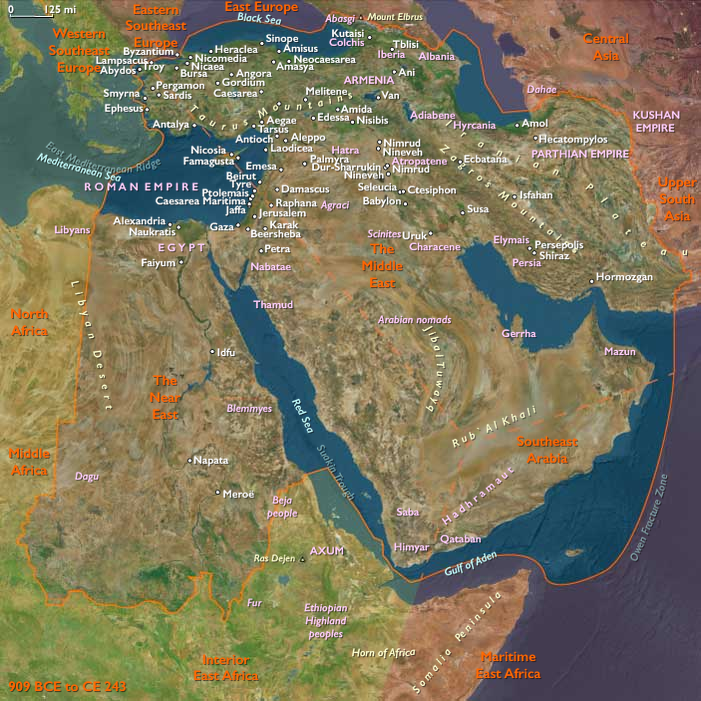
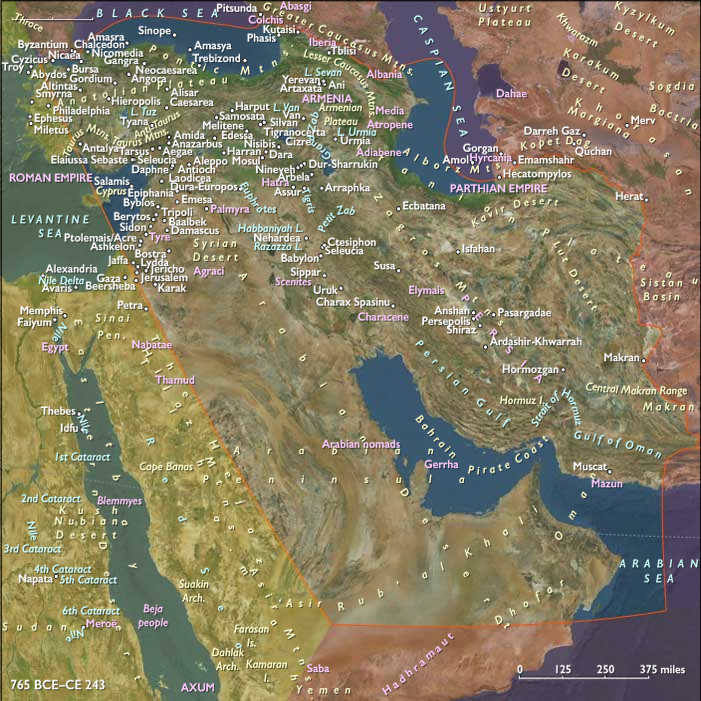
Meanwhile, in Mesopotamia, the city of Hatra emerges as a significant commercial and religious center. Located strategically sixty-eight miles southwest of modern Mosul, Iraq, Hatra gains prominence as the capital of Araba, a semi-autonomous state under increasing Parthian influence, benefiting from its location along critical caravan trade routes.
In Parthia, the historical record during this period is fragmented, though the reign of King Orodes ends amidst internal strife. The subsequent succession is initially obscure until the ascent of Sanatruces around 77 BCE, stabilizing the Arsacid dynasty. The only direct reference to Orodes as king of kings is found in a Babylonian account of a lunar eclipse dated to April 11, 80 BCE.
Thus, this period, from 81 to 70 BCE, sees the continuing struggle for dominance between Rome and Pontus, the strengthening of Parthian influence in Mesopotamia, and the rise of critical regional centers such as Hatra, shaping the geopolitical landscape for future centuries.
Peace is restored between Pontus and Rome on the orders of Sulla, ending the Second Mithridatic War.
The Third Mithridatic War (73–63 BCE) is the last and longest of three Mithridatic Wars fought between Mithridates VI of Pontus and his allies and the Roman Republic.
The alliance between Mithridates VI and Quintus Sertorius, the main leader of the opposition to Sulla, joins these two threats into a unity much larger than its parts and has the serious potential of overturning Roman power.
The immediate cause of the Third War is the bequest to Rome by King Nicomedes IV of Bithynia of his kingdom upon his death in 74 BCE.
Having launched an attack at the same time as a revolt by Sertorius sweeps through the Spanish provinces, Mithridates is initially virtually unopposed.
The Senate responds by sending the consuls Lucius Licinius Lucullus and Marcus Aurelius Cotta to deal with the Pontic threat.
The only other possible general for such an important command, Pompey, is in Gaul, marching to Hispania to help crush the revolt led by Sertorius.
Lucullus is sent to govern Cilicia and Cotta to Bithynia.
Sulla Felix (Fortunate), as he now styles himself, who as dictator has total control of the city of Rome and its affairs, institutes a program of executing those whom he perceives to be enemies of the state.
This is akin to (and in response to) those killings which Marius and Cinna had implemented while they were in control of the Republic during Sulla's absence.
Proscribing or outlawing every one of those whom he perceives to have acted against the best interests of the Republic while he was in the east, Sulla orders some fifteen hundred nobles (i.e., senators and equites) executed, although it is estimated that as many as nine thousand people are killed.
The purge goes on for several months.
Helping or sheltering a person who has beens proscribed is also punishable by death.
The State confiscates the wealth of the outlawed and then auctions it off, making Sulla and his supporters vastly rich.
The sons and grandsons of the proscribed are banned from future political office, a restriction that is not to be removed for over thirty years.
Having observed the violent results of radical popularis reforms (in particular those under Marius and Cinna), Sulla is naturally conservative; his conservatism is more reactionary when dealing with the Tribunate and legislative bodies, while more visionary when reforming the court system and membership of the Senate.
As such, he seeks to strengthen the aristocracy, and thus the Senate.
Sulla retains his earlier reforms, which require senatorial approval before any bill can be submitted to the Plebeian Council (the principal popular assembly), and which had also restored the older, more aristocratic ("Servian") organization to the Century Assembly (assembly of soldiers).
Himself a Patrician and thus ineligible for election to the office of Plebeian Tribune, Sulla thoroughly dislikes the office, having grown up during the turmoil of the Gracchi era.
As Sulla views the Tribunate, the office is especially dangerous, which is in part due to its radical past: his intention is to not only deprive the Tribunate of power, but also of prestige.
The reforms of the Gracchi Tribunes are one such example of its radical past, but by no means the only examples; Sulla himself had been officially deprived of his eastern command through the underhand activities of a tribune.
Over the previous three hundred years, the tribunes have been the officers most responsible for the loss of power by the aristocracy.
Since the Tribunate is the principal means through which the democracy of Rome has always asserted itself against the aristocracy, it is of paramount importance to Sulla that he cripple the office.
Through his reforms to the Plebeian Council, tribunes lose the power to initiate legislation.
Sulla then prohibits ex-tribunes from ever holding any other office, so ambitious individuals would no longer seek election to the Tribunate, since such an election would end their political career.
Finally, Sulla revokes the power of the tribunes to veto acts of the Senate, although he leaves intact the tribunes' power to protect individual Roman citizens.
Sulla now increases the number of magistrates who are elected in any given year, and requires that all newly elected quaestors be given automatic membership in the Senate.
These two reforms are enacted primarily to allow Sulla to increase the size of the Senate from three hundred to six hundred senators.
This also removes the need for the censor to draw up a list of senators, since there are always more than enough former magistrates to fill the senate.
To further solidify the prestige and authority of the Senate, Sulla transfers the control of the courts from the equites, who have held control since the Gracchi reforms, to the senators.
This, along with the increase in the number of courts, further adds to the power already held by the senators.
He also codifies, and thus establishes definitively, the cursus honorum, which requires an individual to reach a certain age and level of experience before running for any particular office.
Sulla also wants to reduce the risk that a future general might attempt to seize power, as he himself had done.
To reduce this risk, he reaffirms the requirement that any individual wait for ten years before being reelected to any office.
Sulla then establishes a system where all consuls and praetors serve in Rome during their year in office, and then command a provincial army as a governor for the year after they leave office.
Finally, in a demonstration of his absolute power, he expands the "Pomerium", the sacred boundary of Rome, untouched since the time of the kings.
Many of Sulla's reforms look to the past (often re-passing former laws), but he also regulates for the future, particularly in his redefinition of maiestas (treason) laws and his reformation of the Senate.
Near the end of 81 BCE, Sulla, true to his traditionalist sentiments, resigns his dictatorship, disbands his legions and reestablishes normal consular government.
He also stands for (with Metellus Pius) and is elected consul for the following year, 80 BCE.
He dismisses his lictors and walks unguarded in the Forum, offering to give account of his actions to any citizen.
(In a manner that the historian Suetonius thought arrogant, Julius Caesar will later mock Sulla for resigning the Dictatorship.)

The formative years of Gaius Julius Casear had been a time of turmoil, though little is recorded of his childhood.
Caesar's father, also called Gaius Julius Caesar, governor of the province of Asia, had died suddenly in 85 BCE, leaving young Caesar head of the family at sixteen.
He had been nominated in the following year to be the new high priest of Jupiter, a position that not only requires the holder to be a patrician but also be married to a patrician. For this reason Caesar had broken off his engagement to a plebeian girl he had been betrothed to since boyhood and married Cornelia, the daughter of Lucius Cinna.
Casear as Cinna's son-in-law had in 81 BCE been one of the targets of Sulla’s purges and fled Rome.
Stripped of his inheritance, his wife's dowry and his priesthood, he had refused to divorce Cornelia and was forced to go into hiding.
Escaping harm through the intervention of such people as his mother's relative, Gaius Aurelius Cotta, and the Vestal Virgins, Caesar had left Rome and joined the army, where he had won the Civic Crown for his part in an important siege, that of Mytilene.
On a mission to Bithynia to secure the assistance of King Nicomedes's fleet, he had spent so long at his court that rumors had arisen of an affair with the king, which Caesar will vehemently deny for the rest of his life.
Ironically, the loss of his priesthood had allowed him to pursue a military career, as the high priest of Jupiter is not permitted to touch a horse, sleep three nights outside his own bed or one night outside Rome, or look upon an army.
Many of Caesar’s relatives are Sulla's supporters, but Sulla notes in his memoirs that he regretted sparing Caesar's life, because of the young man's notorious ambition.
The historian Suetonius records that when agreeing to spare Caesar, Sulla warned those who were pleading his case that he would become a danger to them in the future, saying "In this Caesar there are many Mariuses."
Caesar, hearing of Sulla's death in 78 BCE, feels safe enough to return to Rome.
The weakening of Rhodes in the Mithridatic Wars has resulted in rampant piracy in the eastern Mediterranean, one of the symptoms of the anarchy into which the Roman nobility have allowed the Mediterranean world to fall.
Cesar, captured by pirates on the way across the Aegean Sea and held prisoner, maintains an attitude of superiority throughout his captivity.
When the pirates think to demand a ransom of twenty talents of silver, he insists they ask for fifty.
After the ransom is paid, Caesar raises a fleet, pursues and captures the pirates, and imprisons them.
He has them crucified on his own authority, as he had promised while in captivity—a promise the pirates had taken as a joke.
As a sign of leniency, he had first had their throats cut.
Bithynia has come increasingly under the control of Rome, although the decade following the restoration of Nicomedes IV has been relatively peaceful.
Young Gaius Julius Caesar, sent in 80 BCE, to raise a fleet using Bithynia's resources, had dallied so long with the King that a rumor of a homosexual relationship had surfaced, leading to the disparaging title, "the Queen of Bithynia", an allegation of which Caesar's political enemies will make much use later in his life.
Nicomedes, like Attalus of Pergamon, bequeaths his entire kingdom to Romei n 74 BCE as one of his last acts as king of Bithynia.
The Roman Senate quickly votes it as a new province.
Rome's old enemy Mithridates VI has other plans for Bithynia, however, and Nicomedes’ death and bequest lead directly to the Third Mithridatic War.
The Romans, after the brief so-called Second Mithridatic War ended in 82 BCE without any territorial gains by either side, had begun securing the coastal region of Lycia and Pamphylia from pirates and established Roman control over Pisidia and Lycaonia.
The Cilician pirates have not been completely defeated however, and Mithridates signs an alliance with them.
He is also allied with the government of Quintus Sertorius in Spain and with his help reorganizes some of his troops in the Roman legionary pattern with short stabbing swords.
In joining those two threats into a unity much larger than its parts, Mithridates has the serious potential of overturning Roman power.
Mithridates, having long presumed the Kingdom of Bithynia for himself, invades the country in 73 BCE, putting the small Roman garrison under pressure and isolating them from assistance.