The history of mathematical development in China …
Years: 333BCE - 190BCE
The history of mathematical development in China lacks some evidence.
There are still debates about certain mathematical classics.
For example, the Zhou Bi Suan Jing, one of the oldest and most famous Chinese mathematical texts, may date to around 1200–1000 BCE, yet many scholars believe it was written between 300–250 BCE.
Moreover, its compilation and addition of materials continues into the Han Dynasty (202 BCE – 220 CE).
The Zhou Bi Suan Jing is an anonymous collection of two hundred and forty-six problems encountered by the Duke of Zhou and his astrologer Shang Gao.
Each question states their numerical answer and corresponding arithmetic algorithm.
This book contains one of the first recorded proofs of the Gougu Theorem (Pythagorean Theorem) but focuses more on astronomical calculations.
The Zhou Bi Suan Jing also solves problems involving square roots, and places the value of pi at 3.1547.
Locations
Groups
Topics
Subjects
Regions
Subregions
Related Events
Filter results
Showing 10 events out of 64522 total
The Achaemenids dominate the whole of the Near and Middle East for two centuries until the rise of Macedonian power under Alexander the Great.
Alexander, leading a small but well-trained army, had crossed into Asia in 334 BCE, defeated Persia's forces, and within a few years has built an empire that stretches from the Nile River to the Indus River in contemporary Pakistan.
Alexander's conquests are divided among his Macedonian generals after his death in 323 BCE.
The Ptolemaic Dynasty of pharaohs in Egypt and the line of Seleucid kings in Syria are descended from two of these generals.
King An Duong Vuong of Thuc, the upland neighbor to the kingdom of Van Lang, overthrows the last Hung king in the third century BCE.
An Duong Vuong unites Van Lang with Thuc to form Au Lac, building his capital and citadel at Co Loa, thirty-five kilometers north of present-day Hanoi.
An Duong's kingdom is short-lived, however, being conquered in 208 BCE by the army of the Chinese Qin dynasty (221-207 BCE) military commander Trieu Da (Zhao Tuo in Chinese).
Reluctant to accept the rule of the Qin dynasty's successor, the new Han dynasty (206 BCE-CE 220), Trieu Da combines the territories under his control in southern China and northern Vietnam and establishes the kingdom of Nam Viet (Nan Yue in Chinese), meaning Southern Viet.
Viet (Yue) is the term applied by the Chinese to the various peoples on the southern fringes of the Han empire, including the people of the Red River Delta.
Trieu Da divides his kingdom of Nam Viet into nine military districts; the southern three (Giao Chi, Cuu Chan, and Nhat Nam) include the northern part of present-day Vietnam.
The Lac lords continue to rule in the Red River Delta, but as vassals of Nam Viet.
The earliest known site in the region now called Cambodia is Laang Spean cave in the northwest, first occupied beginning in 7000 BCE.
Also significant is the site Samrong Sen, which was occupied circa 230 to 500 BCE.
Cambodians began to domesticate animals and grow rice from 2000 BCE.
Recent research has discovered so-called ‘red soil’ artificial circular earthworks dating to the Neolithic era in the regions of present Cambodia and Vietnam.
Some historians speculate that the Khmer people arrived before their present Vietnamese, Thai, and Lao neighbors.
Austroasiatic in origin and related to the ancestors of the groups who now inhabit insular Southeast Asia and many of the islands of the Pacific Ocean, they work metals, including iron and bronze, and possess navigational skills.
Most scholars believe the Khmer arrived in Southeast Asia at least three thousand years ago, much earlier than the Tai people who now inhabit many parts of what was originally Austroasiatic territory.
The Khmer are linguistic relatives to the Mon, who settled further to the west.
The reason they migrated into Southeast Asia is generally debated, but scholars believe that speakers of the Mon–Khmer language family were pushed down by invading Sino-Tibetans from the north, as evinced by Austroasiatic vocabulary in Chinese, or for agricultural purposes, as evinced by their migration routes along major rivers.
The history of the Khmer people after their establishment in Southeast Asia parallels the history of Cambodia.
Maritime East Asia (333–190 BCE): Qin Unification and Philosophical Consolidation
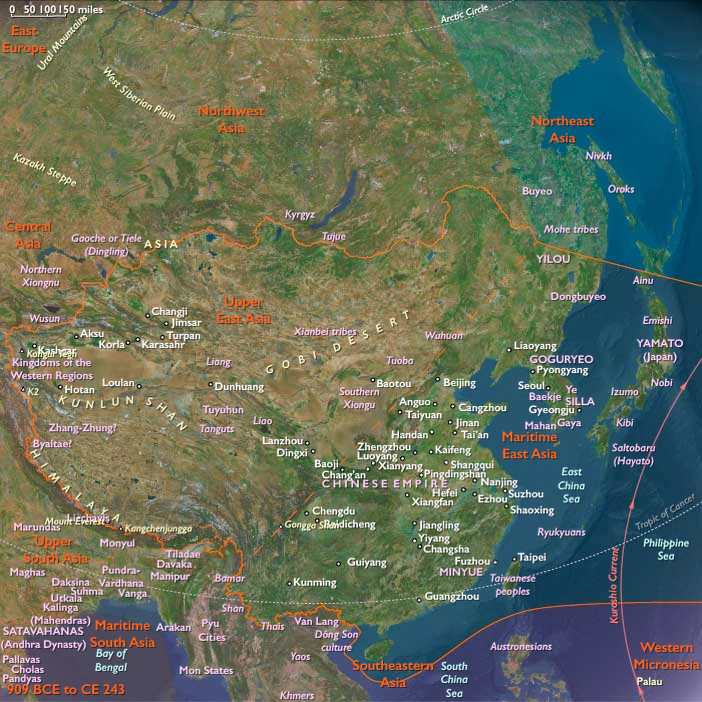
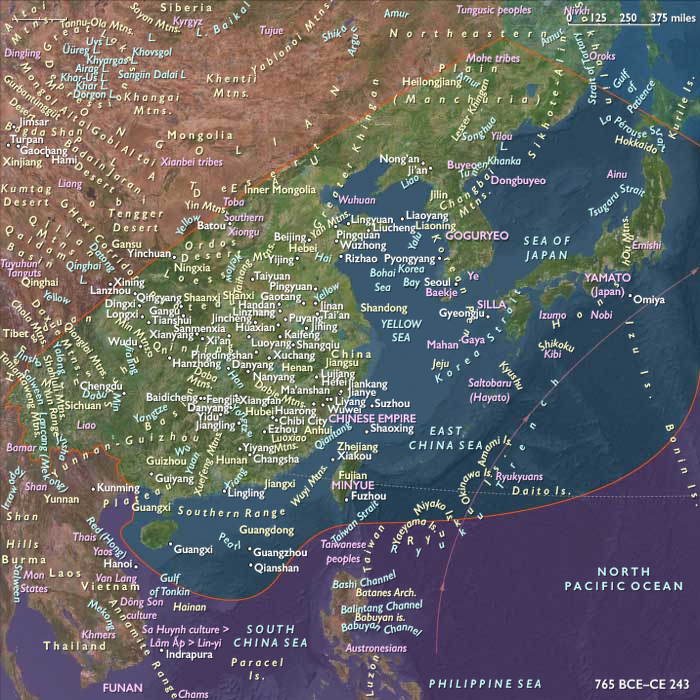
Between 333 BCE and 190 BCE, Maritime East Asia—comprising lower Primorsky Krai, the Korean Peninsula, the Japanese Archipelago below northern Hokkaido, Taiwan, and southern, central, and northeastern China—experiences transformative political unification under the Qin dynasty and significant philosophical and technological developments, setting the stage for imperial China.
Qin Unification and Imperial Foundations
In 221 BCE, the western frontier state of Qin achieves dominance, subjugating the rival Warring States and uniting much of what becomes China Proper. The victorious Qin ruler takes the unprecedented title of Shi Huangdi (First Emperor), centralizing administration through a bureaucratic system that replaces hereditary rule. The Qin empire standardizes legal codes, writing systems, currency, and administrative practices, creating a unified state apparatus.
To consolidate power, the Qin emperors ruthlessly suppress dissent, persecuting Confucian scholars, destroying Confucian texts, and exiling or executing dissidents. Military campaigns expand territorial control northward and southward, while the defensive walls of former states are unified into an extensive fortification, forming the precursor to the Great Wall. Despite these achievements, Qin rule is short-lived; following Shi Huangdi's death in 210 BCE, widespread revolts topple the dynasty by 206 BCE. Nevertheless, the centralized imperial structure established by the Qin endures, influencing Chinese governance for the next two millennia.
Legalism and the State
The Qin dynasty’s consolidation relies heavily on the Legalist philosophy, formulated by Han Feizi and Li Si, who emphasize the inherently selfish nature of humans and advocate strict laws and centralized power as the sole means to maintain social order. Legalism prioritizes state strength, military prowess, and administrative efficiency over individual welfare, becoming the philosophical backbone of the Qin government. Elements of Legalism, combined with Confucian ethics, later underpin the Han dynasty's enduring governmental framework.
Philosophical Traditions and Cultural Developments
Concurrent with Qin's political centralization, philosophical traditions from the Warring States period mature and diversify:
-
Taoism (Daoism), articulated by legendary figures such as Lao Zi and later Zhuang Zi, emphasizes harmony with nature and individual adjustment to the universal Way (dao).
-
The Yin-Yang and Five Elements philosophy emerges prominently, explaining cosmic and natural phenomena through complementary dualities and elemental interactions, significantly impacting both scholarly and popular thought.
-
Mohism, founded by Mo Zi (Mo Di), promotes universal love, pacifism, utilitarianism, and strict social order. Though less dominant, Mohist thought leaves a lasting imprint on Chinese intellectual traditions.
Confucianism continues to evolve, with scholars such as Xunzi presenting a contrasting view to Mencius, arguing for humanity’s inherent selfishness and advocating education and strict authority to achieve social order.
Technological Innovations
Technological developments include early Chinese alchemists experimenting with mercury in attempts at metal transmutation, and notable advancements in mathematics and astronomy. The Zhou Bi Suan Jing, a pivotal mathematical text, emerges during this era, featuring astronomical calculations and providing one of the earliest proofs of the Gougu theorem (Pythagorean theorem). It also calculates an early value of pi, reflecting a sophisticated understanding of geometry and mathematics.
Cultural Influence in Korea
In the Korean Peninsula, archaeological findings from sites like Kŭmtan-ni near modern Pyongyang reveal extensive prehistoric occupation dating back to pottery cultures (Chŭlmun and Mumun periods). Pyongyang itself rises as a significant city during this era under the Gojoseon kingdom, historically identified as the capital Asadal (Wanggomsŏng), highlighting early Korean civilization’s roots.
Legacy of the Age: Foundations for Imperial China
Thus, the age from 333 to 190 BCE is characterized by Qin’s decisive political unification, foundational legalist doctrines, vibrant philosophical traditions, and notable technological advancements. These developments lay critical groundwork for the imperial era of Chinese history, influencing governance, philosophy, and culture profoundly for generations.

The effect of the combined work of Confucius, the codifier and interpreter of a system of relationships based on ethical behavior, and Mencius, the synthesizer and developer of applied Confucian thought, is to provide traditional Chinese society with a comprehensive framework on which to order virtually every aspect of life.
There are to be accretions to the corpus of Confucian thought, both immediately and over the millennia, and from within and outside the Confucian school.
Interpretations made to suit or influence contemporary society made Confucianism dynamic while preserving a fundamental system of model behavior based on ancient texts.
Diametrically opposed to Mencius, for example, is the interpretation of Xunzi (ca. 300-237 BCE), another Confucian follower.
Xunzi preaches that man is innately selfish and evil and that goodness is attainable only through education and conduct befitting one's status.
He also argue that the best government is one based on authoritarian control, not ethical or moral persuasion.
Much of what comes to constitute China Proper is unified for the first time in 221 BCE.
In this year the western frontier state of Qin, the most aggressive of the Warring States, subjugates the last of its rival states. (Qin in Wade-Giles romanization is Ch'in, from which the English China probably derives.)
Once the king of Qin consolidates his power, he takes the title Shi Huangdi (First Emperor), a formulation previously reserved for deities and the mythological sage-emperors, and imposes Qin's centralized, nonhereditary bureaucratic system on his new empire.
In subjugating the six other major states of Eastern Zhou, the Qin kings have relied heavily on Legalist scholar-advisers.
Centralization, achieved by ruthless methods, is focused on standardizing legal codes and bureaucratic procedures, the forms of writing and coinage, and the pattern of thought and scholarship.
To silence criticism of imperial rule, the kings banish or put to death many dissenting Confucian scholars and confiscate and burn their books.
Qin aggrandizement is aided by frequent military expeditions pushing forward the frontiers in the north and south.
To fend off barbarian intrusion, the fortification walls built by the various warring states are connected to make a five thousand-kilometer-long wall. (What is commonly referred to as the Great Wall is actually four great walls rebuilt or extended during the Western Han, Sui, Jin, and Ming periods, rather than a single, continuous wall.)
At its extremities, the Great Wall reaches from northeastern Heilongjiang Province to northwestern Gansu.
A number of public works projects are also undertaken to consolidate and strengthen imperial rule.
These activities require enormous levies of manpower and resources, not to mention repressive measures.
Revolts break out as soon as the first Qin emperor dies in 210 BCE.
His dynasty is extinguished less than twenty years after its triumph.
The imperial system initiated during the Qin dynasty, however, sets a pattern that will be developed over the next two millennia.
Another strain of thought dating to the Warring States Period is the school of yin-yang and the five elements.
The theories of this school attempt to explain the universe in terms of basic forces in nature, the complementary agents of yin (dark, cold, female, negative) and yang (light, hot, male, positive) and the five elements (water, fire, wood, metal, and earth).
In later periods these theories will come to have importance both in philosophy and in popular belief.
Xun Zi's unsentimental and authoritarian inclinations are developed into the doctrine embodied in the School of Law (fa), or Legalism.
The doctrine is formulated by Han Fei (d. 233 BCE) and Li Si (d. 208 BCE), who maintain that human nature is incorrigibly selfish and therefore the only way to preserve the social order is to impose discipline from above and to enforce laws strictly.
The Legalists exalt the state and seek its prosperity and martial prowess above the welfare of the common people.
Legalism becomes the philosophic basis for the imperial form of government.
When the most practical and useful aspects of Confucianism and Legalism are synthesized in the Han period (206 BCE – CE 220), a system of governance comes into existence that is to survive largely intact until the late nineteenth century.
Taoism (or Daoism in pinyin), the second most important stream of Chinese thought, also develops during the Zhou period.
Its formulation is attributed to the legendary sage Lao Zi (Old Master), said to predate Confucius, and Zhuang Zi (369-286 BCE).
The focus of Taoism is the individual in nature rather than the individual in society.
It holds that the goal of life for each individual is to find one's own personal adjustment to the rhythm of the natural (and supernatural) world, to follow the Way (dao) of the universe.
In many ways the opposite of rigid Confucian moralism, Taoism serves many of its adherents as a complement to their ordered daily lives.
A scholar on duty as an official will usually follow Confucian teachings but at leisure or in retirement might seek harmony with nature as a Taoist recluse.
Still another school of thought is based on the doctrine of Mo Zi (470-391 BCE), or Mo Di.
Mo Zi believed that "all men are equal before God" and that mankind should follow heaven by practicing universal love.
Advocating that all action must be utilitarian, Mo Zi condemned the Confucian emphasis on ritual and music.
He regarded warfare as wasteful and advocated pacificism.
Mo Zi also believed that unity of thought and action are necessary to achieve social goals.
He maintained that the people should obey their leaders and that the leaders should follow the will of heaven.
Although Moism fails to establish itself as a major school of thought, its views are said to be "strongly echoed" in Legalist thought.
In general, the teachings of Mo Zi leave an indelible impression on the Chinese mind.
Evidence of prehistoric occupation in a large ancient village called Kŭmtan-ni, in the Pyongyang area, from the Chŭlmun and Mumun pottery periods, will be excavated by archaeologists in 1955.
North Koreans associate Pyongyang with "Asadal", or Wanggomsŏng, the first capital (second millennium BCE) of the Gojoseon kingdom according to Korean history books, notably Samguk Yusa.
Pyongyang becomes a major city under Gojoseon.