
The high imperial rank of proconsul is …
Years: 535 - 535
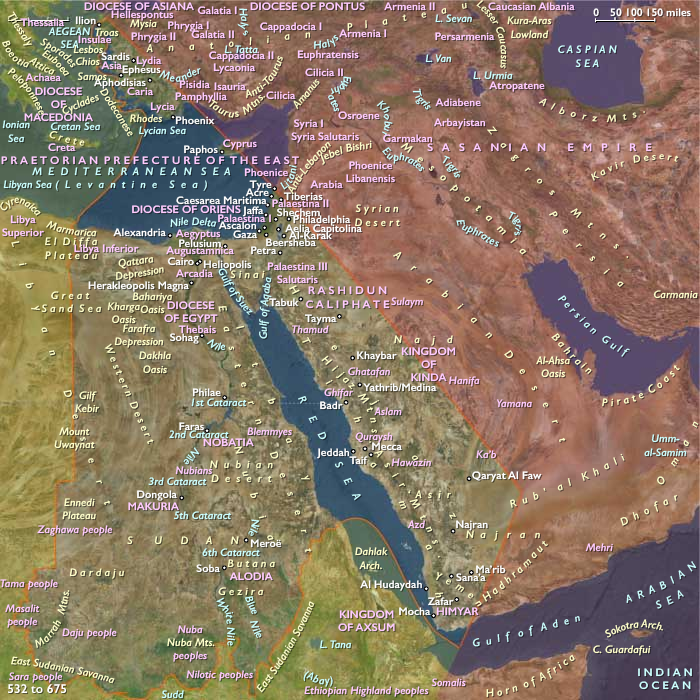
The high imperial rank of proconsul is restored in 535 to the governor of Palaestina Prima, consisting of Judea, Samaria, the coast, and Peraea with the governor residing in Caesarea.
Locations
Groups
- Palaestina Salutaris (Roman province)
- Palaestina Prima (Roman province)
- Roman Empire, Eastern: Justinian dynasty
Topics
Subjects
Regions
Subregions
Related Events
Filter results
Showing 10 events out of 57813 total
The Northern Wei Dynasty, a non-Han polity thought to have been founded in 386 by the Tuoba clan of the Xianbei tribe, is most noted for the unification of northern China in 439.
Also heavily involved in funding the arts (many works from this period survive), the dynasty had moved its capital in 494 from Datong to Luoyang and initiated the construction of the artificial Longmen Caves, where more than thirty thousand Buddhist images from the time of this dynasty will be found in modern times.
The Tuobas had at some point renamed themselves the Yuans as a part of systematic Sinicization.
Towards the end of the dynasty, which comes in 534, there had been significant internal dissidence resulting in civil wars.
General Gao Huan, originally a member of the rebel soldiers from the northern frontier, had surrendered to the general Erzhu Rong, then become one of the Erzhu clan's top lieutenants; after the clan's open war with the emperor, Gao Huan had immediately gathered his own men and turned against his former leader.
He and another general, Yuwen Tai, have established themselves in the eastern and western parts of the state, respectively, and have declared for rival claimants to the Northern Wei throne, leading to the state's division in 534-535 into Eastern Wei and Western Wei, neither of which will last much past twenty years.
The First Council of Constantinople (the fourth ecumenical council), convened in 535, denies the doctrine of the soul’s existence before conception, thus rendering reincarnation incompatible with Christian belief.
The teachings of Origen, the Christian bishop who preached reincarnation, are suppressed.
Justinian I issues the Lex Julia and declares that a wife has no right to bring criminal charges of adultery against a husband.
This makes divorce almost impossible in the Empire.
Imperial troops drive the extremist Monophysite party out of Alexandria and establish Theodosius I as patriarch of the Eastern Orthodox Church.
Agapetus, the son of Gordianus, a Roman priest who had been slain during the riots in the days of Pope Symmachus, had collaborated with Cassiodorus in founding at Rome a library of ecclesiastical authors in Greek and Latin and helped him at Vivarium in translating the canonical Greek philosophers into Latin.
On his election to the papal see in 535, his first official act is to burn, in the presence of the assembled clergy, the anathema which Boniface II had pronounced against the latter's rival Dioscurus and had ordered to be preserved in the Roman archives.
After the Imperial reconquest of Vandal of North Africa, he confirms the decrees of the council of Carthage, according to which converts from Arianism are declared ineligible to Holy Orders and those already ordained merely admitted to lay communion.
Justinian issues an edict in 535 that excludes North African Jews from public office, prohibits Jewish practice, and results in the transformation of synagogues into churches.
Many flee inland to the Berber communities in the mountains and in the desert.
The Berbers not only welcome the Jews, but eight of the tribes, impressed with Jewish erudition and technological acumen, abandon their shamanistic pagan concepts for Judaism.
Two hundred and seventeen bishops assemble in 535 in a council at Carthage and submit to Pope John II the question of whether bishops who had lapsed into Arianism should, on repentance, keep their rank or be admitted only to lay communion.
This question of readmittance to the lapsed will trouble North Africa’s Christians for centuries.
The answer to their question is given by Pope Agapetus, as John II dies on May 8, 535.
Theudebert I: The Warrior King of Austrasia and Frankish Power Struggles (r. 534–548 CE)
Following the death of his father, Theuderic I, in 534 CE, Theudebert I emerges as one of the most capable Frankish rulers, inheriting the largest of the Frankish subkingdoms, centered in Metz, which will later form the kingdom of Austrasia. However, his path to the throne is not uncontested, as his uncles, Childebert I (Paris) and Chlothar I (Soissons), challenge his rule.
1. Theudebert’s Early Military Achievements
Even before ascending to the throne, Theudebert had established himself as a formidable warrior:
-
Victory over the Danes (c. 516 CE)
- While still a prince under his father, Theudebert defeats a Danish raiding force led by King Chlochilaich(Hygelac of Beowulf).
- This battle, fought in northern Gaul, demonstrates Theudebert’s military capability and leadership.
- His success is one of the first recorded Frankish victories over a Scandinavian warlord, marking an early example of Frankish-Norse conflicts.
-
Campaigns Against the Visigoths
- Theudebert also fights in the south of Gaul, engaging the Visigoths in a series of military campaigns.
- His victories expand Frankish influence further south, setting the stage for future Merovingian control over Aquitaine and Provence.
2. The Struggle for His Inheritance (534–536 CE)
- Upon Theuderic’s death in 534 CE, Theudebert faces opposition from his uncles, Childebert I (Paris) and Chlothar I (Soissons), who attempt to seize his kingdom.
- Theudebert militarily defends his inheritance, proving his strength as a commander.
- Childebert, impressed by Theudebert’s prowess, abandons his claim and instead adopts him as his heir, ensuring a future dynastic alliance between their two realms.
3. Theudebert and Childebert’s War Against Chlothar I
- With Childebert now supporting him, Theudebert joins his uncle in a military campaign against Chlothar I.
- The conflict is abruptly halted when a storm strikes both armies, forcing the two sides to sue for peace.
- This truce temporarily stabilizes relations among the Merovingian rulers, allowing Theudebert to consolidate his rule over Austrasia.
4. The Legacy of Theudebert I
- Theudebert’s kingdom, centered in Metz, becomes the foundation of Austrasia, the dominant eastern Frankish realm.
- His military victories over Danes, Visigoths, and rival Franks establish him as one of the most successful early Merovingian rulers.
- His survival and ability to secure his inheritance mark him as a strong and independent leader, maintaining Frankish unity in a period of fragmentation.
Under Theudebert’s rule, Austrasia emerges as a major Frankish power, setting the stage for its future dominance under the Carolingians.
The Council of Clermont (535 CE): Strengthening Ecclesiastical Discipline in the Frankish Kingdom
In 535 CE, under the presidency of Honoratus, Bishop of Bourges, fifteen prelates from the Frankish Kingdom of Reims gather at Clermont-Ferrand for a synod known as the Council of Clermont. This council, like earlier Frankish church councils, aims to establish discipline, regulate clerical conduct, and reinforce Christian authority in society.
1. Canons and Their Influence on Canon Law
- The council drafts seventeen canons, sixteen of which are later included in the Decretum Gratiani, a 12th-century compilation of canon law by Gratian, a jurist from Bologna.
- These canons become part of the Corpus Iuris Canonici, the foundational body of medieval Catholic Church law.
Key Canons Passed at the Council
-
Ecclesiastical Discipline Over Temporal Matters
- Bishops are prohibited from addressing personal or secular disputes in councils before discussing matters of church discipline.
-
Clerical Authority and Secular Appeals
- Clerics are forbidden from appealing to secular authorities in disputes against their bishops.
- This ensures that ecclesiastical matters remain within the Church’s jurisdiction, preventing interference from lay rulers.
-
Condemnation of Corrupt Episcopal Appointments
- Excommunication is declared against bishops who:
- Seek secular intervention (especially from Frankish princes) to obtain bishoprics.
- Forge election decrees to manipulate their way into office.
- Excommunication is declared against bishops who:
2. Anti-Jewish Legislation
Following the precedents set by earlier Frankish councils, the Council of Clermont enacts strict laws aimed at limiting Jewish influence:
- Jewish judges are banned, preventing them from ruling over Christian subjects.
- Jews are prohibited from holding administrative positions, removing them from state and local government offices.
- The council strongly condemns and prohibits interfaith marriages between Christians and Jews, further isolating Jewish communities from Christian society.
These measures reflect the increasing integration of Church and state, as the Frankish monarchy aligns itself closely with Catholic bishops.
3. Clerical Reform and Social Regulation
- The council reinforces prohibitions on marriages between relatives, strengthening previous Church efforts to control familial alliances.
- Clerical misconduct is condemned, emphasizing the need for moral discipline among priests and bishops.
4. The Impact on Frankish Society
- The council expands the power of the Catholic Church in the Frankish Kingdom, reinforcing the hierarchical authority of bishops.
- By aligning canon law with Frankish royal policies, the Church strengthens its control over religious and legal matters.
- The anti-Jewish decrees reflect increasing religious intolerance, which will persist and intensify in medieval Europe.
Conclusion: The Council of Clermont as a Turning Point
The Council of Clermont (535 CE) marks another step in the Merovingian Church’s consolidation of power, reinforcing Christian authority, defining episcopal hierarchy, and shaping canon law. The Frankish Church and monarchy continue to work in tandem, setting the stage for the deep integration of Church and state that will define the medieval European world.
Justinian orders the foundation of the city of Justiniana Prima by law in 535, establishing the a archbishopric and making it at the same time the capital of the prefecture of Illyricum instead of Thessaloniki (although this is disputed among historians).
It also is chosen as the seat of the Dacian diocese.
The city is a completely new foundation in honor of the nearby village of Tauresium (identified with today's village of Taor in the Republic of Macedonia, near Skopje), the birthplace of Justinian.
Serb scholars also identify it as the site of Bederiana, birthplace of Justinian's uncle and mentor Justin I.
The city planning combines classical and Christian elements: thermae, a forum, and streets with colonnades.
Typical Mediterranean features go along with numerous churches.
Justinian seizes the opportunity to protest the murder of Amalasuntha, whose diplomatic relations with the Eastern emperor had always been marked by cordiality and even dependency.
Thinking that this is now his opportunity to support his fellow Catholics and to reassert direct control over the West, Justinian dispatches an expeditionary force of only eight thousand soldiers (half are heavy East Roman cavalry) to begin the reconquest of Italy and sends Belisarius with a fleet to attack Sicily, while an embassy sets off to gain the support of the powerful Franks now settled in Gaul.
Years: 535 - 535
Locations
Groups
- Palaestina Salutaris (Roman province)
- Palaestina Prima (Roman province)
- Roman Empire, Eastern: Justinian dynasty
