
The Hanseatic League is an alliance of …
Years: 1260 - 1260
The Hanseatic League is an alliance of trading guilds that is to establish and maintain a trade monopoly over the Baltic Sea, to a certain extent the North Sea, and most of Northern Europe for a time in the Late Middle Ages and the early modern period, between the thirteenth and seventeenth centuries.
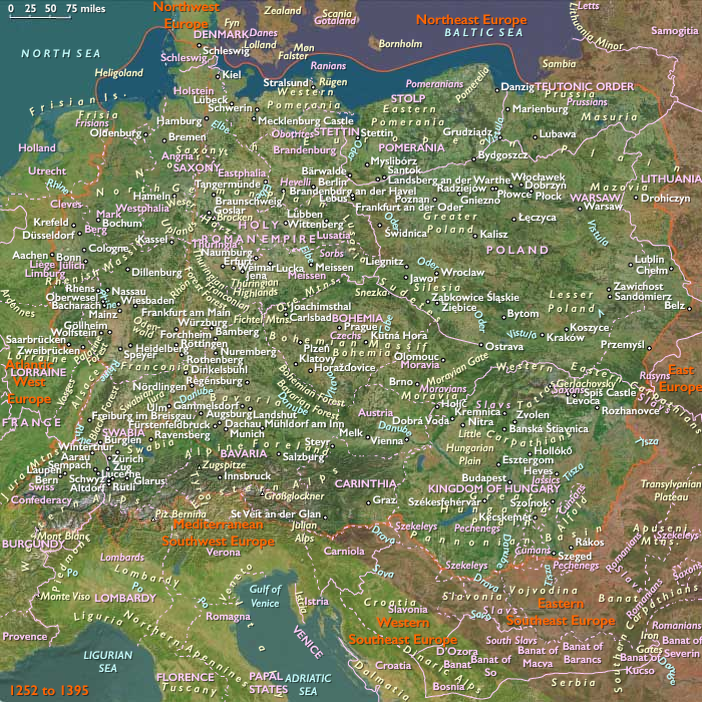
Historians generally trace the origins of the League to the rebuilding of the North German town of Lübeck in 1159 by Duke Henry the Lion of the Duchy of Saxony, after Henry had captured the area from Count Adolf II of Holstein.
Lübeck became a base for merchants from Saxony and Westphalia to spread east and north.
Well before the term Hanse would appear in a document (1267), merchants in a given city had begun to form guilds or Hansa with the intention of trading with towns overseas, especially in the less-developed eastern Baltic area, a source of timber, wax, amber, resins, furs, even rye and wheat brought down on barges from the hinterland to port markets.
The cities of Lübeck, Wismar, and Rostock have entered into a pact to defend against pirates of the Baltic Sea, laying the groundwork for the Hanseatic League.
The "Queen of the Hansa", Lübeck, where traders transshipped goods between the North Sea and the Baltic, had in 1227 gained the privilege of becoming an Imperial city, the only such city east of the River Elbe.
Having access to the Baltic and North Sea fishing grounds, Lübeck had in 1241 formed an alliance in with Hamburg, which controls access to salt-trade routes from Lüneburg.
The allied cities have gained control over most of the salt-fish trade, especially the Scania Market; and Cologne joins them in the Diet of 1260.
Locations
Groups
- Cologne, Electorate of
- Hanseatic league (informally organized)
- England, (Plantagenet, Angevin) Kingdom of
- Bremen, Archbishopric of
- Hamburg, Imperial Free City of
- Dominicans, or Order of St. Dominic
- Lübeck, Free City of
Commodoties
Subjects
Regions
Subregions
Years: 1260 - 1260
Locations
Groups
- Cologne, Electorate of
- Hanseatic league (informally organized)
- England, (Plantagenet, Angevin) Kingdom of
- Bremen, Archbishopric of
- Hamburg, Imperial Free City of
- Dominicans, or Order of St. Dominic
- Lübeck, Free City of
Commodoties
Subjects
Regions
Subregions