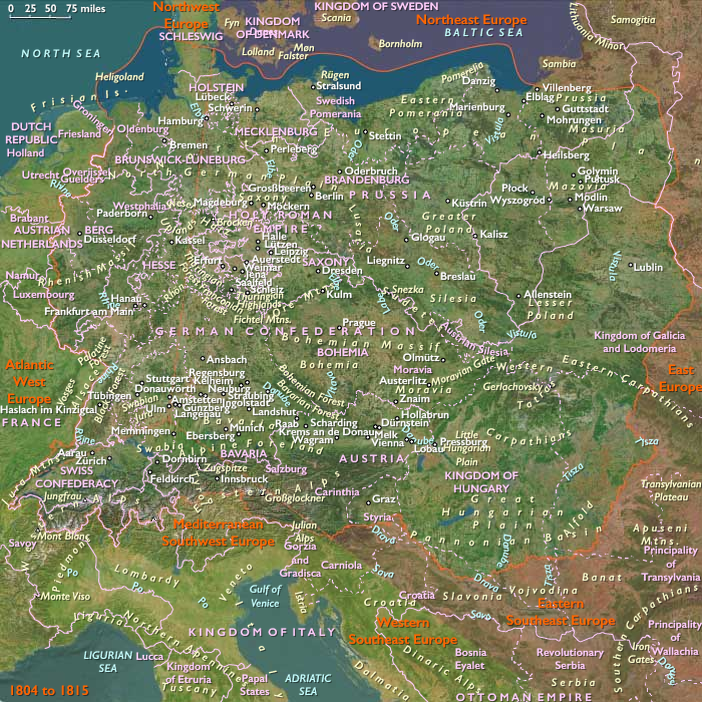
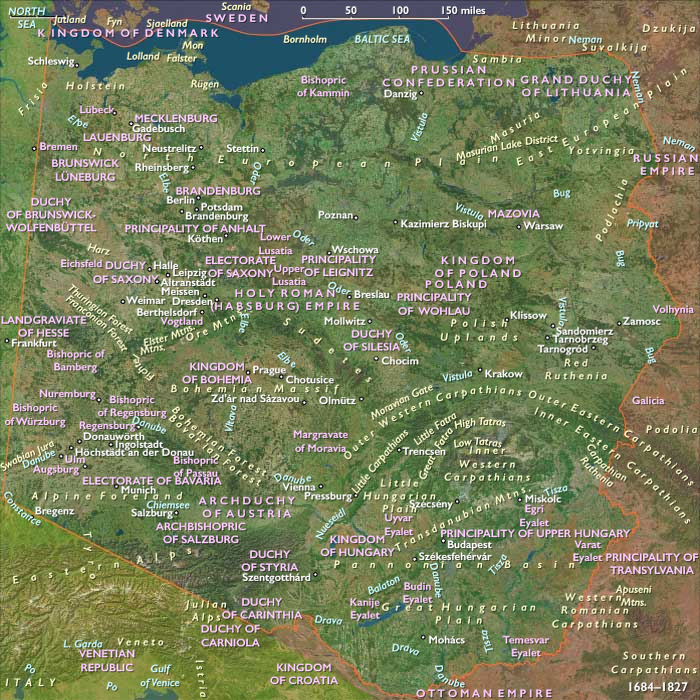
The Hanseatic cities of Bremen and ...
Years: 1812 - 1812
The Hanseatic cities of Bremen and ...
Related Events
Filter results
Showing 10 events out of 21390 total
Hongi Hika has become the war leader of the Ngāpuhi, and in 1812 he leads a large taua (war party) to the Hokianga against Ngāti Pou.
Despite his earlier experiences he seems to have become convinced of the value of muskets, which are used during this campaign.
Governor Macquarie is credited with producing the first official currency specifically for circulation in Australia.
Foreign coins have been common in the early years of the New South Wales colony but much of this coin leaves the colony as a result of trade with visiting merchant ships.
Macquarie, to secure a reliable supply of coins, purchases forty thousand Spanish dollar coins in 1812 and has a convicted forger named William Henshall cut the centers out of the coins and counter stamp them to distinguish them as belonging to the colony of New South Wales and prevent them being useful elsewhere.
The central plug (known as a "dump") is valued at fifteen pence and the rim (known as a holey dollar) becomes a five-shilling piece.
In 1812 also, the first detailed inquiry into the convict system in Australia by a Select Committee on Transportation, supports, in general, Macquarie's liberal policies.
The committee thinks that fewer tickets of leave should be issued, however, and opposes the governor having the power to grant pardons.
The committee concludes that the colony should be made as prosperous as possible so as to provide work for the convicts and to encourage them to become settlers after being given their freedom.

The Korean Revolt is put down by the government only after a savage scorched-earth campaign.
Peasants in the south continue to defy the king in Seoul, the provincial nobility, and the wealthy landlords.
Napoleon, angered by the Russian Tsar’s resumption of trade relations with the British, invades Russia in June, 1812 with an army of nearly half-a-million men, an act that temporarily stops the periodic Russo-Turkish wars.
Napoleon’s Empire at Its Peak and the Road to the Russian Campaign (1810–1812)
By 1812, Napoleon’s imperial system controlled nearly all of continental Western Europe, with the notable exception of Portugal, where British forces maintained a strong foothold. However, despite the apparent strength of the Napoleonic Empire, it had already begun to decline from its peak between 1806 and 1809.
The Growing Strains on Napoleon’s Empire
-
The Peninsular War – A Costly Quagmire
- The drawn-out war in Spain and Portugal had drained French manpower, resources, and morale.
- Guerrilla warfare and British intervention had turned Iberia into a bleeding wound for France.
- By 1812, Napoleon had lost over 250,000 troops in the Peninsular War, making it one of the deadliest conflicts of his reign.
-
Economic and Political Weakness in France
- The Continental System was failing to strangle the British economy, while crippling trade within Europe.
- French industry struggled to replace lost imports, causing economic hardship.
- Napoleon’s political support was waning, and army morale had begun to decline due to prolonged warfare and increasing conscription demands.
-
Napoleon’s Physical and Mental Decline
- By 1812, Napoleon was no longer the energetic commander of his early years.
- He had become overweight, prone to illness, and increasingly impatient in both strategy and diplomacy.
- This decline weakened his ability to inspire and lead as effectively as before.
The Russo-French Rivalry and the Path to War
Despite Napoleon’s difficulties, no major European power dared to challenge him directly—except for Russia, which increasingly viewed French dominance as a threat.
-
The Treaty of Schönbrunn (1809) and Russian Concerns
- After Austria’s defeat in the War of the Fifth Coalition (1809), the Treaty of Schönbrunn annexed Western Galicia to the Grand Duchy of Warsaw.
- Tsar Alexander I saw this as a direct challenge to Russian influence, fearing that Napoleon would use Poland as a base for an invasion of Russia.
-
Russia’s Strategic Shift (1811–1812)
- By 1811, the Russian military command had developed offensive war plans, proposing a preemptive attack on Warsaw and Danzig.
- Russia also began secretly withdrawing from the Continental System, resuming trade with Britain to support its economy.
- Napoleon saw Russia’s defiance as a direct provocation, reinforcing his decision to launch an invasion.
Napoleon Declares the "Second Polish War"
- To gain Polish nationalist support, Napoleon framed the coming war as the "Second Polish War," referring to the previous War of the Fourth Coalition (1806–1807), which had resulted in the creation of the Grand Duchy of Warsaw.
- This reinforced hopes among Polish patriots that Napoleon would fully restore the Polish-Lithuanian Commonwealth, turning Poland into a major battlefield in the campaign.
The Final Break – Russia’s Economic Bind
- Russia’s withdrawal from the Continental System further convinced Napoleon that war was inevitable.
- Russia lacked manufacturing capacity and relied on trade with the French-dominated European economy for money and industrial goods.
- By 1812, Tsar Alexander was caught between economic necessity and military confrontation, leading to the final break between France and Russia.
Conclusion – The Countdown to the Invasion of Russia
By early 1812, Napoleon’s empire still appeared mighty, but its foundation was beginning to crack. The Peninsular War had weakened France, the Continental System was failing, and Russia was moving toward defiance. Napoleon, eager to reassert his dominance, would launch the largest military campaign of his career—the invasion of Russia in June 1812. This reckless gamble would ultimately lead to the downfall of his empire.
...Lübeck, and ..
...the states of Mecklenburg and ...
...Prussia, occupied by French forces, also grant equality to the Jews in 1811-12. (In Berlin, fifty out of the four hundred and five Jewish families in the city had converted between 1892 and 1810).
However, ...
...Bavaria, ...
...Austria, and ...
Years: 1812 - 1812
Locations
Groups
- Jews
- Lübeck, Free City of
- Mecklenburg-Strelitz, Duchy of
- Prussia, Kingdom of
- Mecklenburg-Schwerin, (restored) Duchy of
- France, (first) Empire of
- Austrian Empire
- Bavaria, Kingdom of
- Bremen, Free and Hanseatic City of
- Saxony, Kingdom of