
The Gupta empire reaches its political zenith …
Years: 400 - 411
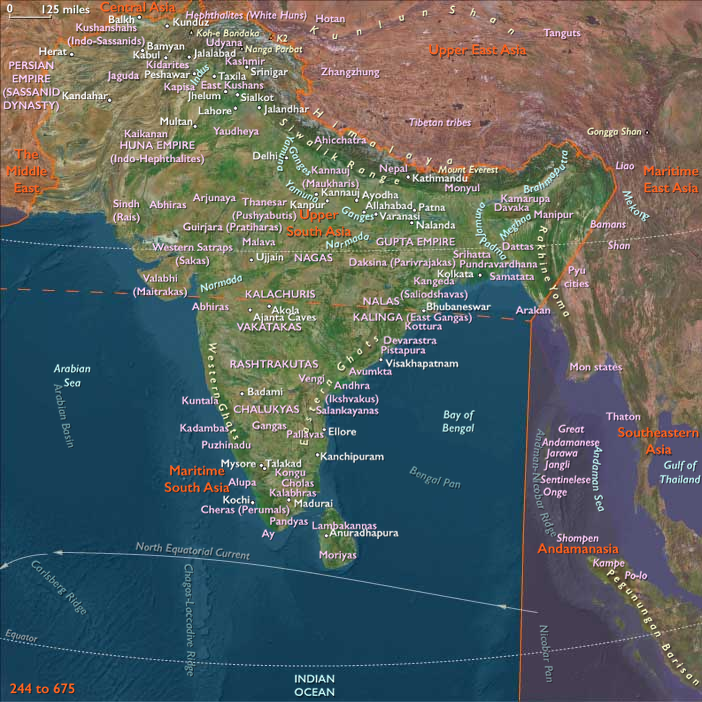
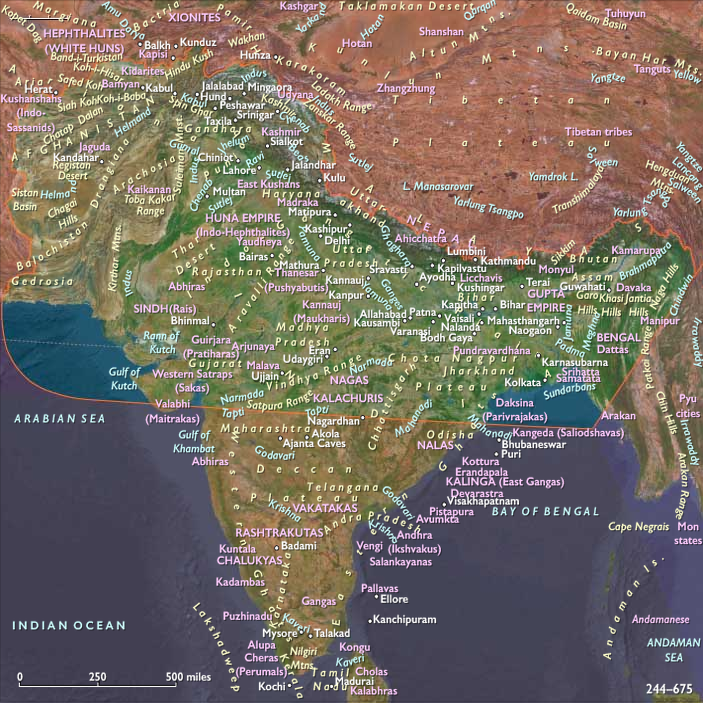
The Gupta empire reaches its political zenith under Chandragupta II, extending far into the Deccan and western India.
A twenty-two-foot- (seven meter-) tall iron pillar represents the remarkable metallurgical advances apparently made under the Gupta dynasty, as the pillar never rusts.
The pillar manufactured by forge welding, is a testament to the high level of skill achieved by ancient Indian iron smiths in the extraction and processing of iron.
The pillar with the statue of Chakra at the top is today at Qutb Minar in Delhi, but its originally location is a place called Vishnupadagiri (meaning “hill with footprint of Lord Vishnu”), identified as modern Udayagiri, situated in the vicinity of Besnagar, Vidisha and Sanchi.
These towns are located about fifty kilometers east of Bhopal, in central India.
There are several aspects to the original site of the pillar at Udayagiri.
Vishnupadagiri is located on the Tropic of Cancer and, therefore, is a center of astronomical studies during the Gupta period.
The Iron Pillar served as a sundial: the early morning shadow of the Iron Pillar falls in the direction of the foot of Anantasayin Vishnu (in one of the panels at Udayagiri) only around the summer solstice (June 21).
The Udayagiri site in general, and the Iron Pillar location in particular, are evidence for the astronomical knowledge that exists in Gupta India.
The pillar bears a Sanskrit inscription in Brahmi script which states that it was erected as a standard in honor of Lord Vishnu.
It also praises the valor and qualities of a king referred to simply as Chandra, who has been identified with the Gupta King Chandragupta II Vikramaditya (375-413).
Locations
People
Groups
Topics
Commodoties
Subjects
- Commerce
- Symbols
- Sculpture
- Labor and Service
- Conflict
- Faith
- Government
- Technology
- Metallurgy
- Astronomy
Regions
Subregions
Related Events
Showing 10 events out of 59279 total
Years: 400 - 411
Locations
People
Groups
Topics
Commodoties
Subjects
- Commerce
- Symbols
- Sculpture
- Labor and Service
- Conflict
- Faith
- Government
- Technology
- Metallurgy
- Astronomy
Regions
Subregions