The growth of Wakayama, situated in west-central …
Years: 1585 - 1585
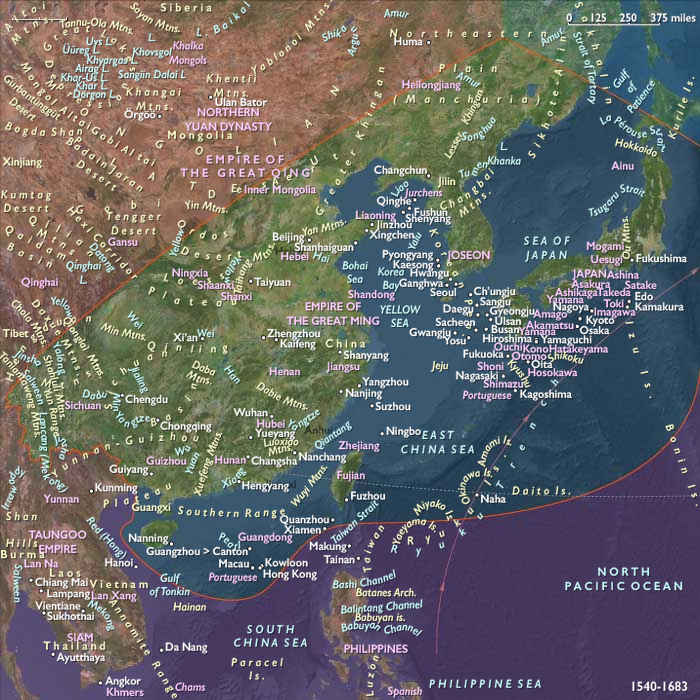
The growth of Wakayama, situated in west-central Honshu at the mouth of the Kino River, on the Kii Peninsula, and lying along the Kii Strait, which leads from the Pacific Ocean into the Inland Sea, begins in 1585 with the construction of a castle there ordered by Hideyoshi.
Locations
People
Groups
Regions
Subregions
Related Events
Filter results
Showing 10 events out of 34725 total
Hideyoshi is appointed kampaku (chancellor to the emperor) in 1585 and soon becomes dajo-daijin (chief minister).
Awarded the family name of Toyotomi by the emperor, he thus comes to bear the name Toyotomi Hideyoshi.
He soon makes peace with Mori Terumoto, who had again become his antagonist.
Architect Fyodor Kon, at the behest of Tsar Feodor and Boris Godunov, begins construction in 1585 on the stone walls of Bely Gorod (Russian: “White Town”), a fortress and settlement comprising the third defense belt around Moscow, which is to join the Kremlin and Kitay-gorod on the left bank of the Moskva River.
The walls are cogged, like the Kremlin walls, loopholes allowed to keep a continuous fire.
Close contact among the so-called Eastern Balts (the Latvians with the Lithuanians as well) had been considerably weakened since 1290 as a result of the conquest of Latvian territory by the German Knights of the Sword.
The Latvian (Latgalian) people achieve a separate identity around the sixteenth century, when they completely assimilate the other Balts, as well as a greater part of the Livs (also called Livonians, Livians), who are of Finnic descent and live on Latvian territory.
The first Latvian book is the Catechismus Catholicorum of 1585.
Karl-Franzens-Universität, also referred to as the University of Graz, is the city's oldest university, founded in 1585 by Archduke Charles II of Austria.
It is today is the third-largest and second-oldest university in Austria.
Spranger, noted for his paintings of nudes executed in the late Mannerist style, employs mannered poses, slender, elongated bodies, and a gleaming, brittle texture in his efforts to develop a Northern artistic canon of the human figure.
The figures smile invitingly, and the influence of Parmigianino and Correggio is evident in their voluptuous contours.
Jeremias II, elected patriarch in 1572 by popular acclaim, had immediately instituted a reform by disciplining the clergy and prosecuting simony (the sale and purchase of ecclesiastical offices).
Having irritated the Holy Synod, the council of bishops, by his zeal, he had been deposed in 1579.
Public clamor, however, returned him to office after nine months.
Jeremias had from 1572 to 1581 corresponded with German Lutheran theologians who sought Orthodox support for the Lutheran articles of faith contained in the 1530 Confession of Augsburg.
Although he had expressed some agreement with certain articles of the Lutheran creed, Jeremias had repudiated the Lutheran beliefs on grace and sacramental worship.
The proceedings of this Lutheran-Orthodox dialogue had been published at Wittenberg, Germany, as Acta et Scripta Theologorum Wirtembergensium et Patriarchae Constantinopolitani, D. Hieremiae (1584; “Acts and Writings of the Württemberg Theologians and His Lordship Jeremias, Patriarch of Constantinople”).
Jeremias' anti-Western spirit had caused him even to reject the Gregorian calendar, the new style of chronological computation instituted in March 1582 by Pope Gregory XIII.
He had in 1584 again been deposed; but once again, after two years, his popularity, backed by the goodwill of the Ottoman sultan, secures his return.

The Druse, or Druze, descend from the original followers of al Hakim (d. 1021), considered an incarnation of God in 1017 while he functioned as the sixth caliph of Egypt’s Fatimid dynasty.
The Druze had become politically important during the eleventh century in the region of present Lebanon, especially as opponents of the then dominant Shi’ite sect.
The Maan family, under orders from the governor of Damascus, had come to Lebanon in 1120 to lead the struggle against the invading Crusaders.
Settling on the southwestern slopes of the Lebanon Mountains, they had soon adopted the Druze religion.
After the Ottoman conquest of the Mamluks in the early sixteenth century and the establishment of Ottoman controls in the region, Sultan Selim, regarding himself as the punisher of the unorthodox, particularly the militant Shi’i, had recognized the importance of placating the Druse by naming Fakhr ad-Din (d. 1544) of the house of Maan as the emir of the Druse in the Ottoman empire.
Following the execution, by the Ottomans, of Fakhr ad-Din’s son Korkmaz, in 1585, a civil war begins between the two predominant religious–political factions in the region, the Kaysis, led by Korkmaz’s son, Fakhr ad-Din II, and the Yamanis.
Fitch descends the Yamuna and Ganges rivers and visits Varanasi (Benares) and ...
...Patna.
Tulsidas, a writer of Indian religious poetry, probably born at Rajapur, probably born at Rajapur, has lived most of his adult life at Varanasi.
Between 1574 and 1576 or 1577 he writes his principal work, the Ramcaritmanas (“Sacred Lake of the Acts of Rama”), an expression of the religious sentiment of bhakti (“loving devotion”) to the Vaisnava avatar, Rama, who is regarded as the chief means of salvation.
Although Tulsidas is above all a devotee of Rama, he remains a Smarta Vaisnava (a follower of the more generally accepted traditions and customs of Hinduism rather than a strict sectarian), and his poem gives some expression both to orthodox monistic Advaita doctrine and to the polytheistic mythology of Hinduism—though these are everywhere subordinated to his expression of bhakti for Rama.
His eclectic approach to doctrinal questions means that he was able to rally wide support for the worship of Rama in northern India, and the success of the Ramcaritmanas has been a prime factor in the replacement of the Krishna (Krsna) cult by the cult of Rama as the dominant religious influence in this area.