
The Großes Schauspielhaus (Great Theater), a theater …
Years: 1919 - 1919
The Großes Schauspielhaus (Great Theater), a theater in Berlin, often described as an example of expressionist architecture, is designed by Hans Poelzig for theater impresario Max Reinhardt.
The structure, originally a market built by architect Friedrich Hitzig, retained its external, gabled form.
It then became the Zirkus Schumann, a circus arena.
It is renovated by Poelzig and reopens in 1919, containig seating for 3500 people.
Reinhardt wants to attract a working class audience to the theater.
The large size allows for people who can pay top prices for the best seats to support the low-cost seats in the back of the theater.
It is painted red.
The cavernous, domed space has no balconies, which contributes to its vastness.
The dome and pillars are decorated with maquernas, a honeycombed pendentive ornament, which resembles stalactites.
When illuminated, the ceiling's lightbulbs form patterns of celestial constellations, and the vaulted ceiling takes on another concept, the night sky.
In the lobby and elsewhere, Poelzig makes use of colored light bulbs to create striking visual backdrops.
Separate entrances are provided for the expensive and the cheap seats.
The theater also includes a restaurant for the wealthy audience members, a cafeteria for the poorer audience members, and a bar.
The performers and technicians enjoy their own bar, a barber shop, ample dressing room space, and the modern stage equipment.
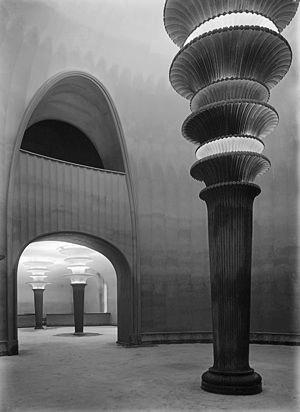
Light columns in the entrance hall, circa 1920 (Photo by Karl Ernst Osthaus († 1921))
Locations
Groups
Topics
Subjects
Regions
Related Events
Showing 6 events out of 6 total
Years: 1919 - 1919
Light columns in the entrance hall, circa 1920 (Photo by Karl Ernst Osthaus († 1921))
Locations
Groups
Topics
Subjects
Regions