
The grieving widower Shah Jahan, emperor during …
Years: 1653 - 1653
The grieving widower Shah Jahan, emperor during the Mughal empire's period of greatest prosperity, had begin construction of the Taj Mahal in 1632, one year after the death of his wife.
The principal mausoleum had been completed in 1648 and the surrounding buildings and garden are finished five years later.
While earlier Mughal buildings were primarily constructed of red sandstone, Shah Jahan has promoted the use of white marble inlaid with semiprecious stones, and buildings under his patronage have reached new levels of refinement.
Taj Mahal incorporates and expands on design traditions of Persian architecture and earlier Mughal architecture.
Specific inspiration came from such successful Timurid and Mughal buildings as the Gur-e Amir (the tomb of Timur, progenitor of the Mughal dynasty, in Samarkand), Humayun's Tomb, Itmad-Ud-Daulah's Tomb (sometimes called the Baby Taj), and Shah Jahan's own Jama Masjid in Delhi.
Widely considered as one of the most beautiful buildings in the world, the Taj Mahal stands today as a symbol of eternal love.
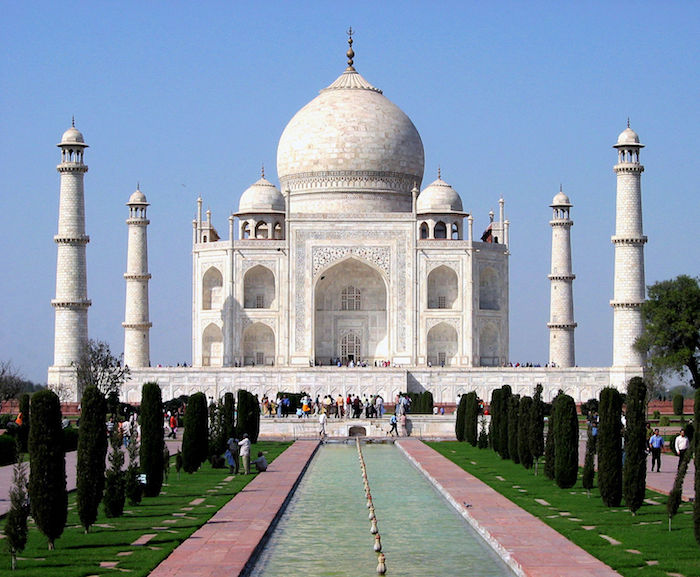
Southern view of the Taj Mahal, Agra, India. (Photo by Dhirad, picture edited by J. A. Knudsen, March 2004)
Locations
People
Groups
Topics
Subjects
Regions
Subregions
Related Events
Showing 4 events out of 4 total
Years: 1653 - 1653
Southern view of the Taj Mahal, Agra, India. (Photo by Dhirad, picture edited by J. A. Knudsen, March 2004)
Locations
People
Groups
Topics
Subjects
Regions
Subregions