The Greeks who have settled in Bactria …
Years: 249BCE - 238BCE
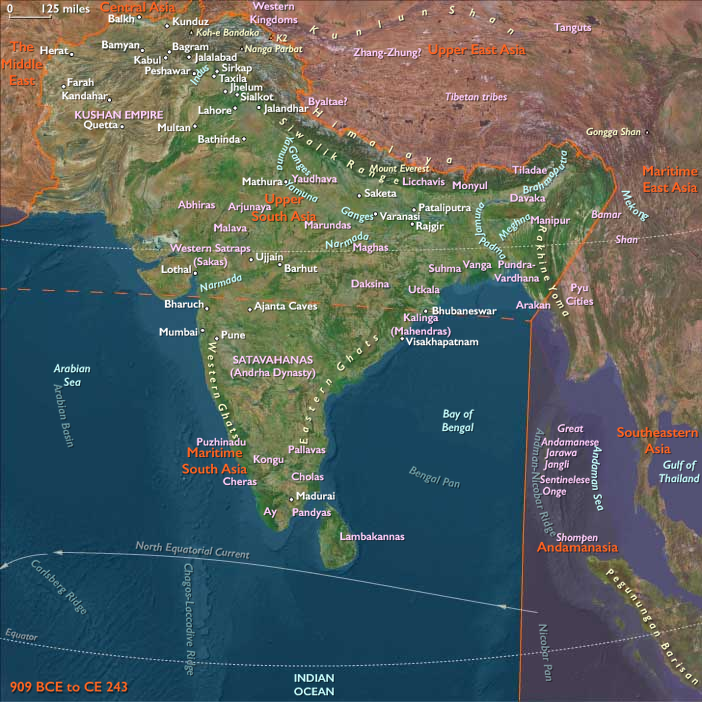
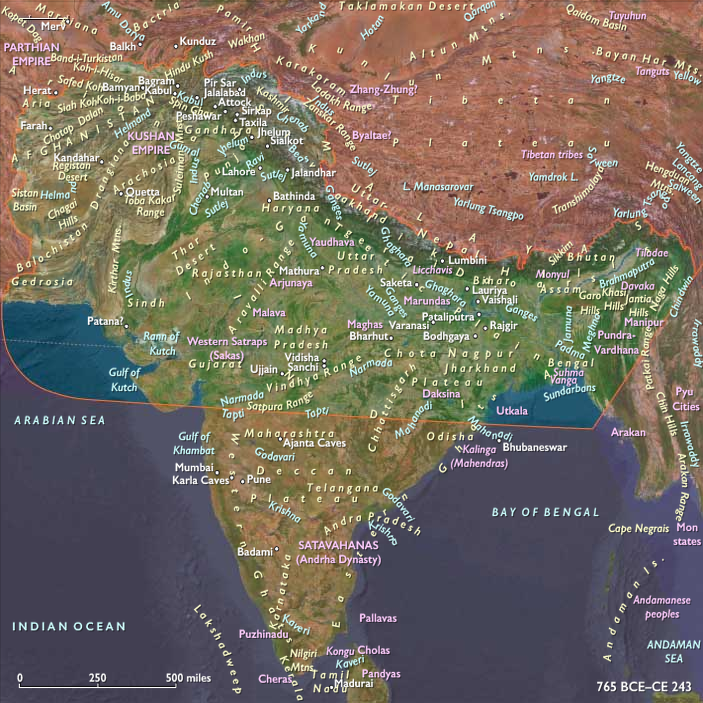
The Greeks who have settled in Bactria establish an independent kingdom about 246 BCE.
Locations
Groups
Topics
Subjects
Regions
Subregions
Related Events
Filter results
Showing 10 events out of 63859 total
Halley's comet, which swings around the Sun once every seventy-six years, becomes known to astronomers in 240 BCE.
Its orbital period over the last three centuries has been between seventy-five and seventy-six years, though it has varied between seventy-four and seventy-nine years since its discovery.
The Qin state, centered in present Shaanxi (Shenxi), has emerged as the most powerful of the Warring Kingdoms.
The once-mighty Seleucid kingdom had in the beginning of the third century BCE begun to lose control over large territories.
Parthia, Bactria, and Sogdiana have by the middle of this century gained their independence.
The Middle East: 249–238 BCE
Parthian Emergence and Hellenistic Decline
Rise of Arsaces and the Parthian State
In 247 BCE, following the death of Antiochus II, Seleucid control weakens as their governor (satrap) of Parthia, Andragoras, declares independence amidst the turmoil caused by the seizure of the Seleucid capital Antioch by Ptolemy III. Andragoras struggles to defend his territory without Seleucid military backing.
Around 238 BCE, the situation deteriorates further when Arsaces, a leader of the nomadic Parni tribes of Scythian or Bactrian origin, launches a decisive invasion into Parthia, aided by his brother Tiridates. Quickly capturing Astabene (Astawa) and its capital, Kabuchan (modern Kuchan), the Parni decisively end Andragoras' rule, killing him in the process. The Parni tribes subsequently adopt the name Parthians, derived from the conquered province, marking the birth of a new and influential Persian dynasty.
Advances in Hellenistic Astronomy
Amidst these geopolitical shifts, significant advancements occur in Greek astronomy. Aristarchus of Samos, a prominent student of Strato of Lampsacus, advocates for a revolutionary heliocentric model, asserting that the Sun, not the Earth, is the center of the universe. Aristarchus also conducts pioneering work in determining celestial distances. In his surviving treatise, On the Sizes and Distances of the Sun and Moon, he uses geometric reasoning to calculate that the Sun is approximately twenty times further away and twenty times larger than the Moon. Although his estimates are imprecise due to technological limitations, Aristarchus's methods remain conceptually sound and significantly influence future astronomical thought.
The Third Syrian War, also known as the Laodicean War or War of Berenice, begins with one of the many succession crises that plagues the Hellenistic states.
Antiochus II leaves two ambitious mothers, his repudiated wife Laodice and Berenice Syra, the daughter of Egypt's Ptolemy II, in a competition to put their respective sons on the throne.
Laodice claims that Antiochus had named her son heir while on his deathbed, but Berenice argues that her newly born son is the legitimate heir.
Berenice asks her brother Ptolemy III, the new Ptolemaic king, to come to Antioch and help place her son on the throne.
When Ptolemy arrives, Berenice and her child have been assassinated.
Ptolemy declares war on Laodice's newly crowned son, Seleucus II, in 246 BCE, and campaigns with great success.
He wins major victories over Seleucus in Syria and Anatolia, briefly occupies Antioch and, as a recent cuneiform discovery proves, even reaches Babylon.
These victories are marred by the loss of the Cyclades to Antigonus Gonatas in the Battle of Andros.
Seleucus has his own difficulties.
His domineering mother asks him to grant co-regency to his younger brother, Antiochus Hierax, as well as rule over Seleucid territories in Anatolia.
Antiochus promptly declares independence, undermining Seleucus' efforts to defend against Ptolemy.
Ptolemy, in exchange for a peace in 241 BCE, is awarded new territories on the northern coast of Syria, including Seleucia Pieria, the port of Antioch.
The Ptolemaic kingdom is at the height of its power.

Andragoras, the Seleucid governor (satrap) of Parthia (roughly, western Khorasan) had proclaimed independence from the Seleucids in 247 BCE, when—following the death of Antiochus II—Ptolemy III had seized control of the Seleucid capital at Antioch.
Meanwhile, one Arsaces, of Scythian or Bactrian origin, has been elected leader of the Parni tribes.
Following the secession of Parthia from the Seleucid Empire and the resultant loss of Seleucid military support, Andragoras has difficulty in maintaining his borders, and about 238 BCE—under the command of Arsaces and his brother Tiridates—the Parni invade Parthia and seize control of Astabene (Astawa), the northern region of that territory, the administrative capital of which is Kabuchan (Kuchan in the vulgate).
The Parni shortly seize the rest of Parthia from Andragoras, killing him in the process, and soon become known as the Parthians, taking their name from the Seleucid province that they have conquered.
Aristarchus of Samos, a student of Strato of Lampsacus who flourishes in the mid-third century BCE, champions the notion of a Sun-centered universe and makes a pioneering attempt to determine the sizes and distances of the Sun and Moon.
Aristarchus’ only surviving work, On the Sizes and Distances of the Sun and Moon, details his remarkable geometric argument, based on observation, whereby he determined that the Sun is about twenty times as distant from the Earth as the Moon, and twenty times the Moon's size. (Both these estimates are an order of magnitude too small, but the error stems from Aristarchus' lack of accurate instruments rather than in his faultless method of reasoning. Scant evidence exists concerning the origin of his belief in a heliocentric world system; his theory, rejected by his contemporaries, is known only because of a summary statement in Archimedes' The Sand Reckoner.)
The rock-cut basilical temples known as chaityas, Buddhist or Jain shrines including a stupa, appear during the reign of Ashoka.
Additional examples of Buddhist art from this age include the great stupa shrine-mounds such as those at Bharhut and ...
…Sanchi, surrounded by ornately carved gateways and railings, and the sensually sculpted images of Yakshi (female) and Yaksha (male), deities associated with fertility and wealth.
Buddhist-inspired artists, technically and aesthetically influenced by Achaemenid Persia, sculpt great pillars topped with enormous lotus capitals and lions (of which the best-preserved example is at Lauriya Nandangarh in northern India, executed in 242 BCE).