The Greek rebellion shocks the Porte, which …
Years: 1822 - 1822
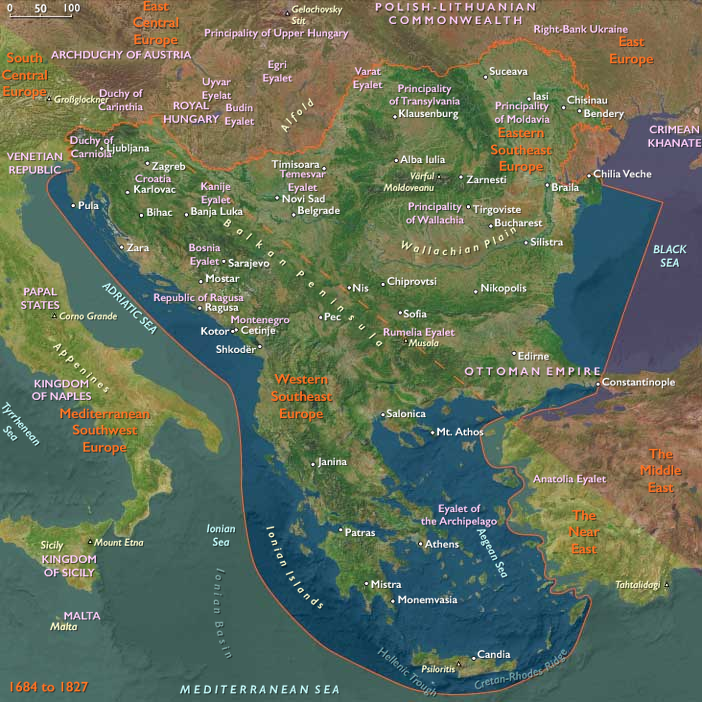
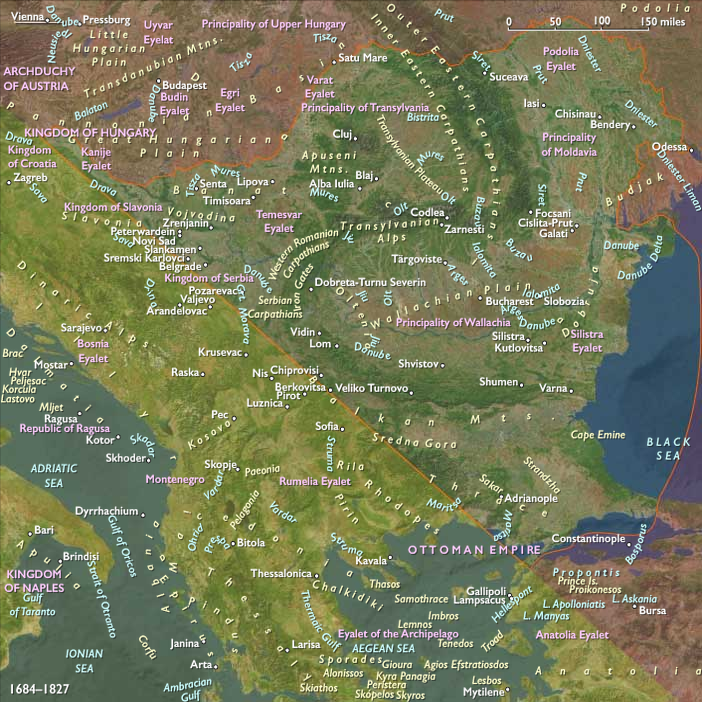
The Greek rebellion shocks the Porte, which will no longer appoint Phanariote princes to the Wallachian and Moldavian thrones and will choose instead native Romanians.
Locations
Groups
- Romanians
- Turkish people
- Greece, Ottoman
- Ottoman Empire
- Greeks (Modern)
- Moldavia (Ottoman vassal), Principality of
- Phanariotes
- Wallachia (Ottoman vassal), Principality of
Topics
Subjects
Regions
Subregions
Related Events
Filter results
Showing 10 events out of 704 total
Adolphe Thiers publishes the first two volumes of his celebrated Histoire de la Révolution française in 1823. which founds his literary reputation and boosts his political career.
Having trained for the law, the twenty-four-year-old Thiers had moved to Paris two years earlier with just a hundred francs in his pocket.
Thanks to his letters of recommendation, he had been able to get a position as a secretary to the prominent philanthropist and social reformer, the Duke of La Rochefoucalt-Liancourt; the man who in 1789, when King Louis XVI, asked if there was a revolt in Paris, replied, "No, Majesty, this is a Revolution."
He stayed only three months with the Duke, whose political views were more conservative than his own, and with whom he could see no rapid avenue for advancement.
He was then introduced to Charles-Guillaume Étienne, the editor of the Le Constitutionnel, the most influential political and literary journal in Paris.
The newspaper is the leading opposition journal against the royalist government; it has forty-four thousand subscribers, compared with just twelve thousand eight hundred subscribers for the royalist, or legitimist, press.
He had offered Etienne an essay on the political figure François Guizot, Thiers' future rival, which was original, polemical and aggressive, and caused a stir in Paris literary and political circles.
Etienne commissioned Thiers as a regular contributor.
At the same time that Thiers began writing, his friend from the law school in Aix, Mignet, had been hired as a writer for another leading opposition journal, the Courier Français, then worked for a major Paris book publisher.
Within four months of his arrival in Paris, Thiers was one of the most read-journalists in the city.
He writes about politics, art, literature, and history.
His literary reputation introduces him into the most influential literary and political salons in Paris.
He meets Stendhal, the Prussian geographer Alexander Von Humboldt, the famed banker Jacques Laffitte, the author and historian Prosper Mérimée, the painter François Gérard; he is the first journalist to write a glowing review for a young new painter, Eugene Delacroix.
When a revolution breaks out in Spain in 1822, he travels as far as the Pyrenees to write about it.
He soon collects and published a volume of his articles, the first on the salon of 1822, the second on his trip to the Pyrenees.
He is very well paid by Johann Friedrich Cotta, the part-proprietor of the Constitutionnel.
Most important for his future career, he has been introduced to Talleyrand, the former foreign minister of Napoleon, who has become his political guide and mentor.
Under the tutelage of Talleyrand, Thiers becomes an active member of the circle of opponents of the Bourbon regime, which include the financier Lafitte and the Marquis de Lafayette.

Caventou and Pelletier had isolated strychnine in 1818 and Brucine in 1819, both from Nux vomica.
In 1820, the pair had isolated cinchonine and quinine, the active anti-malarial ingredient in the bark of cinchona tree. (Quinine sulfate will later prove to be an important remedy for the disease malaria.)
Neither of the partners had chosen to patent their discovery of this compound, releasing it for all to use.
In 1821, they had isolated caffeine, and in 1823 they discover nitrogen in alkaloid compounds.
Other compounds they have isolated include colchicine (1820) and veratrine.
Cemeteries have been banned from Paris since the closure, owing to health concerns, of the Cimetière des Innocents in 1786.
Several new cemeteries outside the precincts of the capital replace all the internal Parisian ones in the early nineteenth century: The soon-to-open Montmartre Cemetery in the north, Père Lachaise Cemetery in the east, and Montparnasse Cemetery in the south.
At the heart of the city, and today sitting in the shadow of the Eiffel Tower, is Passy Cemetery.
The Paris Salon of 1824 shows three of John Constable’s works, including The Hay Wain and View on the Stour near Dedham.
Eugène Delacroix, impressed by Constable’s use of high-key colors to render light and shadow upon viewing the paintings at a Paris dealer, repaints portions of his Scenes from the Massacre at Chios.
Gioachino Rossini assumes the directorship of the Theatre Italien in Paris in 1824.
Louis Daguerre begins efforts in 1824 to fix chemically the image of the camera obscura, now widely used as an aide to sketching.
Washington Irving, still struggling with writer's block, had traveled to Germany, settling in Dresden in the winter of 1822.
Here he had dazzled the royal family and attached himself to Mrs. Amelia Foster, an American living in Dresden with her five children.
Irving was particularly attracted to Mrs. Foster's eighteen-year-old daughter Emily, and vied in frustration for her hand.
Emily finally had refused his offer of marriage in the spring of 1823.
He had returned to Paris and begun collaborating with playwright John Howard Payne on translations of French plays for the English stage, with little success.
He had also learned through Payne that the novelist Mary Shelley is romantically interested in him, though Irving never pursues the relationship.
In August 1824, Irving publishes another lighthearted collection of essays, Tales of a Traveller—including the short story "The Devil and Tom Walker"—under his Geoffrey Crayon persona.
While the book sells respectably, Traveller largely bombs with critics, who pan both Traveller and its author.
John Constable’s The Hay Wain causes a sensation when it was exhibited with other works by Constable at the 1824 Paris Salon (it has been suggested that the inclusion of Constable's paintings in the exhibition were a tribute to Géricault, who died early that year).
In this exhibition, The Hay Wain is singled out for a gold medal awarded by Charles X of France, a cast of which is incorporated into the picture's frame.
The works by Constable in the exhibition inspire a new generation of French painters, including Eugène Delacroix, who, after seeing the Constables at Arrowsmith's Gallery, which he says had done him a great deal of good, repaints the background of his 1824 Massacre de Scio.
Constable is to sell only twenty paintings in England in his lifetime, but in France he will sell more than twenty in just a few years.
Despite this, he will refuse all invitations to travel internationally to promote his work.
Louis XVIII's health has been worsening since the beginning of 1824.
Suffering from both dry and wet gangrene in his legs and spine, he dies on September 16 of this year.
His brother succeeds him to the throne as King Charles X of France.
In his first act as king, Charles attempts to unify the House of Bourbon by granting the style of Royal Highness to his cousins of the House of Orléans, who had been deprived of this by Louis XVIII because of the former Duke of Orléans' role in the death of Louis XVI.
The New Christianity of Claude Henri de Rouvroy, Comte de Saint-Simon, offers a new religion of socialism.
The Comte de Saint-Simon, who has spent the past few decades writing prolifically and funding a Paris salon for intellectuals and scientists, has developed a theory of "evolutionary organicism," which postulates history as an orderly progression culminating in an industrial, harmonious society ruled by a scientific elite on the basis of a division of labor.
French social theorist Barthelemy Prosper Enfantin meets the Comte de Saint-Simon shortly before the latter’s death on May 19, 1825.
Saint-Simon’s New Christianity, published that year, synthesizes Catholic and Enlightenment ideas.
Enfantin, with St. Amand Bazard, establishes Saint-Simonism, a political and religious movement based on Saint-Simon’s thought, which advocates a highly centralized, planned society, ruled for the common good by a natural aristocracy of the most talented.
Years: 1822 - 1822
Locations
Groups
- Romanians
- Turkish people
- Greece, Ottoman
- Ottoman Empire
- Greeks (Modern)
- Moldavia (Ottoman vassal), Principality of
- Phanariotes
- Wallachia (Ottoman vassal), Principality of