
The great Ma'rib Dam in South Arabia …
Years: 568 - 579
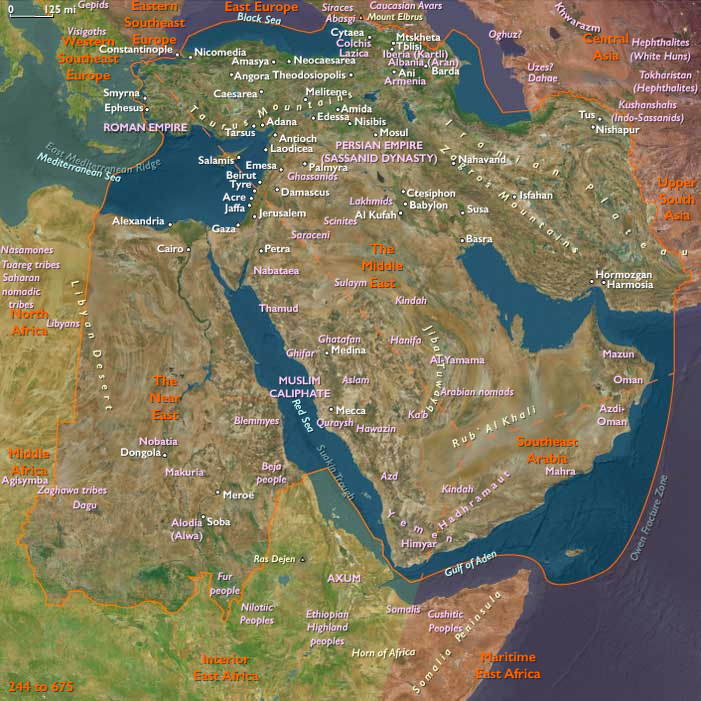
The great Ma'rib Dam in South Arabia controls the flow from the extensive Wadi Dhana basin.
Fifty feet high, nearly nineteen hundred and seventy feet long, and flanked by spillways, the stone and masonry dam has delivered water to a system of irrigation canals for more than one thousand years.
It irrigates more than four thousand acres (one thousand six hundred hectares) and supports a densely settled agricultural region, dependent on careful water conservation.
Successive generations of Sabaean and Himyarite rulers have improved the works, though there were breaks in it in the fifth and sixth centuries CE.
Its rupture in 570 or 575 constitutes the symbolic end to the ascendancy of the Yemeni empires.
Locations
People
Groups
Topics
Commodoties
Subjects
Regions
Subregions
Related Events
Filter results
Showing 10 events out of 57489 total
Emperor Pyeongwon, the twenty-fifth ruler of Goguryeo, the northernmost of the Three Kingdoms of Korea, is said to have been courageous, and skilled in horsemanship and archery.
By this time, the royal power has been significantly eroded by the aristocracy.
Concerned for the people, Pyeongwon has encouraged agricultural and sericultural developments, and maintained tense but relatively peaceful relations with the Gökturks and the various Chinese dynasties, briefly battling the Northern Zhou in the Liaodong Peninsula.
East Central Europe (568–579 CE): Avar Khaganate Established, Slavic Consolidation, and Roles of Thuringia and Bavaria
Between 568 and 579 CE, East Central Europe—encompassing Poland, Czechia, Slovakia, Hungary, and those portions of Germany and Austria lying east of 10°E and north of a line stretching from roughly 48.2°N at 10°E southeastward to the Austro-Slovenian border near 46.7°N, 15.4°E—underwent significant geopolitical transformations. The migration of the Lombards into Italy (568 CE) left the Pannonian Avars firmly established as regional rulers, forming their powerful Avar Khaganate in the Carpathian Basin. Simultaneously, Slavic populations expanded dramatically, solidifying control over territories vacated by Germanic tribes. On the region's western periphery, the semi-autonomous Germanic duchies of Thuringia and Bavaria continued to play crucial roles, significantly influencing economic interactions, diplomatic alignments, and cultural exchanges between Frankish and Avar realms.
Political and Military Developments
Avar Khaganate and Byzantine Frontier Diplomacy
-
After Lombard withdrawal (568 CE), the Avar Khaganate rapidly established control, dominating former Gepid and Lombard territories across modern Hungary, Slovakia, Czechia, and eastern Austria.
-
Byzantium intensified diplomatic engagements with the Avars, employing tribute and negotiation to secure its Danube frontier against incursions and maintain regional stability.
Thuringia and Bavaria: Western Influences
-
Thuringia, previously conquered by the Franks in 531 CE, operated as a Frankish-dominated region that retained substantial cultural independence. It became a frontier zone interacting with newly consolidated Slavic groups, facilitating trade and cultural exchanges.
-
Bavaria, centered around Regensburg, emerged distinctly as a semi-autonomous duchy under Frankish political influence. Bavaria played a strategic intermediary role between the Frankish west, Avar east, and Slavic north, managing careful diplomacy and commercial relationships with multiple powers, thus becoming a critical political and economic player.
Extensive Slavic Territorial Consolidation
-
Slavic groups (Sclaveni, Antes, Polanes, Vislanes, Sorbs, Veleti, Obotrites, Pomeranians, and White Croats) rapidly consolidated control over regions vacated by Germanic tribes, establishing permanent settlements that transformed the demographic landscape.
Economic and Technological Developments
Avar Economic Stability and Bavarian Trade Networks
-
Under Avar governance, regional economies flourished, maintaining robust agricultural productivity, livestock husbandry, and extensive trade connections.
-
Bavarian territories facilitated critical trade routes between western Europe (Frankish territories), Lombard-controlled Italy, and the Avar-controlled east, enhancing the region's overall economic connectivity and prosperity.
Infrastructure Maintenance
-
Both Avars and Bavarians maintained vital trade routes, roads, bridges, and fortifications, ensuring regional stability and economic resilience.
Cultural and Artistic Developments
Cultural Exchanges: Avar, Bavarian, and Slavic Influences
-
The Avars introduced distinctive Central Asian steppe traditions into regional art, including metalwork, jewelry, and ceramics.
-
Bavaria and Thuringia maintained and blended Germanic artistic traditions with influences from neighboring Slavic and Frankish cultures, creating unique regional hybrid forms.
Slavic Cultural Identity
-
Slavic communities across East Central Europe solidified distinct cultural identities, evident through settlement patterns, ceramics, and communal customs, contributing significantly to regional cultural diversity.
Settlement and Urban Development
Continuity in Avar-Controlled Settlements
-
Strategic urban centers such as Augusta Vindelicorum (Augsburg), Vindobona, and Aquincum remained economically and administratively central under Avar rule.
Bavarian and Thuringian Settlement Stability
-
Bavarian settlements, notably Regensburg, flourished economically and culturally, benefiting from active trade and diplomacy with Avar and Slavic territories.
-
Thuringian communities, despite Frankish oversight, retained cultural independence and economic stability, becoming key contact points between Frankish, Slavic, and Avar spheres.
Rapid Expansion of Slavic Settlements
-
Slavic villages rapidly proliferated, permanently reshaping demographic landscapes and laying foundations for future medieval states.
Social and Religious Developments
Hierarchical Societies of Avars and Bavarians
-
The Avar Khaganate introduced hierarchical structures rooted in Central Asian traditions, creating clearly defined military and administrative classes.
-
Bavarian and Thuringian societies, though influenced by Frankish governance, maintained distinct Germanic social structures centered around ducal leadership, noble hierarchies, and tribal traditions.
Slavic Social Cohesion
-
Slavic tribes continued forming robust communal social structures and leadership hierarchies, enabling successful territorial consolidation.
Long-Term Consequences and Historical Significance
The era 568–579 CE was pivotal for East Central Europe. The establishment of the Avar Khaganate decisively reshaped geopolitical dynamics, while the significant roles played by Thuringia and Bavaria facilitated critical economic, diplomatic, and cultural exchanges. Simultaneously, Slavic territorial consolidation established lasting demographic and cultural foundations. These developments set enduring historical trajectories, shaping the medieval landscape and cultural identity of the region profoundly.
Eastern Southeast Europe (568–579 CE): Defensive Restructuring and Demographic Shifts
Settlement and Migration Patterns
Avar Arrival and Slavic Settlement
Between 568 and 579 CE, Eastern Southeast Europe experienced substantial demographic shifts driven by the arrival of the Eurasian Avars. After defeating the Germanic Gepidae in 567 CE, the Avars facilitated extensive Slavic migrations into the region of Dacia. Unlike previous transient populations, the Slavs permanently settled the area, significantly intermarrying and integrating with local Daco-Roman communities, reshaping the regional demographic and cultural landscape.
Integration and Cultural Blending
The integration of Slavic settlers with the existing population established enduring community structures, influencing future regional demographics. These new settlements contributed to a distinctive cultural and social synthesis within Dacia and the surrounding areas.
Political and Military Developments
Enhanced Defensive Measures
Responding to severe and frequent incursions from across the Danube, the Eastern Roman Empire undertook significant defensive restructuring, including the extensive construction and rebuilding of fortifications in the Balkans and Greece. These efforts aimed to strengthen regional security, although complete repulsion or assimilation of the invading groups remained elusive.
Avar Impact on Regional Stability
The emergence of the Avars as a dominant power significantly impacted regional political dynamics, altering power balances and necessitating continuous military vigilance and defensive adjustments throughout the Balkans.
Economic and Technological Developments
Economic Strain and Adaptation
Persistent military pressures and the necessity for defensive investments placed considerable strain on regional economic resources. Nonetheless, communities adapted by maintaining agricultural productivity and trade networks where possible, ensuring regional economic resilience.
Infrastructure and Technological Advances
Infrastructure improvements, notably fortifications and defense systems, were a key focus. These developments were crucial in managing ongoing security threats and maintaining logistical and administrative capabilities under challenging circumstances.
Cultural and Artistic Developments
Cultural Integration and Continuity
The fusion of Slavic traditions with local customs contributed to a unique cultural synthesis. Despite external threats, cultural and artistic activities persisted, preserving regional identity and continuity.
Preservation of Intellectual Heritage
Educational and scholarly traditions continued to be maintained, albeit under challenging conditions. Institutions persisted in their roles, safeguarding classical and theological knowledge through periods of instability.
Social and Religious Developments
Governance and Community Resilience
Imperial and local administrative structures worked vigorously to manage the complex demographic and security challenges of the period. These efforts included adaptive governance strategies to sustain social order and community resilience.
Deepening Influence of Christianity
Christianity continued expanding its societal influence, offering significant communal cohesion and moral support during this turbulent period. The ongoing growth of religious institutions further solidified their integral role in regional stability and identity.
Long-Term Consequences and Historical Significance
The period from 568 to 579 CE marked significant defensive restructuring and demographic transformations driven by Slavic settlement and Avar influence. These developments profoundly reshaped the social, cultural, and political landscapes, setting crucial foundations for the region's historical evolution.
The Empire constructs new and rebuilt fortifications and defense works in the Balkans and in Greece in response to the immense damage caused by attacks from beyond the Danube, although the Romans neither effectively repulse nor assimilate the newcomers.
The Eurasian Avars arrive in the region of what is now Romania in the sixth century along with a steady inflow of Slavic peasants.
The Germanic Gepidae, hegemons of the region from 454, have had little impact on the Daco-Roman population, but the Avars' defeat of the Gepidae in 567 has opened the way for a massive advance of Slavs into Dacia.
Unlike other tribes, the Slavs settle the land and intermarry with the Dacians.
The Middle East: 568–579 CE
Renewed Conflict and Territorial Struggles
Byzantine–Sassanian War of 572–591
In the period 568 to 579 CE, the Eastern Roman Empire (often termed the Byzantine Empire) and the Sassanian Empire of Persia enter a prolonged and intense conflict, commonly referred to by modern historians as the Byzantine–Sassanian War (572–591). This conflict arises primarily due to rebellions in Persian-controlled territories within the Caucasus, where local powers favor alignment with Constantinople. Although these revolts significantly spark the war, broader strategic and territorial disputes also contribute substantially to its outbreak.
Geographic Extent and Impact
The fighting predominantly takes place across the southern Caucasus region and Mesopotamia, areas that become focal points for control and influence. However, the war's scope soon expands further, affecting territories in eastern Anatolia, Syria, and even extending into northern Iran. The extensive military campaigns of both empires reflect their ambitions to secure strategic regions, which are vital for economic and defensive purposes.
This ongoing conflict significantly influences the political landscape of the Middle East, further destabilizing the region and perpetuating the rivalry between two of the most powerful empires of the time. The era thus stands as a critical period marked by military engagements, shifting alliances, and lasting implications for the future territorial divisions and cultural developments of the region.
A war fought from 572 to 591 between the Sassanian Empire of Persia and the Eastern Roman Empire, termed by modern historians as the Byzantine Empire, is triggered by pro-Constantinople revolts in areas of the Caucasus under Persian hegemony, although other events contribute to its outbreak.
The fighting is largely confined to the southern Caucasus and Mesopotamia, although it also extends into eastern Anatolia, Syria, and northern Iran.
The Chalukyas (Calukyas) are the most significant of the myriad ruling families of the Deccan (i.e., peninsular India) between the fourth and seventh centuries—including the Nalas, the Kalacuris, the Gangas, and the Kadambas.
The Western Chalukyas’ rule as emperors in the Deccan began in 543 with Pulakesin I, a petty chieftain of Pattadakal in the Bijapur district, who had taken and fortified the hill fort of Vatapi (modern Badami) and seizes control of the territory between the Krishna and Tungabhadra rivers and the Western Ghats.
After military successes farther north, his son Kirtivarman I (reigned 566–597) secures the valuable Konkan coast, the western coastline of India from Raigad to Mangalore.
The initial phase of the South Indian style of Karnataka temple architecture, as in Tamil Nadu, opens with the rock-cut Brahmanical and Jaina cave temples, featuring elaborate interior decorations.
Of the elaborate and richly sculptured group at Badami (known as Vatapi in ancient times and the first capital of the Chalukya kings), one cave temple is dated 578.
Near East (568–579 CE): Political Shifts and Environmental Challenges
Between 568 and 579 CE, significant political shifts and environmental challenges reshape the Near East, marking transitions in regional power and stability.
Abraha's Expedition and the Year of the Elephant
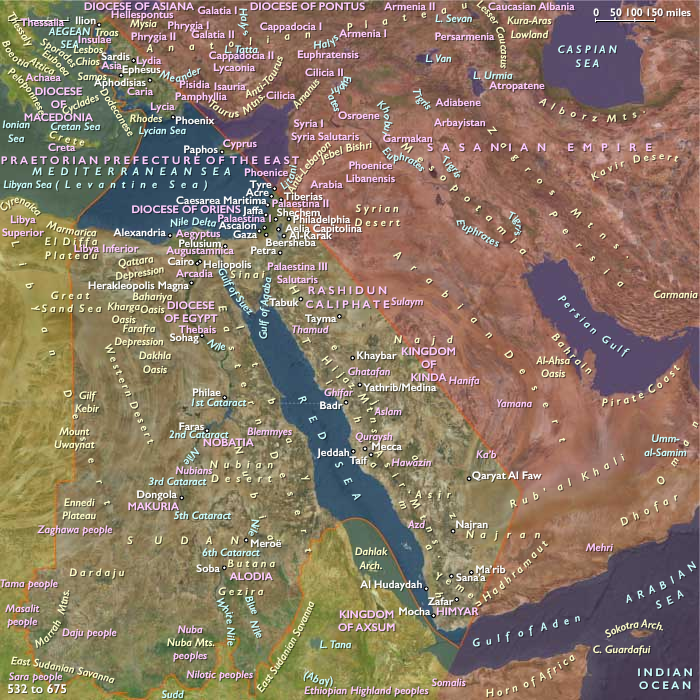
In 570 CE, the self-proclaimed king of Himyar, Abraha, leads a notable military campaign northward against the city of Mecca, famously known as the Year of the Elephant. His forces, supported by elephants, fail to capture Mecca—a defeat later attributed by Islamic tradition to divine intervention. This event coincides with the birth year of the Prophet Muhammad, making it a landmark year in regional historical narratives. Recent archaeological findings suggest the actual year of Abraha’s campaign might have been 568 or 569 CE, aligning closely with broader geopolitical shifts in southern Arabia.
Collapse of the Ma'rib Dam
A pivotal environmental event occurs around 570–575 CE with the rupture of the great Ma'rib Dam in southern Arabia. This ancient structure, about fifty feet high and nearly two thousand feet long, has for over a millennium sustained extensive irrigation across the agriculturally rich Wadi Dhana basin. Its failure results in severe economic and social disruptions, symbolically marking the end of the Yemeni empires' historical prominence and destabilizing the once-prosperous agricultural region.
Persian Expansion into Yemen
Amid these disruptions, Persian influence expands into southern Arabia. King Khosrow I sends an expedition to South Arabia, successfully conquering Yemen and establishing a military base. This strategic move aims to control the vital sea trade routes connecting the region with the East, further altering the regional balance of power and commercial dynamics.
Regional Consequences
The environmental and political turbulence of this period notably weakens southern Arabian states, facilitating shifts in regional influence and the rise of new centers of power. These developments set the stage for subsequent cultural and religious transformations, including the eventual emergence of Islam in the following decades.
Legacy of the Era
The era from 568 to 579 CE significantly alters the Near Eastern geopolitical and environmental landscapes. Abraha’s military campaign underscores political ambitions and religious tensions, while the collapse of the Ma'rib Dam and Persian expansion into Yemen highlight the profound impacts of environmental change and imperial ambitions on historical trajectories, laying groundwork for major historical transitions in the region.
Abraha, apart from promoting construction projects and massacres of Jews, is chiefly famous for the military expedition that he leads northward against the city of Mecca in the same year as Muhammad's birth, about 570.
Although elephants support the expedition, it fails, and later Muslims, who will remember this year as “the Year of the Elephant,” will profess the belief that Mecca had escaped capture only through a miracle.
According to Islamic tradition, it was in this year that Muhammad was born.
Recent discoveries in southern Arabia suggest that Year of the Elephant may have been 569 or 568, as the Sassanid Empire overthrew the Axumite- and Roman-affiliated regimes in Yemen around 570.
Years: 568 - 579
Locations
People
Groups
Topics
Commodoties
Subjects
Regions
Subregions