The Great Plague has claimed thirty-six thousand …
Years: 1740 - 1740
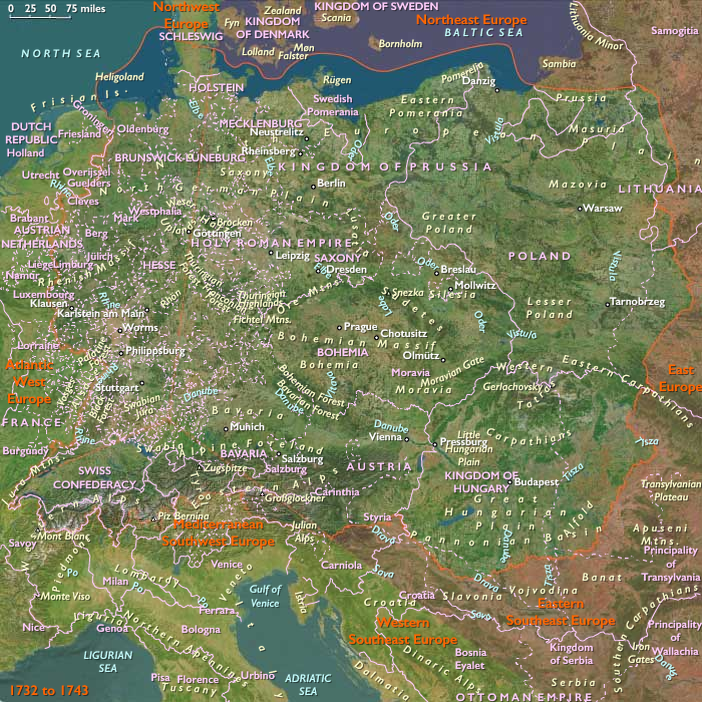
The Great Plague has claimed thirty-six thousand lives according to the Hungarian Diet of 1740.
Locations
Groups
- Austria, Archduchy of
- Serbia, Ottoman
- Croatia, (Habsburg) Kingdom of
- Hungary, Kingdom of
- Habsburg Monarchy, or Empire
- Wallachia (Ottoman vassal), Principality of
- Transylvania, (Austrian) Province of
Topics
Subjects
Regions
Subregions
Related Events
Filter results
Showing 10 events out of 27392 total
The level and extent of Uzbek influence slides under Ashtarkhanid rule, reaching a low point by the mid-1700s, when Iran's Afsharid ruler, Nader Shah, quickly defeats Bukhara and Khiva in 1740, effectively decapitating the Ashtarkhanid dynasty.
Crown Prince Frederick's Anti-Machiavel, an idealistic refutation of Niccolò Machiavelli, whose works, such as The Prince, are considered a guideline for the behavior of a king in this age, is published anonymously in 1740, but Voltaire distributes it in Amsterdam to great popularity.
Frederick's years dedicated to the arts instead of politics had ended upon the death of Frederick William and his inheritance of the Kingdom of Prussia.
Before his ascension, Frederick had been told by d'Alembert, "The philosophers and the men of letters in every land have long looked upon you, Sire, as their leader and model."
Such devotion, however, has to be tempered by political realities.
Frederick William dies on May 31 of this year at age fifty-one and is interred at the Garrison Church in Potsdam.
Frederick II succeeds him.
Once Frederick secures the throne, he prevents his wife Elisabeth from visiting his court in Potsdam, granting her instead Schönhausen Palace and apartments at the Berliner Stadtschloss.
Frederick bestows the title of the heir to the throne, "Prince of Prussia", on his brother Augustus William; despite this, his wife remains devoted to him.
Frederick ascends the throne in 1740 as "King in Prussia", which consists of scattered territories, including Cleves, Mark, and Ravensberg in the west of the Holy Roman Empire; Brandenburg, Hither Pomerania, and Farther Pomerania in the east of the Empire; and the former Duchy of Prussia, outside of the Empire bordering the Polish-Lithuanian Commonwealth, when
He is titled King in Prussia because this is only part of historic Prussia.
Frederick's goal is to modernize and unite his vulnerably disconnected lands; toward this end, he will fight wars mainly against Austria, whose Habsburg dynasty has reigned as Holy Roman Emperors almost continuously from the fifteenth century.
Frederick will establish Prussia as the fifth and smallest European great power by using the resources his frugal father had cultivated.
Berlin suffers a smallpox epidemic in 1740.
Frederick, who desires the prosperous Austrian province of Silesia, declines to endorse the Pragmatic Sanction of 1713, a legal mechanism to ensure the inheritance of the Habsburg domains by Maria Theresa of Austria.
He is also worried that Augustus III, King of Poland and Elector of Saxony, will seek to connect his own disparate lands through Silesia.
The Prussian king thus invades Silesia the same year he takes power, using as justification an obscure treaty from 1537 between the Hohenzollern and the Piast dynasty of Brieg (Brzeg).
The ensuing First Silesian War (1740–1742), part of the War of the Austrian Succession (1740–1748), will result in Frederick conquering the province (with the exception of Austrian Silesia).
Southeastern Transylvania may have been the hardest area hit by the Great Plague of 1738.
The plague from 1738 to 1746 will kill a sixth of the population of Timişoara.
Timişoara's Monument of the Holy Trinity in Piaţa Unirii is dedicated to the plague's victims.
Although no exact figure is available, the epidemic likely kills over fifty thousand people in southeastern Europe.
The plunder seized from India is so rich that Nader stops taxation in Persia for a period of three years following his return.
The Indian campaign had been the zenith of Nader's career.
Afterwards, he becomes increasingly despotic as his health declined markedly.
Nader had left his son Reza Qoli Mirza to rule Persia in his absence.
Reza has behaved highhandedly and somewhat cruelly but he has kept the peace in Persia.
Having heard rumors that his father had died, he had had made preparations for assuming the crown.
These include the murder of the former shah Tahmasp and his family, including the nine-year old Abbas III.
On hearing the news, Reza's wife, who is Tahmasp's sister, commits suicide.
Nader is not impressed with his son's waywardness and reprimands him, but he takes him on his expedition to conquer territory in Transoxiana.
This incorporation of Whydah into Dahomey had transformed the latter into a significant regional power, gut constant warfare with the Oyo Empire from 1728 to 1740 results in Dahomey becoming a tributary state of the Oyo.
The compositions of Benedetto Marcello, a member of a noble Venetian family, are frequently referred to as Patrizio Veneto.
Although he is a music student of Antonio Lotti and Francesco Gasparini, his father wants Benedetto to devote himself to law.
Benedetto manages to combine a life in law and public service with one in music.
He had in 1711 been appointed a member of the Council of Forty (in Venice's central government).
Il teatro alla moda (The Fashionable Theater) is a satirical pamphlet in which Marcello vents his critical opinions on the milieu of the Italian opera seria in the first decades of the eighteenth century.
It is first published by the end of 1720 anonymously in Venice.
Marcello criticizes virtually every aspect of opera seria and its social environment: the artificiality of plots, the stereotyped format of music, the extravagant scenography and machinery, the inability and venality of composers and poets, the vanity and vulgarity of singers, the avidity of impresarios, the ineptitude of musicians.
The full title reads "THE FASHIONABLE THEATER – OR – safe and easy METHOD for correctly composing and performing Italian OPERAS in the modern style, – In which – useful and necessary Advice is given to Librettists, Composers, Musicians of both sexes, Impresarios, Performers, Engineers, and Scene Painters, comic Characters, Tailors, Pages, Dancers, Prompters, Copyists, Protectors, and MOTHERS of female Virtuoso singers, & other People belonging to Theater."
Il teatro alla moda is in fact written as a series of chapters where advice is ironically given to the various people involved in operatic productions, in order to meet "the modern customs" and bizarre requirements of such theatrical events.
This little work, which will be frequently reprinted, is not only extremely amusing, but is most valuable as a contribution to the history of opera.

Years: 1740 - 1740
Locations
Groups
- Austria, Archduchy of
- Serbia, Ottoman
- Croatia, (Habsburg) Kingdom of
- Hungary, Kingdom of
- Habsburg Monarchy, or Empire
- Wallachia (Ottoman vassal), Principality of
- Transylvania, (Austrian) Province of