
The Great Northern War, in which the …
Years: 1725 - 1725
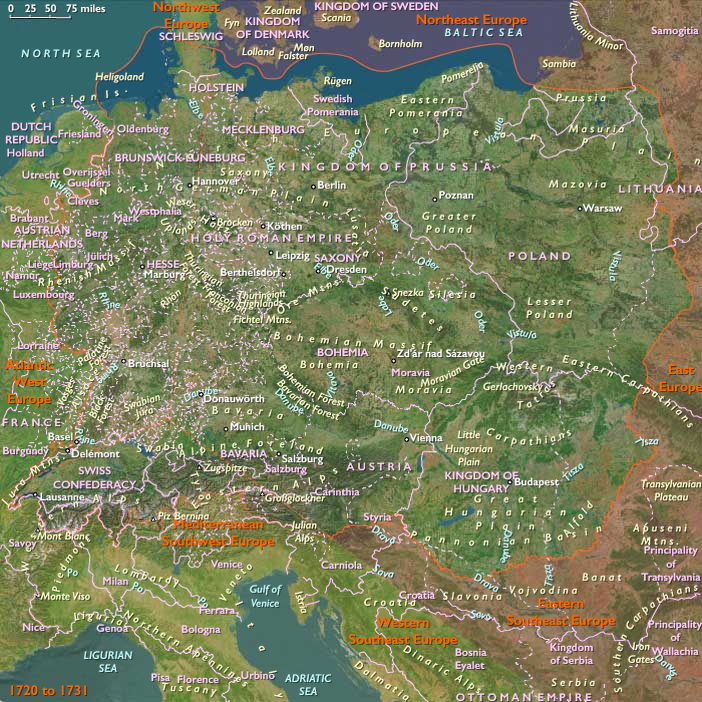
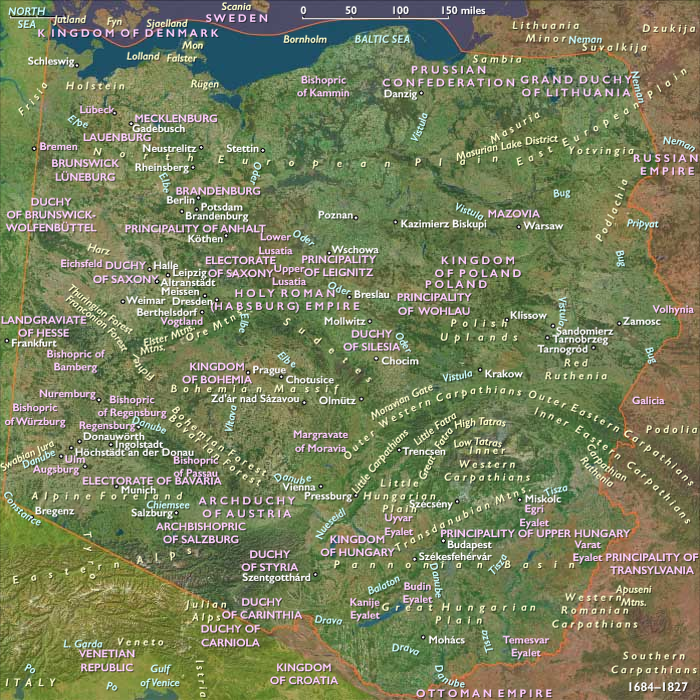
The Great Northern War, in which the overambitious Augustus II, King of Poland and Elector of Saxony, had embroiled Poland, has ruined the country economically.
A crushing defeat of Sweden by Peter I (the Great) of Russia at the Battle of Poltava (Ukraine, Russian Empire) in 1709 had eventually restored Augustus II to the throne but made him dependent on the tsar.
Augustus, having failed to strengthen his position through war and territorial acquisitions, contemplates domestic reforms while his entourage plays with the idea of a coup backed by Saxon troops.
Russia in 1716 and 1717 had intervened in an internal dispute between Augustus and dissident Polish nobles (Confederation of Tarnogród).
A settlement at the “silent Sejm” surrounded by Russian troops had removed Saxon contingents from Poland, but it had brought about certain reforms.
After Peter annexed Livonia in 1720, the king had seen the danger of Russia's growing influence in Polish affairs.
Subsequent attempts by Augustus to mount a coalition against the rising might of Russia founder on the distrust of the king's motives.
He had even been suspected of plotting partitions of the Commonwealth.
During the remaining years of his reign, Augustus's main preoccupation is to ensure the succession of his one legitimate son, Frederick Augustus II (eventually king of Poland as Augustus III), and to secure other lands for his many illegitimate children, but his hopes of establishing a strong hereditary monarchy will come to naught.
The “Saxon Era,” which lasts for more than sixty years, marks the lowest point in Polish history.
The neighboring states had signed agreements among themselves to promote weakness within the Commonwealth, as for instance the Austro-Russian accord of 1675 and the Swedish-Brandenburg pacts of 1686 and 1696, which have been followed by others in the 1720s.
Foreign interlopers corrupt politicians and foment disorder.
Attempts at reform are stymied by the determination of the szlachta to preserve their "golden freedoms" as well as the liberum veto, the use of which has paralyzed ten out of eighteen Sejms during the reign of Augustus II.
A Protestant-Catholic riot in Torun in 1724 had resulted in Protestant officials' being sentenced to death.
Prussian and Russian propagandists speak of a “bloodbath” and use the situation as an opportunity to denounce Polish intolerance.
Posing as a protector of non-Catholics, St. Petersburg is in fact using them as a political instrument.
Polish politics, ways, and manners, as well as declining education and rampant religious bigotry, are increasingly pictured as exotically anachronistic.
The Polish nobles have become the laughingstock of Europe.
Because the promises John Casimir had made during the darkest days of Swedish invasion to improve the lot of the peasantry have remained empty, the oppressed peasants are largely alienated from the nation.
Locations
People
Groups
- Christians, Eastern Orthodox
- Christians, Roman Catholic
- Saxony, Electorate of
- Protestantism
- Sweden, (second) Kingdom of
- Polish-Lithuanian Commonwealth (Commonwealth of the Two Nations)
- Prussia, Kingdom of
- Russian Empire
Topics
Subjects
Regions
Subregions
Years: 1725 - 1725
Locations
People
Groups
- Christians, Eastern Orthodox
- Christians, Roman Catholic
- Saxony, Electorate of
- Protestantism
- Sweden, (second) Kingdom of
- Polish-Lithuanian Commonwealth (Commonwealth of the Two Nations)
- Prussia, Kingdom of
- Russian Empire
Topics
Subjects
Regions
Subregions