The governor in San'a, Abu'l-Atahiyah, tired of …
Years: 899 - 899
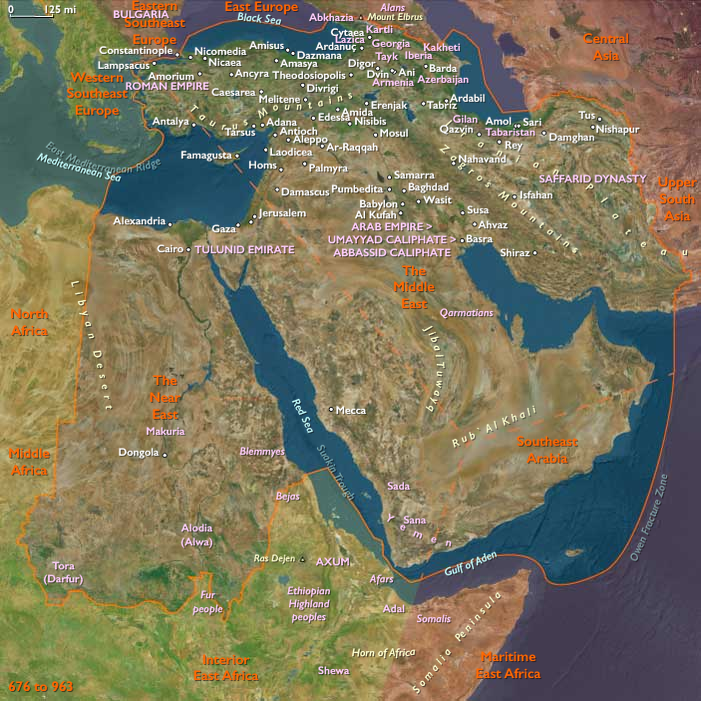
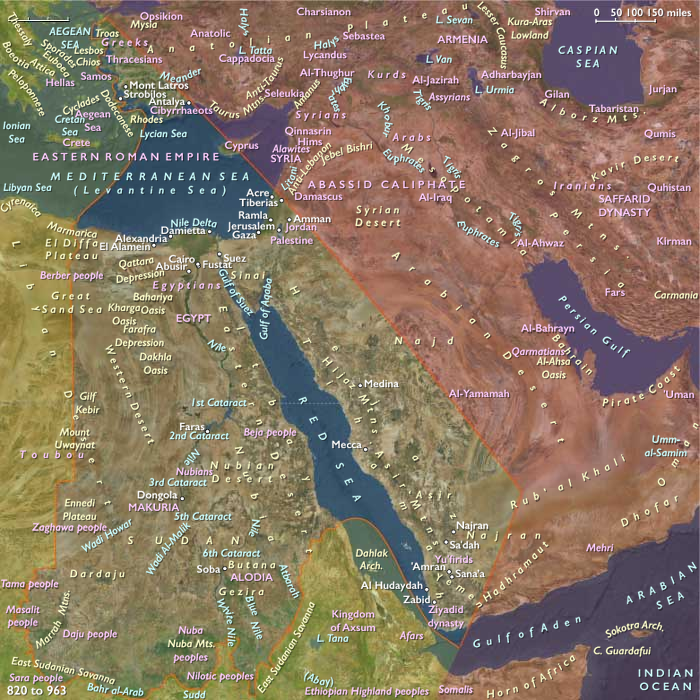
The governor in San'a, Abu'l-Atahiyah, tired of the Yu’firid faction, invites al-Hadi to rule over the city in 899, and acknowledges his status as imam.
Locations
People
Groups
Topics
Commodoties
Subjects
Regions
Subregions
Related Events
Filter results
Showing 10 events out of 53577 total
Various Shī‘ī groups organize in secret opposition to the Abbasid Caliphate.
Among them are the supporters of the proto-Isma'ili community, of whom the most prominent group are called the Mubarakiyyah.
According to the Isma'ili school of thought, Imam Jaʿfar al-Ṣadiq (702–765) designated his second son, Isma'il ibn Jafar, born in 721, as heir to the Imamate.
However, Ismā‘īl predeceased his father in 755.
Some claimed he had gone into hiding, but the proto-Isma'ili group accepted his death and therefore accordingly recognized Isma'il’s eldest son, Muḥammad ibn Isma'il (746–809), as Imām.
He remained in contact with the Mubarakiyyah group, most of whom resided in Kufah.
The split among the Mubarakiyyah came with the death of Muḥammad ibn Isma'ili in about 813 CE.
The majority of the group denied his death; they recognized him as the Mahdi.
The minority believed in his death and will eventually emerge in later times as the Faṭimid Isma'ili, the precursors to all modern groups.
The majority Isma'ili missionary movement has settled in Salamiyah (in present-day Syria) and has had great success in Khuzestan (southwestern Persia), where the Isma'ili leader al-Husayn al-Ahwazi had converted the Kūfan man Ḥamdan in 874 CE, who had taken the name Qarmaṭ after his new faith.
Qarmaṭ and his theologian brother-in-law ‘Abdān have prepares southern Iraq for the coming of the Mahdi by creating a military and religious stronghold.
Other such locations have grown up in Yemen, in Bahrain in 899 CE and in North Africa.
These attract many new Shī‘ī followers due to their activist and messianic teachings.
This new proto-Qarmaṭi movement continues to spread into Greater Iran and into Transoxiana.
A change in leadership in Salamiyah in 899 leads to a split in the movement.
The minority Isma'ilis, whose leader has taken control of the Salamiyah center, begin to proclaim their teachings—that Imam Muḥammad has died, and that the new leader in Salamiyah is in fact his descendant come out of hiding.
Qarmaṭ and his brother-in-law oppose this and openly break with the Salamiyyids; when ‘Abdān is assassinated, he goes into hiding and subsequently repents.
Qarmaṭ becomes a missionary of the new Imam, Ubayd Allah al-Mahdi Billah, who will found the Fatimid Caliphate in North Africa in 909.
Nonetheless, the dissident group retains the name Qarmaṭī.
Their greatest stronghold remains in Bahrain, which at this period includes much of eastern Arabia as well as the islands that comprise the present state.
Bahrain is under Abbasid control at the end of the ninth century, but a slave rebellion in Basra disrupts the power of Baghdad.
The Qarmaṭians seize their opportunity under their leader, Abu-Saʿid Jannabi, who captures Bahrain’s capital Hajr and al-Hasa in 899, which he makes the capital of his republic.
Once in control of the state he seeks to set up a utopian society.
The Qarmatians are alleged to oppose many of the teachings of the Prophet Muhammad, and they encourage social equality for nomads, townspeople, and peasants.

Charles the Simple in 899 confiscates, for the profit of the church at Narbonne, all the property held by the Jews and subject to the payment of tithes (Vaissette.
iii.
63).
According to Saige ("Hist.
des Juifs du Languedoc," p. 9), this signifies that the Jews might not possess land upon which Church tithes were levied, but it did not abrogate their right to hold free land.
The Franks had taken Reggio Emilia from the Lombards in 773.
Charlemagne had given the bishop the authority to exercise royal authority over the city and established the diocese' limits in 781.
Reggio had been handed over to the Kingdom of Italy in 888.
The Magyars heavily damage the city in 899, killing Bishop Azzo II.
As a result of this raid, new walls are built.
Regino of Prüm, according to the statements of a later era, was the son of noble parents and was born at the stronghold of Altrip on the Rhine near Speyer at an unknown date.
From his election as abbot and from his writings, it is evident that he had entered the Benedictine Order, probably at Prüm itself, and that he had been a diligent student.
The rich and celebrated Imperial Abbey of Prüm suffered greatly during the ninth century from the marauding incursions of the Norsemen.
It had been twice seized and ravaged, in 882 and 892.
After its second devastation by the Danes, the abbot Farabert had resigned his office and Regino had in 892 been elected his successor.
His labors for the restoration of the devastated abbey have been hampered by the struggle between contending parties in Lorraine.
Regino is driven from his office in 898 by Richarius, later Bishop of Liège, the brother of Count Gerhard and count Mattfried of Hainaut.
Richarius is made abbot; Regino resigns the position and retires to …
…Trier, where he is honorably received by Archbishop Ratbod and is appointed abbot of St. Martin's, a house which he reforms.
He supports the archbishop in the latter's efforts to carry out ecclesiastical reforms in that troubled era, rebuilds the Abbey of St. Martin that had been laid waste by the Norsemen, accompanies the archbishop on visitations, and uses his leisure for writing.
Al-Mu'tadid has meanwhile continued his efforts to regain control of al-Jazira following the defeat of the Kharijites.
Muhammad ibn Ahmad al-Shaybani is the son of Ahmad ibn Isa al-Shaybani and grandson of Isa ibn al-Shaykh al-Shaybani.
Exploiting the weakness of the Abbasid Caliphate after the turmoil of the "Anarchy at Samarra", Isa and Ahmad had established themselves as the virtually independent rulers of Diyarbakr in the Jazira.
Ahmad had also been able to expand his control into southern Armenia and for a short time controlled Mosul as well, before the Caliph al-Mu'tadid evicted him from the city and forced him to recognized Abbasid suzerainty in 893.
Ahmad had remained in control of Diyar Bakr and his Armenian gains, but was thereafter careful to appease the Caliph and appear loyal to him.
When Ahmad died in 898, Muhammad had succeeded him in Diyarbakr, but al-Mu'tadid now resolved to complete the resubmission of the entire Jazira to direct caliphal control.
In 899, he campaigns against Muhammad and besieges him in his capital from April/May until June, when Muhammad surrenders in exchange for clemency both for himself and his followers.
The Caliph treats Muhammad well, and after installing his own son, Ali al-Muktafi, as governor of the Jazira, takes the captive emir with him to Baghdad.
King Alfred of Wessex dies on October 26, 899.
The first monarch of an English kingdom to become a symbol and focus of national unity, he is he only English king called “the Great”.
The brothers Æthelred and Alfred had agreed that the bulk of their property should go to the survivor, an arrangement which left Æthelhelm and Æthelwold at a disadvantage when Æthelred died first, and Alfred's will makes clear that they complained that he had denied them their property.
He had left the bulk of his estate to his eldest son Edward, while Æthelhelm had been left eight estates, and Æthelwold only three at Godalming and Guildford in Surrey, and Steyning in Sussex.
Alfred had also favored his own son by giving him opportunities for command in battle once he was old enough.
After Alfred's death, Æthelwold, as the senior ætheling (prince of the royal dynasty eligible for kingship), has a strong claim to succeed him, and made a bid for the throne.
Æthelwold's revolt is probably partly motivated by a belief that he had been denied his rights in his uncle's will.
Very little is known of Æthelwold's family.
His mother was probably the Wulfthryth who in 868 witnessed a charter.
She is described there as regina, whereas Edward's mother was only the king's wife, and Æthelwold's status as the son of a queen may have given him an advantage over Edward.
In the only surviving charter that recorded Æthelwold, he is listed above Edward, implying that he ranked above him.
The only record of Æthelwold's older brother Æthelhelm is as a beneficiary of Alfred's will in the mid-880s, and he probably died soon afterwards.
According to the 'A' version of the Anglo-Saxon Chronicle, Æthelwold seized a nun from her convent and married her without the permission of King Edward and against the command of the bishop.
Her identity is not known, but it must have been intended to strengthen his claim, and in the view of historian Pauline Stafford, the Chronicle's account is biased in favor of Edward and may have been intended to delegitimize a politically important marriage.
Æthelwold takes her to the royal manors of Twynham (now Christchurch) and then to Wimborne Minster, symbolically important as his father's burial place, where he declares that "he would live or die".
However, when Edward's army approaches and camps nearby at Badbury Rings, he is unable to gain sufficient support to meet them in battle.
Arnulf had found on his return to Germany in 896 that his physical ill health (he suffers from morbus pediculosis—infestation of lice under the eyelid) means he is unable to deal with the problems besetting his reign.
Italy is lost, raiders from Moravia and Hungary are continually raiding his lands, and Lotharingia is in revolt against Zwentibold.
He is also plagued by escalating violence and power struggles between the lower German nobility.
Arnulf of Carinthia dies on December 8, 899, at Ratisbon (today known as Regensburg), Bavaria; he is the last Carolingian to be crowned Frankish emperor.
He is succeeded as a king of the East Franks by Louis the Child, his six-year-old son by his wife Ota, a member of the Conradine dynasty.
Gyeon Hwon conquers the southwest regions and in 900 declares himself king of Hubaekje ("later Baekje"), a country meant to revive Baekje's glory.
He establishes his capital at Wansanju, today's Jeonju, and continues to expand the kingdom.
The chancellor Cui Yin, who harbors an ardent hatred for the eunuchs and who is allied with Zhu Quanzhong, is meanwhile also rising in power at the Tang court.
By 900, Emperor Zhaozong, who has come to trust Cui and who will later describe him as "faithful but trickier" (than Han Wo, the official to whom the emperor was addressing his comment) is planning with Cui to slaughter the eunuchs.
When Cui's fellow chancellor Wang Tuan urges against such action, believing the plans to be too drastic, Cui accuses Wang of being in league with the powerful eunuchs Zhu Daobi and Jing Wuxiu, who serve as the directors of palace communications.
Upon Cui's accusations, Emperor Zhaozong orders Wang, Zhu Daobi, and Jing to commit suicide, and it is said that from this point Cui became the leading figure at court, the eunuchs regarding him with anger and fear.
The eunuchs also have become fearful of Emperor Zhaozong himself, who, after returning from Hua Prefecture, is described to be depressed, alcoholic, and unpredictable in his temperament.
The four top-ranked eunuchs—Liu Jishu and Wang Zhongxian, the commanders of the Shence Armies, and Wang Yanfan and Xue Qiwo, the new directors of palace communications—begin plotting to remove him.
After an incident in winter 900 in which Emperor Zhaozong, in a drunken rage, kills several attending eunuchs and ladies in waiting, Liu Jishu leads Shence Army troops into the palace and forces Emperor Zhaozong to yield the throne to his son Li Yu the Crown Prince.
Emperor Zhaozong and his wife (Li Yu's mother) Empress He ware honored as retired emperor (Taishang Huang) and retired empress (Taishang Huanghou) but put under house arrest.
Li Yu, whose name the eunuchs change to Li Zhen, is proclaimed emperor, but the eunuchs control the court.
They want to kill Cui, but are fearful that Cui's ally Zhu Quanzhong might react violently, so they only relieve Cui from his secondary posts as the director of finances and the director of salt and iron monopolies.