
The Goths at first negotiate, then stiffen …
Years: 536 - 536
September
The Goths at first negotiate, then stiffen their resistance.
One of their nobles, Vitiges, had married Amalasuntha's only surviving child, Mathesuentha, in a ceremony designed to bolster his claim to kingship over the Ostrogoths.
The panegyric upon the wedding in 536 is delivered by Cassiodorus, the praetorian prefect.
(It survives as a traditionally Roman form of rhetoric that sets the Gothic dynasty in a flatteringly Roman light.)
Theodohad had had been an elderly man at the time of his succession; following the imprisonment and death of his mother-in-law, he is murdered in autumn 536 at the order of Vitiges.
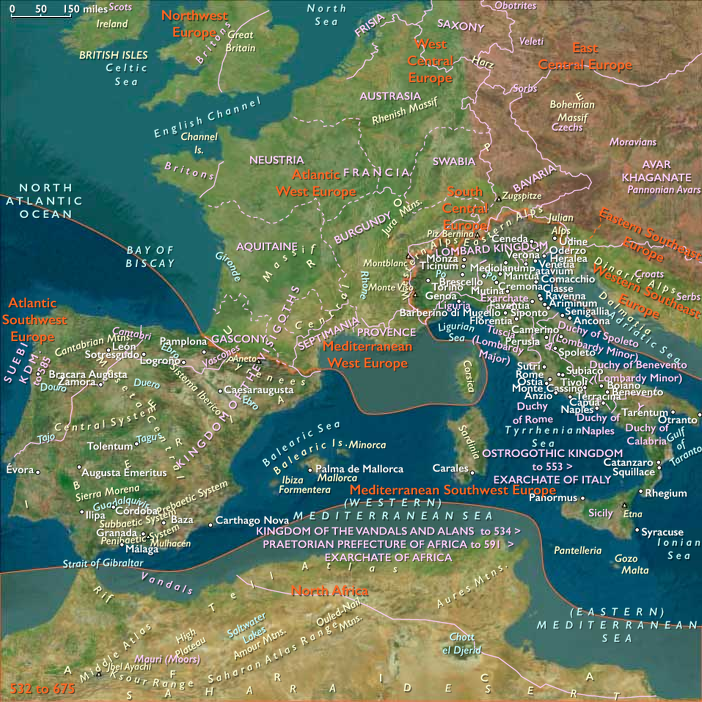
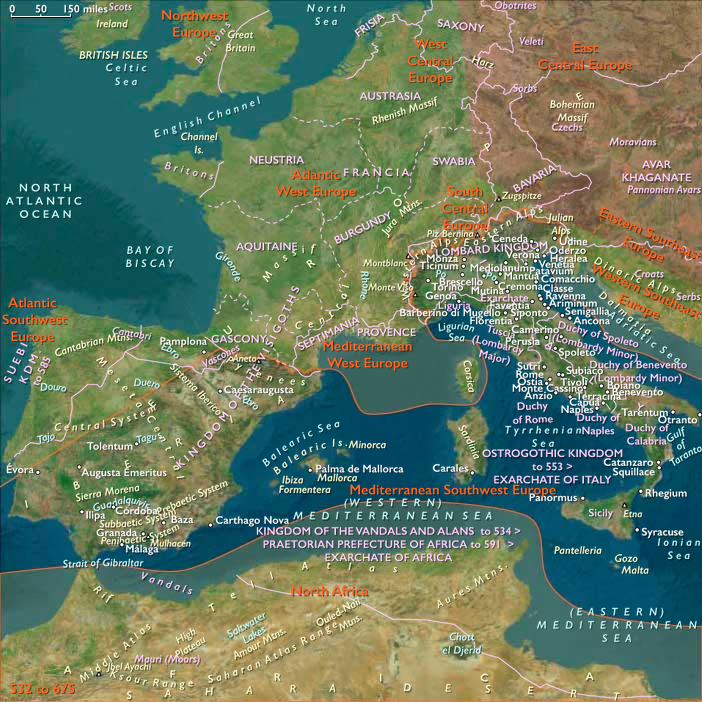
The Goths attempt to block Belisarius' armies as they enter the Italian peninsula, where the progress of East Roman arms, replenished by Hunnish and Slavic conscripts, proves slower.
Locations
People
Groups
- Goths (East Germanic tribe)
- Huns
- East, or Oriens, Praetorian prefecture of
- Slavs, South
- Italy, Praetorian prefecture of
- Ostrogoths, Italian Kingdom of the
- Roman Empire, Eastern: Justinian dynasty
Topics
- Migration Period
- Migration Period Pessimum
- Gothic (Italian) War
- Wars against the Moors
- Extreme weather events of 535-536
Commodoties
Subjects
Regions
Subregions
Related Events
Filter results
Showing 10 events out of 57800 total
The Climate Catastrophe of 535–536 CE: A Global Crisis
Beginning in 535 CE, a series of extreme weather events disrupt the Northern Hemisphere, likely triggered by a massive veil of atmospheric dust. This climatic anomaly persists into 536 CE, leading to unseasonal weather, widespread crop failures, and severe food shortages across multiple civilizations. The crisis exacerbates economic and political instability, particularly in regions already weakened by war, migration, and disease.
1. Possible Causes: Volcanic Eruption or Extraterrestrial Impact?
Scientists propose two main explanations for the atmospheric disturbance:
-
Massive Volcanic Eruption
- Ice cores from Greenland and Antarctica show significant sulfate deposits dating to 533–534 CE, indicating a major volcanic eruption.
- A tropical eruption—possibly in Central America, Indonesia, or Iceland—may have injected large amounts of sulfur dioxide into the atmosphere, blocking sunlight and cooling the Earth.
-
Extraterrestrial Impact
- Some researchers suggest that a comet or asteroid impact could have ejected dust and debris into the stratosphere, creating a global veil that reduced solar radiation.
- Evidence for micrometeorite impacts during this period supports this theory, though the exact cause remains debated.
2. Evidence of a Climate Anomaly
-
Eyewitness Accounts
- The Byzantine historian Procopius, writing in his History of the Wars, describes the phenomenon in 536 CE:
"During this year a most dread portent took place. For the sun gave forth its light without brightness... and it seemed exceedingly like the sun in eclipse, for the beams it shed were not clear."
- The Roman senator Cassiodorus also records dim sunlight and severe winter conditions in Italy.
- In China, historical sources report summer frosts and a yellow dust veil, disrupting agriculture.
- The Byzantine historian Procopius, writing in his History of the Wars, describes the phenomenon in 536 CE:
-
Tree Ring Data
- Dendrochronologists, such as Mike Baillie of Queen's University Belfast, observe abnormally little growth in Irish oak tree rings for 536 CE and another sharp decline in 542 CE.
- This suggests multiple climatic disturbances, possibly due to a second eruption or environmental stressors.
-
Glacial Ice Core Samples
- Ice cores from Greenland and Antarctica reveal high sulfate concentrations, providing evidence of an acidic dust veil from volcanic eruptions.
3. Widespread Effects: Crop Failures and Societal Disruption
-
Europe and the Mediterranean
- Unseasonal cold summers lead to failed harvests.
- Chronic food shortages trigger famine and malnutrition, further weakening populations.
- Economic decline destabilizes the Byzantine Empire, already struggling with war and political upheaval.
-
Asia
- China experiences summer frosts and reports crop devastation in multiple provinces.
- Unusual weather patterns disrupt trade and food production.
-
Scandinavia and the North Atlantic
- Harsh climate conditions force migrations and lead to the abandonment of farmlands.
- Some scholars speculate that this period of famine contributed to later Viking expansion as Scandinavian societies adapted to environmental challenges.
-
The Americas
- Evidence from Mesoamerican civilizations suggests major environmental stress, possibly linked to volcanic eruptions affecting global climate patterns.
4. The Second Climate Event in 540 CE and the Plague of Justinian (541–542 CE)
- Another major cooling event occurs in 540 CE, potentially from a second volcanic eruption or a comet impact.
- This climatic instability weakens populations and exacerbates disease outbreaks.
- The Plague of Justinian (541–542 CE) emerges in the Eastern Mediterranean, spreading rapidly and causing millions of deaths, further destabilizing the Byzantine Empire.
5. Long-Term Consequences: The Shaping of Medieval Europe
- The prolonged climate crisis accelerates economic decline, hastening the transition from urban Roman society to localized feudal economies.
- Political fragmentation intensifies, as regions struggle to maintain order amid famine, disease, and depopulation.
- The Church gains influence, providing stability in an era of crisis and preserving classical knowledge.
Conclusion: A Global Disaster with Lasting Impact
The climate catastrophe of 535–536 CE marks one of the most severe short-term cooling events in recorded history. Whether caused by volcanic eruptions or an extraterrestrial impact, its effects ripple across Europe, Asia, and the Americas, contributing to famine, migration, and political upheaval. Combined with the Plague of Justinian, this period reshapes the trajectory of medieval history, influencing the development of post-Roman Europe, early medieval trade networks, and global population movements.
Buddhism’s characteristic stupa-and-pagoda architecture follows the spread of the religion into China and elsewhere.
Pagodas grow taller, their number of stories increasing to five in the sixth century.
Emperor Wu of Liang constructs a twelve-story pagoda in 536 that reportedly reaches a height of four hundred feet (one hundred and twenty-two meters).
Ecclesiastical architects in Constantinople have adopted the central plan for large-scale churches, in contrast to the horizontally oriented Christian basilica preferred by church architects in the West.
Their use of a succession of domes and half-domes, dependent on one another for receiving the thrusts (as in the Church of Saints Sergius and Bacchus in Constantinople, begun in 527 and completed in 536; now called Little Hagia Sophia), achieve a remarkable flow of interior space.
The light entering the windows at the base of the dome optically blurs the supports, with the extensive use of pendentives producing the effect of an airy canopy.
Saints Sergius and Bacchus exemplify the centralized plans beginning to be used for congregational churches as well as for martyrs' shrines, probably because of the growing importance of the cult of relics.
King Theodahad of the Ostrogoths had ceded Provence and upper Alamannia to the Franks for gaining their support in the war.
The possession of Arles and …
…Marseilles is guaranteed to Childebert by his brothers.
Roman control over Africa is not yet secure, despite Justinian's intentions and proclamations.
Belisarius had secured most of the provinces of Byzacena, Zeugitana and Tripolitania during his campaign, but further west, imperial control extends in a series of strongholds captured by the fleet along the coast as far as Constantine, while most of the inland areas of Numidia and Mauretania remain under the control of the local Moorish tribes, as indeed had been the case under the Vandal kings.
The Moors had initially acknowledged the Emperor's suzerainty and had given hostages to the imperial authorities, but they soon become restive and rise in revolt.
The first imperial governor, Belisarius' former domesticus Solomon, who, as exarch, combines the offices of both magister militum and praetorian prefect, is able to score successes against them and strengthen Roman rule in Africa, but his work is interrupted by a widespread military mutiny in Easter 536, caused by dissatisfaction of the soldiers with Solomon.
Solomon, together with Procopius, who works as his secretary, is able to escape to Sicily, which had just been conquered by Belisarius.
Solomon's lieutenants Martinus and Theodore are left behind, the first to try to reach the troops at Numidia, and the second to hold Carthage.
Upon hearing about the mutiny, Belisarius, with Solomon and one hundred picked men, sets sail for Africa.
Carthage is being besieged by nine thousand rebels, including many Vandals, under a certain Stotzas, who had served as a bodyguard of the general Martinus in the army under Belisarius.
The rebels aim to expel the imperial loyalists and establish Africa as a separate state, ruled by themselves.
Theodore is contemplating capitulation, when Belisarius appears.
The news of the famous general's arrival are sufficient for the rebels to abandon the siege and withdraw westwards.
Belisarius, although able to muster only two thousand men, immediately gives pursuit and catches up with and defeats the rebel forces at Membresa.
The bulk of the rebels, however, is able to flee, and continues to march towards Numidia, where Stotzas persuades most of the imperial garrison to join him, after murdering their officers; according to the historian Procopius, at this point two thirds of the Byzantine army in Africa had gone over to the rebel camp.
Belisarius himself is forced to return to Italy to prosecute the war against the Ostrogoths, and Justinian appoints his able cousin Germanus as magister militum to deal with the crisis.
He sends a mobile force of comitatenses, (mostly cavalry) and a elite guard.
Solomon returns to Constantinople.
A link between the Tierra Blanca Joven (TBJ) eruption of the Ilopango caldera in central El Salvador and the CE 536 event is suggested in evidence presented by 2010 by Robert Dull, John Southon and colleagues.
Although earlier published radiocarbon evidence suggested a two-sigma age range of CE 408-536, which is consistent with the global climate downturn, the connection between CE 536 and Ilopango was not explicitly made until research on Central American Pacific margin marine sediment cores by Steffen Kutterolf and colleagues showed that the phreatoplinian TBJ eruption was much larger than previously thought.
Detailed AMS 14C dating of successive growth increments from a single tree killed by a TBJ pyroclastic flow supports a death age for the tree of CE 535.
A conservative bulk tephra volume for the TBJ event of ~84 km3 was calculated, indicating a large VEI 6+ event and a magnitude of 6.9.
The results suggest that the Ilopango TBJ eruption size, latitude and age are consistent with the ice core sulfate records of Larsen, et al., 2008.
The collapse of the Ilopango caldera produced widespread pyroclastic flows and devastated Mayan cities.
The eruption produced about twenty-five cubic kilometers (six cubic miles) of tephra (twenty times as much as the 1980 eruption of Mount St. Helens), thus rating a 6 on the (VEI) Volcanic Explosivity Index.
The "ash-cloud fallout [..] blanketed an area of at least 10,000 square kilometers waist-deep in pumice and ash", which would have stopped all agricultural endeavor in the area for decades. (Clive Oppenheimer (2011). Eruptions that shook the world. Cambridge University Press. ISBN 978-0-521-64112-8.)
The imperial general Belisarius, having easily conquered Sicily, is now preparing for an invasion of Italy.
Theodahad resorts to begging the aged pontiff to proceed on an embassy to Constantinople, and use his personal influence to appease Emperor Justinian’s displeasure at the death of Amalasuntha.
Compelled to pledge the sacred vessels of the Church of Rome to defray the costs of the embassy, Agapetus sets out in midwinter with five bishops and a large retinue.
Pope Agapetus appears in Constantinople in February 536.
He is received with all the honors befitting the head of the Catholic Church, but his attempt fails: Justinian will not be swerved from his resolve to reestablish the rights of the Empire in Italy.
The current patriarch of Constantinople, Anthimus, had without the authority of the canons left his episcopal see of Trebizond to join the crypto-Monophysites who, in conjunction with the Empress Theodora, had been intriguing to undermine the authority of the Council of Chalcedon.
Against the protests of the orthodox, the Empress had finally seated Anthimus in the patriarcilal chair.
No sooner had the Pope arrived than the most prominent of the clergy entered charges against the new patriarch as an intruder and a heretic.
Agapetus orders him to make a written profession of faith and to return to his forsaken see; upon his refusal, he declines to have any relations with him.
This vexes the Emperor, who had been deceived by his wife as to the orthodoxy of her favorite, and the Emperor threatens the Pope with banishment.
Agapetus is said to have replied "With eager longing have I come to gaze upon the Most Christian Emperor Justinian. In his place I find a Diocletian, whose threats, however, terrify me not."
This language gives Justinian pause; and eventually Justinian, convinced that Anthimus is unsound in faith, makes no objection to the Pope's exercising the plenitude of his powers in deposing and suspending Anthimus and, for the first time in the history of the Church, personally consecrating his legally elected successor, Mennas.
Shortly afterwards, Agapetus falls ill and dies on April 22, 536.
Agapetus had appointed Vigilius papal representative (Apocrisiary) at Constantinople, where Empress Theodora has sought to win him as a confederate, to revenge the deposition of Anthimus by Agapetus and also to gain aid for her efforts in behalf of the Monophysites.
Vigilius is said to have agreed to the plans of the intriguing empress, who promises him the Papal See and a large sum of money (seven hundred pounds of gold).
Theodahad sends a new Gothic army to reclaim the Dalmatian province early in 536.
Mundus's son Mauricius is trapped with only a few men by a larger Gothic force and is killed in a skirmish near Salona.
Mundus, enraged by the loss of his son, sallies out and defeats the Goths but is mortally wounded in the pursuit.
The imperial army withdraws.
Years: 536 - 536
September
Locations
People
Groups
- Goths (East Germanic tribe)
- Huns
- East, or Oriens, Praetorian prefecture of
- Slavs, South
- Italy, Praetorian prefecture of
- Ostrogoths, Italian Kingdom of the
- Roman Empire, Eastern: Justinian dynasty
Topics
- Migration Period
- Migration Period Pessimum
- Gothic (Italian) War
- Wars against the Moors
- Extreme weather events of 535-536
