
The Gold Coast is the region of …
Years: 1874 - 1874
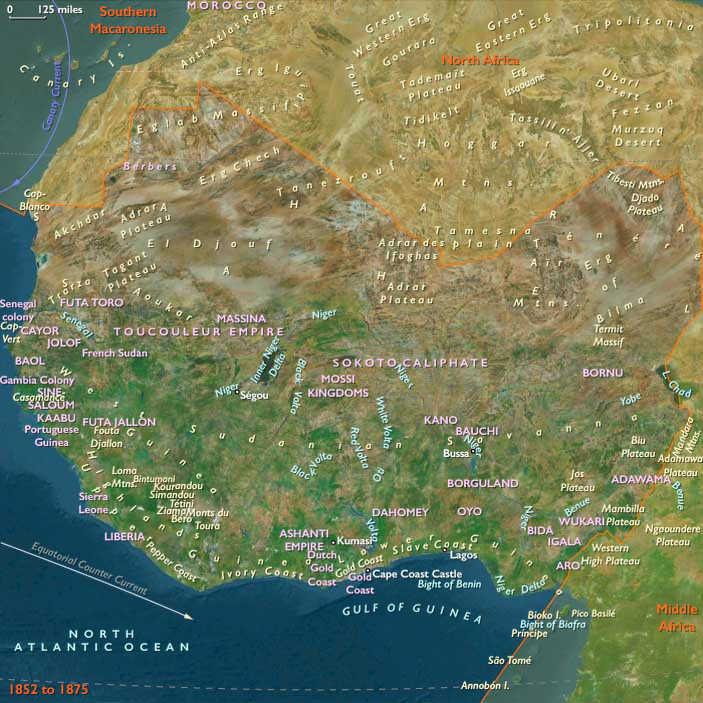
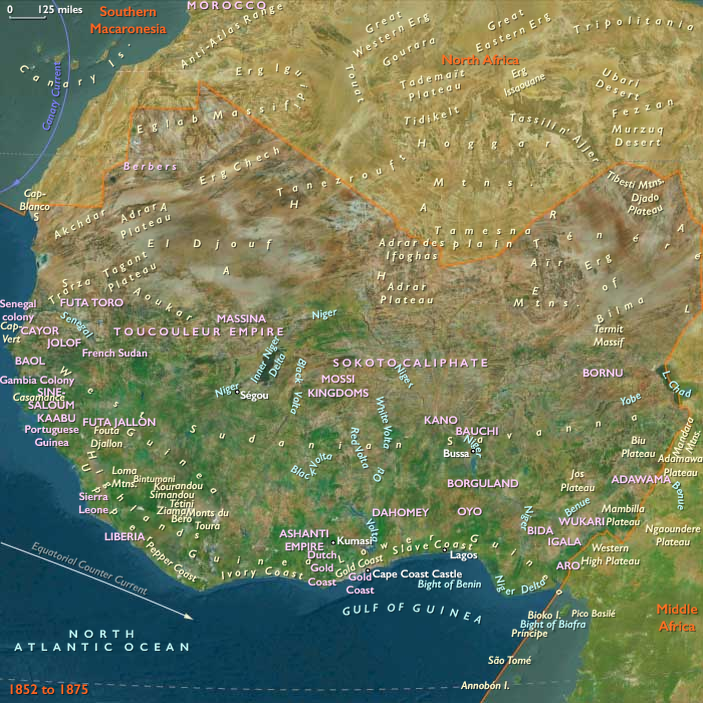
The Gold Coast is the region of West Africa which is now Akanland.
The Gold Coast, Slave Coast, and Ivory Coast are named after the resources there.
Early uses of the term refer literally to the coast and not the interior.
It is not until the nineteenth century that the term comes to refer to areas that are far from the coast.
It is to the east of the Ivory Coast and to the west of the Slave Coast.
The first Europeans to arrive at the coast had been the Portuguese in 1471, who had encountered a variety of African kingdoms, some of which controlled substantial deposits of gold in the soil.
In 1482, the Portuguese had built the Castle of Elmina, the first European settlement on the Gold Coast.
From here they had traded slaves, gold, knives, beads, mirrors, rum and guns.
News of the successful trading had spread quickly, and eventually British, Dutch, Danish, Prussian and Swedish traders arrived as well.
The European traders had built several forts along the coastline.
The Gold Coast had long been a name for the region used by Europeans because of the large gold resources found in the area.
The slave trade has been the principal exchange for many years.
The British Gold Coast had been formed in 1867 when the British government abolishes the African Company of Merchants and seizes privately held lands along the coast.
They also had taken over the remaining interests of other European countries, annexing the Danish Gold Coast in 1850 and the Dutch Gold Coast, including Fort Elmina, in 1872.
Britain has steadily expanded its colony through the invasion of local kingdoms as well, particularly the Ashanti and Fante confederacies.
The Ashanti people, who are the largest ethnic community in the region, had controlled much of the territory before the Europeans arrived and are often in conflict with them.
Four wars, the Anglo-Ashanti Wars, are fought between the Ashanti (Asante) and the British, who are sometimes allied with the Fante.
During the First Anglo-Ashanti War (1863–1864), the two groups had fought because of a disagreement over an Ashanti chief and slavery.
Locations
Groups
- Ashanti of Kumasi, Kingdom of the
- Britain (United Kingdom of Great Britain and Ireland)
- Gold Coast, British colony
- Côte d'Ivoire (Ivory Coast), French protectorate of
- Fante Confederacy
- Gold Coast Crown Colony
Topics
Commodoties
Subjects
Regions
Subregions
Related Events
Showing 10 events out of 12508 total
Years: 1874 - 1874
Locations
Groups
- Ashanti of Kumasi, Kingdom of the
- Britain (United Kingdom of Great Britain and Ireland)
- Gold Coast, British colony
- Côte d'Ivoire (Ivory Coast), French protectorate of
- Fante Confederacy
- Gold Coast Crown Colony
Topics
Commodoties
Subjects
Regions
Subregions