
The Ghaznavid Empire extends by 1030 from …
Years: 1030 - 1030
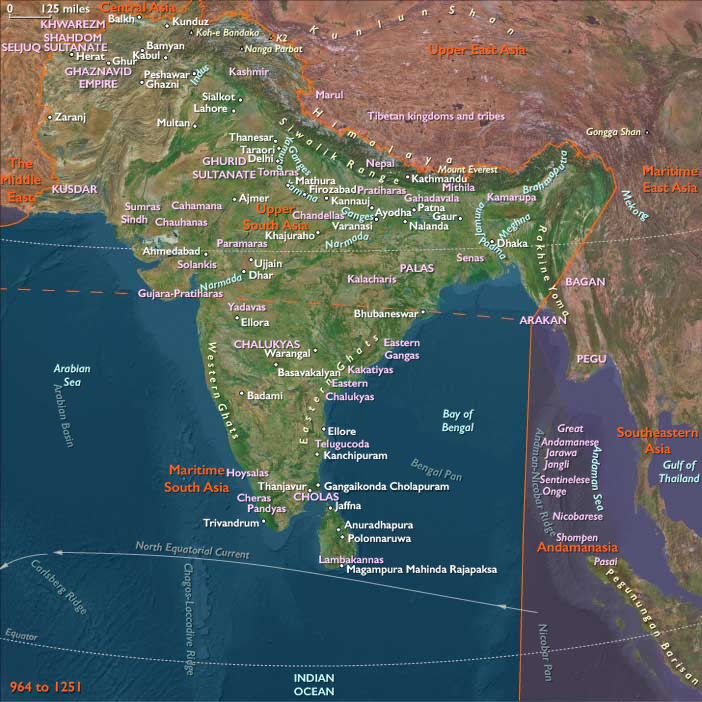
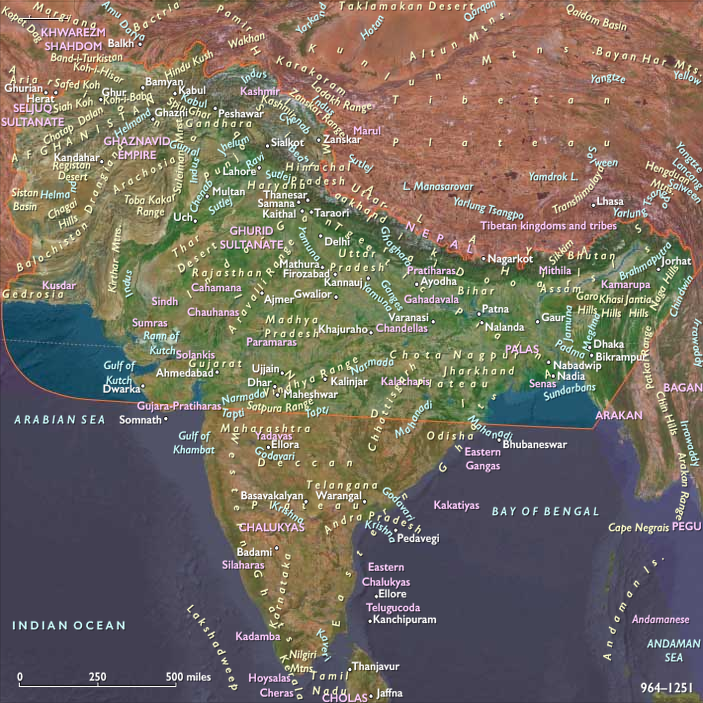
The Ghaznavid Empire extends by 1030 from Ray in the west to Samarkand in the northeast, and from the Caspian Sea to the Yamuna.
Although his raids have carried his forces across the South Asia, only a portion of Punjab and Sindh in modern-day Pakistan come under his semi-permanent rule; Kashmir, the Doab, Rajasthan and Gujarat remain under the control of the local Rajput dynasties.
The booty brought back to Ghazni is enormous, and contemporary historians (e.g.
Abolfazl Beyhaghi, Ferdowsi) give descriptions of the magnificence of the capital, as well as of the conqueror's munificent support of literature.
He has transformed Ghazni, the first center of Persian literature, into one of the leading cities of Central Asia, patronizing scholars, establishing colleges, laying out gardens, and building mosques, palaces, and caravansaries.
He has patronized Ferdowsi to write the Shahnameh; and, after his expedition across the Gangetic plains in 1017, of Al-Biruni to compose his Tarikh Al-Hind in order to understand the Indians and their beliefs.
During his rule, universities have been founded to study various subjects such as mathematics, religion, the humanities, and medicine.
Islam is the main religion of his kingdom.
Persian, spoken in the empire, is made to the official language.
Sultan Mahmud, who had contracted malaria during his last invasion, dies in Ghazni at the age of fifty-nine on April 30, 1030.
The medical complication from malaria had caused lethal tuberculosis.
The Ghaznavid Empire will be ruled by his successors for one hundred and fifty-seven years.
Mohammad Ghaznavi, the younger of a set of twins, ascends the throne upon the death of his father Mahmud in 1030.
His uncle Yusuf Sebüktigin initially supported his coronation but later forms a confederacy supporting Mas'ud, the elder twin.
Mas'ud had proved himself a capable general during his father's time, annexing the provinces of Joorjistan, Tuburistan and the Persian portion for his father.
He had been appointed governor of Rayy, Isfahan, Balkh and Herat.
Upon his father's death, he gathers his supporters at Nishapur, where his captured brother is delivered to him, after which he is blinded and imprisoned.
Locations
People
Groups
- Hinduism
- Arab people
- Rajasthan, Rajput Kingdoms of
- Rajputs
- Islam
- Chandelas (Candellas) of Khajuraho, Kingdom of the
- Gurjara-Pratihara
- Ghaznavids
Topics
Commodoties
Subjects
Regions
Subregions
Years: 1030 - 1030
Locations
People
Groups
- Hinduism
- Arab people
- Rajasthan, Rajput Kingdoms of
- Rajputs
- Islam
- Chandelas (Candellas) of Khajuraho, Kingdom of the
- Gurjara-Pratihara
- Ghaznavids
Topics
Commodoties
Subjects
Regions
Subregions