
The Ghassanids, who successfully oppose the Persian-oriented …
Years: 580 - 591
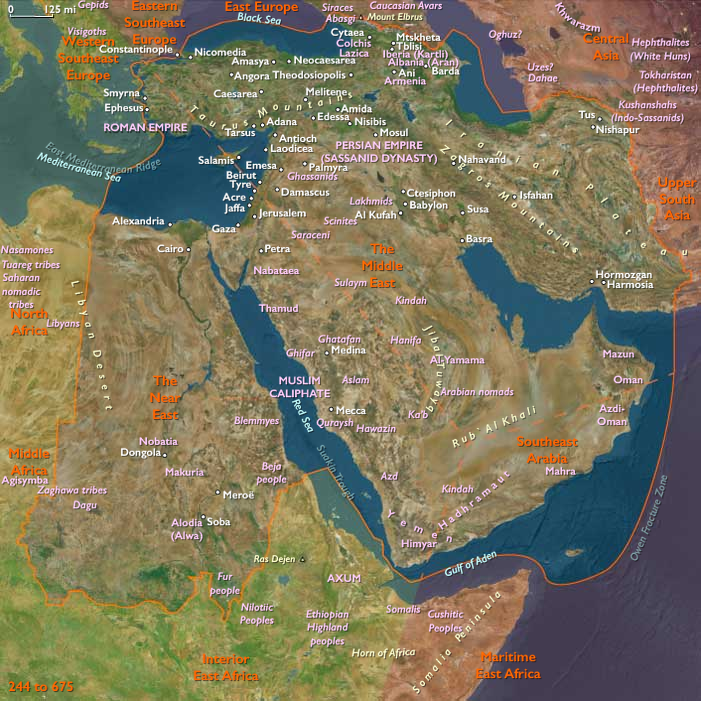
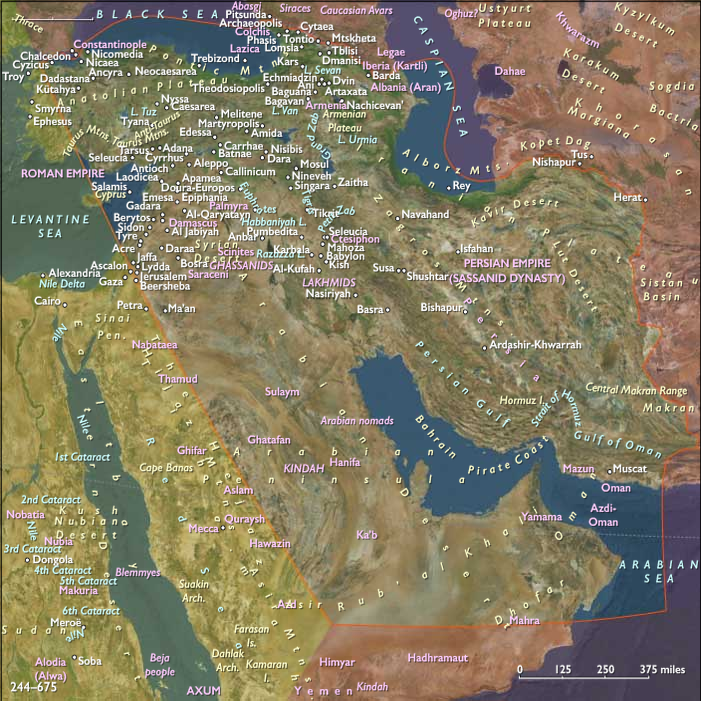
The Ghassanids, who successfully oppose the Persian-oriented Lakhmids of al-Hirah, prosper economically and engage in much religious and public building; they also patronize the arts and entertain the poet Nabighah adh-Dhubyani and, later, Hassan ibn Thabit at their courts.
Subsequent Roman distrust of Ghassanid religious unorthodoxy brings down al-Harith's successors, al-Mundhir and Nu'man.
(According to one story, which seems to be supported by Nabighah's later poetry, his enemies forged a satire against Nu'man, who was so enraged that Nabighah had to leave al-Hirah in great haste.)
Nabighah moves from Jabiyah to the enemy court of the Ghassanids in Syria, where he becomes a favorite, interceding several times on behalf of his tribesmen during their wars and defeats.
He never ceases to assert his innocence to Nu'man and eventually returns to al-Hirah.
Orthodox leaders of the Eastern Roman empire, viewing the Monophysite beliefs of the the Arab Ghassanids to be unacceptably heretical, reduce Ghassan to vassal status and dispatch imperial troops to secure its borders.
Locations
People
- Al-Mundhir IV ibn al-Mundhir
- Al-Mundhir ibn al-Ḥārith
- Al-Nabigha
- Al-Nu'man III ibn al-Mundhir
- Al-Nu'man IV ibn al-Mundhir
Groups
- Arab people
- Persian people
- Persian Empire, Sassanid, or Sasanid
- Lakhmid kingdom of al-Hira
- East, Diocese of the
- East, or Oriens, Praetorian prefecture of
- Christians, Monophysite
- Christianity, Chalcedonian
- Ghassan, Kingdom of
- Roman Empire, Eastern: Justinian dynasty
- Greeks, Medieval (Byzantines)
Topics
Commodoties
Subjects
- Commerce
- Writing
- Labor and Service
- Conflict
- Faith
- Government
- Technology
- Movements
- Theology
- Christology
Regions
Subregions
Related Events
Showing 10 events out of 57370 total
Years: 580 - 591
Locations
People
- Al-Mundhir IV ibn al-Mundhir
- Al-Mundhir ibn al-Ḥārith
- Al-Nabigha
- Al-Nu'man III ibn al-Mundhir
- Al-Nu'man IV ibn al-Mundhir
Groups
- Arab people
- Persian people
- Persian Empire, Sassanid, or Sasanid
- Lakhmid kingdom of al-Hira
- East, Diocese of the
- East, or Oriens, Praetorian prefecture of
- Christians, Monophysite
- Christianity, Chalcedonian
- Ghassan, Kingdom of
- Roman Empire, Eastern: Justinian dynasty
- Greeks, Medieval (Byzantines)
Topics
Commodoties
Subjects
- Commerce
- Writing
- Labor and Service
- Conflict
- Faith
- Government
- Technology
- Movements
- Theology
- Christology
Regions
Subregions