The Germans and Italians, fearful that a …
Years: 1943 - 1943
March
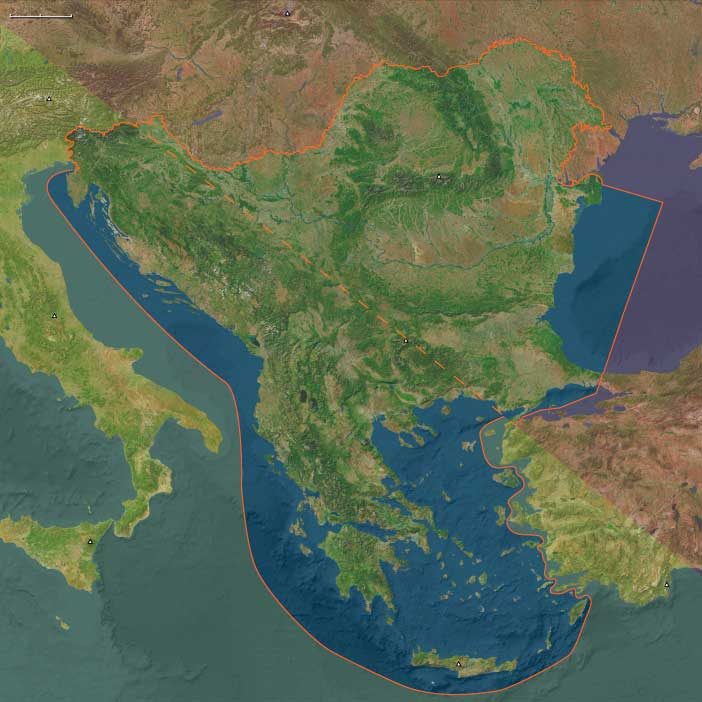
The Germans and Italians, fearful that a powerful resistance force might encourage the Allies to invade the Balkan Peninsula, lead seven major offensives against the PLA in 1943.
The Partisans, fearing that an Allied invasion will benefit the Cetnici, attack Mihajlovic’s forces.
In March, the Partisans outmaneuver the German army and defeat the Cetnici decisively in Herzegovina and Montenegro.
Locations
Groups
- Italy, Kingdom of
- Bulgaria, Kingdom of
- Yugoslavia, Kingdom of
- Germany, Third Reich
- Yugoslav Partisans (National Liberation Army and Partisan Detachments of Yugoslavia)
- Croatia, Independent State of (Nezavisne Drzave Hrvatske, or NDH)
- Montenegro, German-occupied republic of
- Chetniks (Yugoslav Royal Army in the Fatherland)
Topics
Subjects
Regions
Subregions
Related Events
Filter results
Showing 10 events out of 5460 total
Throughout 1943, the Japanese continue to send reinforcements and supplies to New Britain, New Guinea, and the Solomons from their essential naval base of Truk in the Caroline Islands.
MacArthur, commander in the Southwest Pacific, pushes for an approach to Japan along the New Guinea-Philippines axis, while Central Pacific Commander Chester A. Nimitz favors the capture of key Central Pacific Islands to win strategic naval and air bases.
In the summer of 1943, Nimitz’s plan receives priority from the Combined Chiefs of Staff, but elements of MacArthur’s plan are also incorporated.
Nimitz is to island-hop through the Gilberts, Marshalls, Carolines, and Marianas, while MacArthur’s forces are to take northern New Guinea and islands lying in between New Guinea and Mindanao, the Philippines southernmost island.
US task forces head northwest from the Gilberts to the larger archipelago of the Marshall Islands, in which lies the world’s largest atoll, Kwajalien.
The first of 40,000 American troops land on February 1, 1944; the US forces control the island within a week, having killed more than 8,000 Japanese in the process.
MacArthur’s forces, their progress hindered by New Guinea’s coastal swamps and mountainous terrain, capture strategic points on New Guinea’s Papuan penisula in Jauary 1943.
With the closing of the Burma Road, the only way for the Allies to send supplies to Jiang Jeishei is a five-hour airlift over the formidable Himalayas, the “Hump”.
By February 1943, 3,200 is still the maximun tonnage per month that can be delivered by this route.
In 1943, Stilwell, supported by British guerilla Orde Wingate’s Chindits, or Wingate Raiders, and American guerilla Frank D. Merrill’s Merrill Marauders, resumes combat operations in Burma to protect the Ledo Road and keep the Japanese from entering India.
The Japanese continue to send reinforcements and supplies to New Britain, New Guinea and the Solomons from their key naval base of Truk in the Caroline Islands.
In late February 1943, American assault troops capture the Russell Islands 60 miles (96 kilometers) northwest of Guadalcanal on February 21.
The Japanese couterstrike, launched from bases in the northern Solomons to thwart the invasion of New Georgia Island, suffers heavy losses of both planes and ships.
MacArthur’s Allied forces threaten the Japanese positiosn at Lae and Salamaua, on Papua close to New Britain’s western tip.
The Japanese command sends reinforcements to strengthen Lae and Salamaua’s defenses, but US B-24 Liberators and B-17 Flying Fortresses destroy most of the troop transports and their naval escorts on March 3—4, 1943, killing more than 3,500 Japanese soldiers and sailors in the Battle of the Bismarck Sea.
The Allies lose five aircraft in the battle.
On June 30, a US amphibious force lands at Nassau Bay oin Eastern new Guinea and advances on Lae and Salamaua.
MacArthur, commander in the Southwest Pacific, pushes for an approach to Japan along the New Guinea-Philippines axis, while Central Pacific Commander Chester A. Nimitz favors the capture of key Central Pacific Islands to win strategic naval and air bases.
In the summer of 1943, Nimitz’s plan receives priority from the Combined Chiefs of Staff, bu elements of MacArthur’s plan are also incorporated.
Nimitz is to island -hop through the Gilberts, Marshalls, Carolines, and Marianas, while MacArthur’s forces are to take northern New Guinea and islands lying in between New Guinea and Mindanao, the Philippines’ southernmost island.
In August 1943, British admiral Lord Mountbatten, newly created head of the Sooutheast Asia command, begins planning the recapture of Burma.
The Americans take Rendova Island, Munda (on New Georgia Island), and the island of Vella Lavella by mid-August 1943.
The Americans capture Lae, Salamaua and Finschhafen by early October 1943.
The American force advancing up the Solomons reaches Bougainville in November 1943, allowing Allied planes to reach Rabaul.
Ther British begin their push from india into Burma in November 1943, meeting with initial success.
In December, the US amphibious force in eastern New Guinea crosses to the southwestern tip of New britain Island.
By the end of 1943, Allied bombers have eliminated Rabaul as an offensive threat, stranding more than 100,000 veteran Japanese troops ar Rabaul and the surrounding area.
During the war, the Muslim League and Congress adopt different attitudes toward British rule.
The Muslim League follows a course of cooperation, gaining time to consolidate.
The British appreciate the loyalty and valor of the British Indian Army, many of whose members are Punjabi Muslims.
Relics of a Judeo-Italian (Italkian) survive within Italy (especially in Rome and Livorno); in Greece, however, an entire colony of 6,000 Corfu Jews, who use a Venetan dialect as a home language, is exterminated by the Germans during the war.
Archbishop Damaskinos has opposed the German occupation and urged the concealment of Jews to save them from the Nazis.
However, virtually the entire Jewish population is deported in 1943 to death camps in Germany.
A devastatingly high rate of inflation adds to the miseries and humiliations of everyday life.
Although the Greek communists had been a marginal force during the interwar period, EAM-ELAS becomes the largest resistance organization and the most powerful guerrilla band in Greece.
It also establishes an effective administrative apparatus, through which it rules liberated areas.
In occupied Yugoslavia, the royalist Cetnik forces turn increasingly to German and Italian forces for assistance and commit atrocities against Bosnian Muslims.
The Russians encircling Stalingrad begin a devastating air assault and artillery bombardment of the city in January 1943, forcing Paulus’s February 2 surrender of his 100,000 starving survivors; 300,000 more German soldiers lie dead in the rubble.
By this point, Germany has lost a total 850,000 dead or captured since the beginning of the Soviet invasion in the summer of 1941.
Iran declares war on Germany in 1943, but participates in no active hostilities.
In 1943, Nazi Admiral Karl Doenitz allegedly boasts that the German submarine fleet has built, in another part of the world, a Shangri-La on land, an impregnable fortress.
After the Casablanca Conference, the Allies launch the Combined Bomber Offensive, resulting in better organized and more intensive bombing runs over German cities.
On April 19, 1943, a heavily armed force of over 2,000 German troops, supported by Lithuanian militiamen and Polish police and firemen, attack the remaining Jews of the Warsaw ghetto.
The barely-armed Jews resist heroically, but 20,000 are shot in the streets, burned in their homes, or drowned in the bombing of the sewers used as escape routes.
By May 16, according to Nazi general Juergen Stroop, “the former Jerwish quarter of Warsaw is no longer in existence.” 36,000 of the 40,00 survivors will die in the camps.
Partisan resistance weakens Nazi control in France and Yugoslavia.
By July of 1943, Nazi Germany retains direct control of all of continental Europe save neutral Sweden, Switzerland, Portugal and (ostensibly neutral) Spain.
Allied bombers begin to demolish German cities.
In the summer of 1943, combined allied raids destroy three-quarters of Hamburg.
Round-the-clock bombing increases, eventually covering all of Germany.
US fighter escorts render the Luftwaffe increasingly unable to counter the raids.
German general Erich von Manstein mounts a desperate summer counteroffensive against the Soviets in the south, striking with new Tiger and Panther tanks at a bulge in the Soviet salient near Kursk on July 5, 1943.
Hitler commits more than 1,000 planes to support what becomes one of the largest and most brutal armored engagements yet waged, involving 3,000 tanks on the steppes.
When the Soviets move in fresh tank divisions on July 12, Manstein, having lost 70,000 men, half his tanks and more than 1,000 planes, withdraws to strong defensive lines.
The Red Army launches a new offensive northward toward Orel, taking the city on August 4, 1943, Kharkov on August 23, Poltava on September 22 and Smolensk on September 25.
The Soviets liberate Kiev in early November.
Hitler does not permit Manstein a full witdrawal of his now-outnumbered troops, who suffer further reductions by the Soviet war machine.
Swiss chemist Albert Hofmann synthesizes LSD-25 in 1943.
Stalin meets with Roosevelt and Churchill for the first time at the Tehran Conference from November 28 to December 1, 1943, in which the date for the Normandy invasion, code-named Operation Overlord, is confirmed.
The Anglo-Americans also assure Hitler that a simultaneous second invasion of France (from the Mediterranean) code-named Operation Anvil, will take place.
Stalin reassures Churchill and Roosevelt that the Soviet Union will declare war on Japan following Germany’s defeat in return for an Allied pledge to give the USSR Sakhalin, the Kuril Islands and a year-round Pacific port on the Asian mainland.
The conferees also discuss the postwar disposition of Iran, their host country.

Bulgaria remains relatively untouched by military operations until the summer of 1943, when Allied bombers begin to attack rail and industrial centers.
The government has thus far complied with German requests to deport the Jews of the occupied territories to the concentration camp at Treblinka, but Tsar Boris cancels orders for the deportation of the rest of Bulgaria's Jews in the face of protests led by prominent political figures and Metropolitan Stefan, head of the Bulgarian Orthodox church.
Years: 1943 - 1943
March
Locations
Groups
- Italy, Kingdom of
- Bulgaria, Kingdom of
- Yugoslavia, Kingdom of
- Germany, Third Reich
- Yugoslav Partisans (National Liberation Army and Partisan Detachments of Yugoslavia)
- Croatia, Independent State of (Nezavisne Drzave Hrvatske, or NDH)
- Montenegro, German-occupied republic of
- Chetniks (Yugoslav Royal Army in the Fatherland)