
The Germanic invaders of Britain, all initially …
Years: 600 - 600
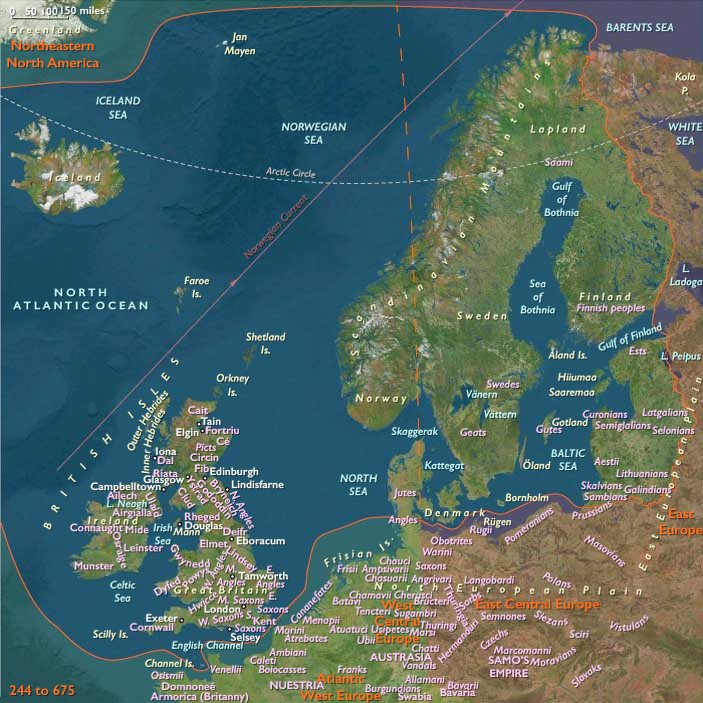
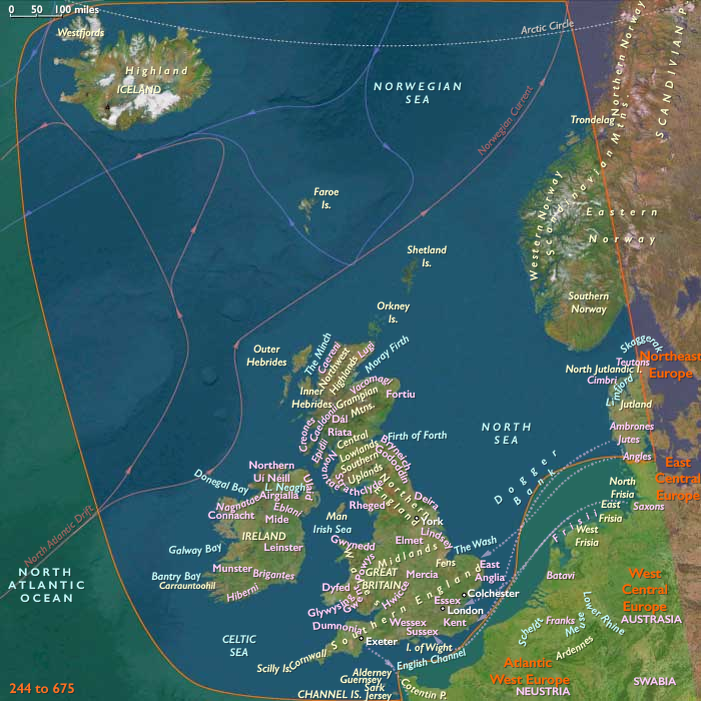
The Germanic invaders of Britain, all initially called Saxons, come to be known as Angles.
Pope Gregory refers to the recently converted King Æthelbert of Kent (a kingdom founded by Jutes) as rex Anglorum ("king of the Angles").
Augustine, an Italian monk, had served as prior of a monastery in Rome until June of 595, when Pope Gregory dispatched him and thirty other monks to convert the Anglo-Saxons.
He carries letters of commendation to bishops and is accompanied by Frankish interpreters.
Æthelbert, who had married a Christian Frankish princess, allows them to enter his realm, to preach, and to establish a church at Canterbury; Augustine baptizes Æthelbert into Christianity the following year.
Freely adapting local customs to Christianity in accord with Gregory's instructions, Augustine pursues a policy of preserving pagan temples and destroying only the idols, transforming pagan rites and customs into Christian practices whenever possible.
Augustine founds an abbey in Canterbury and becomes the first archbishop here.
The West Germanic language of the invader-colonizers of Britain, whether spoken by Angles, Saxons, or Jutes (and perhaps some Frisians), is apparently always referred to as English.
The Anglo-Saxons begin using the Latin alphabet: King Æthelbert’s code of law, circa 600, is the oldest surviving document in Old English.
The code is concerned with preserving social order, through compensation and punishment for personal injury.
When Christian monks attempt to write the Germanic languages in Latin characters, they encounter many difficulties because Latin and Germanic sounds do not very closely resemble one another.
Locations
People
Groups
- Polytheism (“paganism”)
- Angles
- Anglo-Saxons
- Bernicia, Kingdom of
- Christianity, Chalcedonian
- Kent, Kingdom of
- Deira, Kingdom of
- Frisians
- Mercia, Kingdom of
- East Angles, Kingdom of the
Topics
Subjects
Regions
Subregions
Years: 600 - 600
Locations
People
Groups
- Polytheism (“paganism”)
- Angles
- Anglo-Saxons
- Bernicia, Kingdom of
- Christianity, Chalcedonian
- Kent, Kingdom of
- Deira, Kingdom of
- Frisians
- Mercia, Kingdom of
- East Angles, Kingdom of the
Topics
Subjects
Regions
Subregions