
The German Empire’s remarkable victories against the …
Years: 1688 - 1688
The German Empire’s remarkable victories against the Ottomans have a profound effect on Europe.
In contrast to Louis, who had refused to help, both Protestant and Catholic princes extol Leopold as a champion of Christendom; the French king’s support in Germany disintegrates almost overnight and Louis is branded as the ‘Christian Turk’.
Locations
People
Groups
- Papal States (Republic of St. Peter)
- Bavaria, Wittelsbach Duchy of
- Saxony, Electorate of
- Palatinate, Electoral (Wittelsbach)
- Brandenburg, (Hohenzollern) Margravate of
- Sweden, (second) Kingdom of
- Spain, Habsburg Kingdom of
- Savoy, Duchy of
- France, (Bourbon) Kingdom of
- Habsburg Monarchy, or Empire
- England, (Stewart, Restored) Kingdom of
- League of Augsburg
Topics
Subjects
Regions
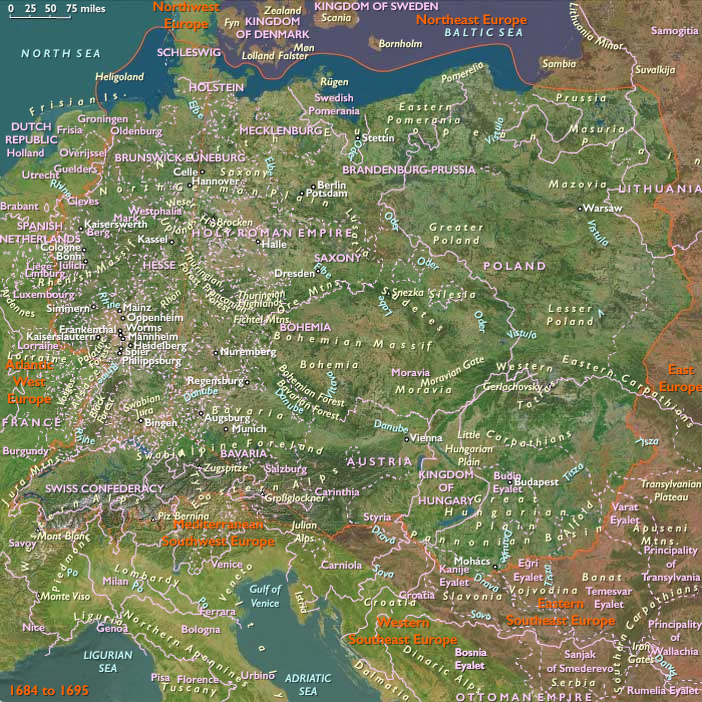
Subregions
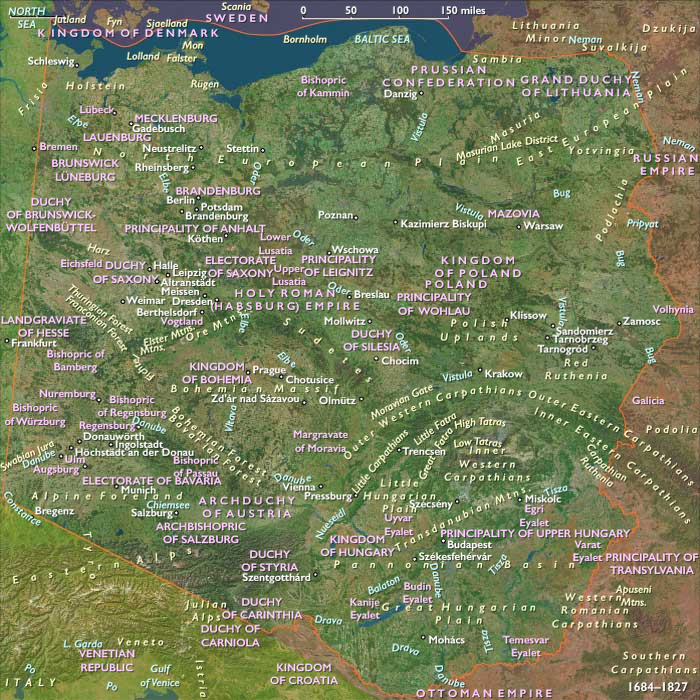
Related Events
Showing 10 events out of 29391 total
Years: 1688 - 1688
Locations
People
Groups
- Papal States (Republic of St. Peter)
- Bavaria, Wittelsbach Duchy of
- Saxony, Electorate of
- Palatinate, Electoral (Wittelsbach)
- Brandenburg, (Hohenzollern) Margravate of
- Sweden, (second) Kingdom of
- Spain, Habsburg Kingdom of
- Savoy, Duchy of
- France, (Bourbon) Kingdom of
- Habsburg Monarchy, or Empire
- England, (Stewart, Restored) Kingdom of
- League of Augsburg
Topics
Subjects
Regions
Subregions